Dishwasher Not Draining but No Blockage: What Causes It?
If the filter, hose, and sink trap are clear, a dishwasher that still holds water usually points to a drain-pump, check-valve, float-switch, or installation problem such as a missing high loop. Leaving it alone can trap dirty water in the tub, cause leaks, and overheat or burn out the pump. This guide shows how to tell plumbing faults from control, pump, and setup faults by the symptom pattern.
What leftover water is normal?
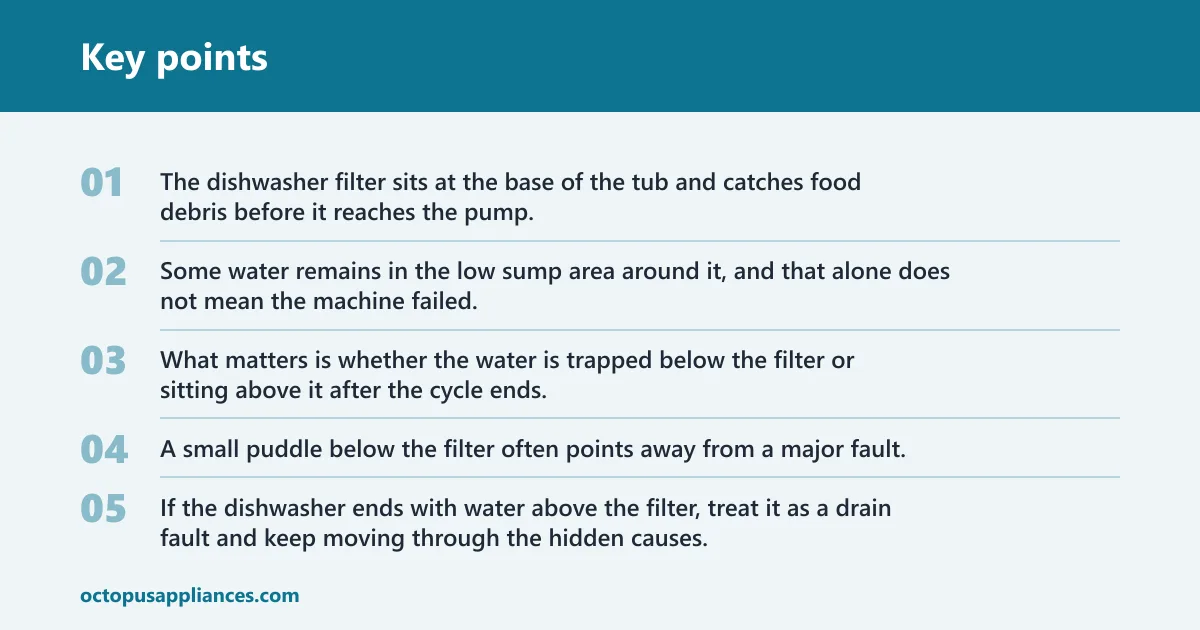
A small amount of water below the filter can be normal after a cycle. Standing water above the filter is treated as a drainage fault. The key difference is water level: a damp sump area is expected, but water that covers the filter or stays high in the tub points to a problem that did not clear.
Normal sump water versus a drain failure
The dishwasher filter sits at the base of the tub and catches food debris before it reaches the pump. Some water remains in the low sump area around it, and that alone does not mean the machine failed. What matters is whether the water is trapped below the filter or sitting above it after the cycle ends.
Timing also helps. If the tub looks dry during the wash and only a shallow pool remains at the bottom when the cycle ends, that is different from a full tub that never clears. A small puddle below the filter often points away from a major fault.
When standing water means a real problem
If the dishwasher ends with water above the filter, treat it as a drain fault and keep moving through the hidden causes. That pattern fits a blocked pump path, a restricted hose, a plumbing backup, or a control problem that stopped the drain sequence too soon.
Say your dishwasher finishes the cycle and leaves half an inch of water under the lower rack but not up over the filter. That may still be normal residual water. If the next cycle leaves about an inch or more above the filter, the symptom may have shifted from residue to a failure condition.
Dishwasher not draining but decision table
| Symptom pattern | Most likely hidden cause | What to test next | When to stop and call service |
|---|---|---|---|
| Water stays above the filter after every cycle | Drain pump obstruction or failed pump | Remove the filter and inspect the sump for glass, labels, pits, or twist ties | Stop if the pump hums, grinds, or stays silent while water remains. |
| Drainage works one cycle, then fails the next | Intermittent hose restriction or control issue | Check the drain hose for a pinch, crush point, or sag under the sink | Call if the pattern repeats after hose and plumbing checks |
| Pump hums but water barely moves | Blocked impeller or jammed pump path | Inspect the sump area for debris that can reach the impeller | Stop if the pump noise changes to grinding or the motor overheats |
| Sink drains slowly at the same time | Sink drain plumbing backup | Check the P-trap and drain line area for a partial clog | Call if sink water backs up into the dishwasher line. |
| Problem started after a new garbage disposal was installed | Knockout plug still in place or disposal connection blocked | Verify the dishwasher inlet on the disposal is open and run the disposal | Call if the dishwasher line backs up after the disposal runs clear |
| Water spills from the air gap onto the counter | Clogged air gap | Remove the air gap cap and clear sludge or debris | Stop if the spill returns soon after cleaning. |
| Water returns to the tub after a drain attempt | Backflow from sink plumbing or a bad check valve | Inspect the hose routing and the sink-side connection for reverse flow | Call if clean water leaves and dirty water comes back |
| Repeated standing water after reset | Cycle interruption or control fault | Use Cancel/Drain, Start/Drain, or Reset, then try a breaker power-off if needed | Call if the machine still holds water after a full reset sequence. |
Why is my dishwasher not draining but there’s no blockage?
If no blockage is visible, the fault is often hidden in the drain path, pump, or control sequence. The dishwasher may move water through the cycle normally, then fail at the final drain because the pump cannot move water, the hose is restricted inside, or the cycle never reached the drain command.
Why water level matters
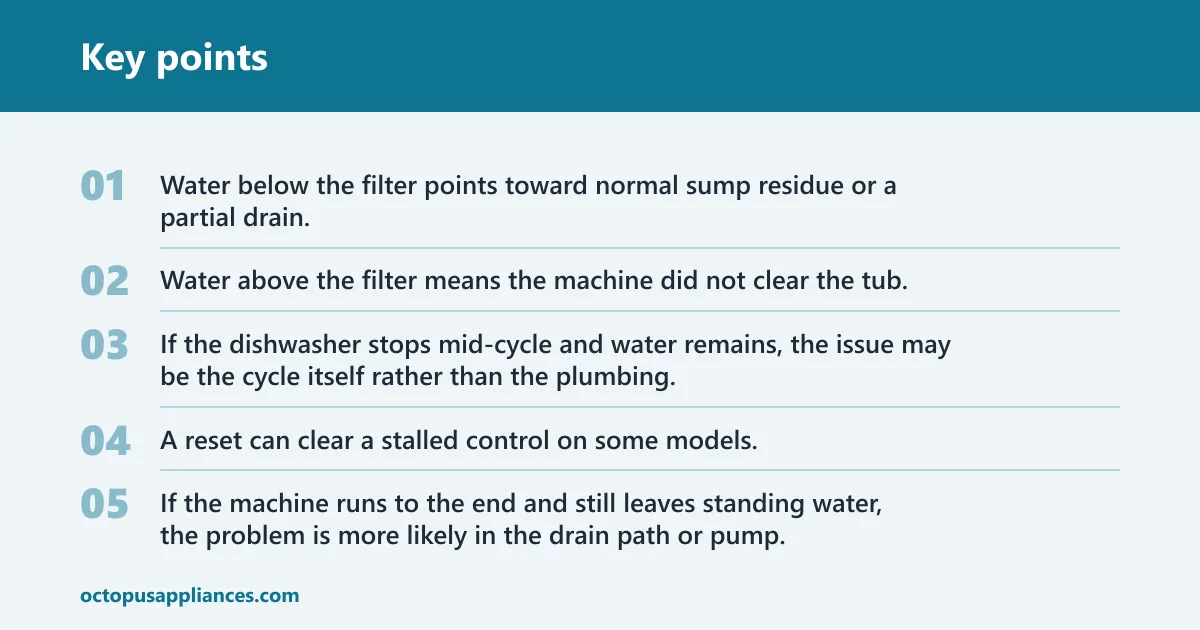
Look at where the water sits. Water below the filter points toward normal sump residue or a partial drain. Water above the filter means the machine did not clear the tub. That distinction helps separate a harmless leftover pool from a real drainage failure.
Why timing matters
If the dishwasher stops mid-cycle and water remains, the issue may be the cycle itself rather than the plumbing. A reset can clear a stalled control on some models. If the machine runs to the end and still leaves standing water, the problem is more likely in the drain path or pump.
A common first-timer mistake is to stop at a clean filter and call the problem solved. Hidden debris can sit in the sump area, and a hose can look clear from the outside while still being restricted inside. The visible parts are only part of the drain path.
What if my dishwasher pump is running but it still won’t drain?
A running pump does not prove that water is moving. If the pump hums, grinds, or runs without lowering the water level, the impeller may be jammed by debris such as broken glass, or the pump motor or electrical circuit may be failing. The sound pattern helps separate a mechanical jam from an electrical fault.
Blocked impeller or sump restriction
Start with the sump area after removing the filter. That low point can trap glass, labels, pits, and twist ties before they reach the pump. If debris reaches the impeller, the pump may hum but fail to push water through the hose.
-
Unplug or power off.
Turn off power at the breaker before reaching into the tub. Remove the lower rack so you can work at the base of the tub without forcing parts. -
Remove the filter.
Lift out the dishwasher filter at the base of the tub and clean it manually. Check the sump area underneath for debris that can block the pump inlet. -
Inspect the pump opening.
Look for glass shards, cutlery pieces, and labels around the impeller area. Clear only loose debris you can reach safely; do not force the impeller if it resists.
Electrical or motor failure signs
If the pump is quiet when the drain cycle starts, or if it hums for a moment and then stops without moving water, the motor or control circuit may be the issue. A drain pump can fail mechanically or electrically. At that point, cleaning alone will not solve it.
If the pump sound changes from a steady hum to grinding, stop and inspect rather than keep cycling it. Continued running can worsen the damage.
Can the sink or disposal be the cause?
Yes. Dishwasher drainage shares the sink plumbing on many kitchens, so a slow sink drain or a restricted disposal can block the dishwasher even when the appliance itself is fine. Whitegoods Help says a dishwasher may fail if the sink drain or disposal is restricted, and a clogged disposal can sometimes block dishwasher draining.
Slow sink drain and shared plumbing
If the sink also drains slowly, look at the P-trap and drain line area before blaming the dishwasher. A backup in that section can send water back toward the dishwasher line. That is one reason a dishwasher may hold water even after the pump runs.
-
Run the sink first.
Fill and drain the sink to see whether water clears at normal speed. Slow sink drainage points to a shared plumbing restriction rather than a dishwasher-only fault. -
Check the disposal inlet.
If the dishwasher line connects to a disposal, verify that the inlet is open and that the disposal runs clear. Food buildup at the disposal can block the dishwasher path. -
Inspect the drain line area.
Look at the hose connection under the sink for backups, standing water, or loose fittings. A shared clog can make the dishwasher look faulty when the plumbing is the real problem.
New disposal install and knockout plug issues
Why would a dishwasher stop draining after a new garbage disposal was installed? A common cause is a leftover knockout plug in the disposal inlet. Vertex identifies that plug as a likely cause after installation, and a clogged disposal can block the dishwasher line as well.
Picture a dishwasher that drained fine yesterday, then stopped after a new disposal went in this morning. If the sink drains slowly too, the disposal connection is one of the first places to check. That pattern points to installation, not a hidden dish rack clog.
How the drain hose and air gap fail
The drain hose carries wastewater to the sink plumbing or disposal. It can be kinked, crushed, or internally restricted, and it may hold residual water when disconnected. House Beautiful describes different layouts, including high loop and air gap versions, so the hose route matters as much as the hose itself.
Hidden hose restrictions
The hose may look fine from the front of the machine but pinch under the sink or behind the unit. A small crush point can limit flow enough to leave water in the tub, especially at the end of a wash when the pump has less pressure to work with.
-
Follow the hose route.
Trace the drain hose from the dishwasher to the sink area. Look for tight bends, a crushed section behind the unit, or a sag that traps water. -
Check under the sink.
Inspect the hose where it enters the disposal or drain line. Make sure it is not pinched by storage items or squeezed by the cabinet wall. -
Detach with care.
If you disconnect the hose, expect some residual water inside it. A hose that holds water when removed is not automatically blocked, but heavy sludge or a kinked shape is a warning sign.
Air gap clogs and water spill at the sink
Could an air gap be the reason my dishwasher isn’t draining? Yes. Vertex says a clogged air gap can stop proper drainage. An air gap prevents dirty sink water from flowing back, and when it blocks, it may spill water onto the sink or counter instead of sending it through the drain path.
If your kitchen has an air gap, a spill at the cap is a strong clue. That means the restriction may be in the air gap itself rather than in the dishwasher tub or pump.
What to check after a reset or interrupted cycle
If the cycle was interrupted, the dishwasher may still hold water until you reset it. Bob Vila advises holding Cancel, Start, or Reset for 3 seconds, and says a dishwasher can also be reset by power cycling at the breaker. If the machine only drains after a reset, the control path deserves attention.
Cancel, drain, and breaker reset behavior
Some models drain as part of the cancel sequence, while others need a full power-off before they clear. If the drain begins only after a reset, the motor may be fine and the problem may lie in a stalled cycle or a control that did not send the drain command.
-
Try the cancel function.
Hold Cancel, Start, or Reset for 3 seconds if your model uses that pattern. Watch for the pump to start draining at the end of the cancel cycle. -
Wait for completion.
Give the machine time to finish the drain sequence before opening the door. Opening too soon can make it look like nothing happened. -
Power cycle the breaker.
If the model does not respond, switch off power at the breaker briefly, then restore power and run a drain or cancel command again. A successful drain after this step points to a control interruption.
Repeated standing water after reset
If standing water returns after every reset, the problem is no longer just a stalled cycle. That pattern suggests a hidden restriction, a bad pump, or a plumbing path that keeps backing water into the tub. Repeating the reset will not fix a recurring return flow.
When should I call a repair technician for a dishwasher that won’t drain?
Call service when the pump runs but the water stays, when draining is intermittent after you have checked the filter and hose, or when water returns to the tub after it drains. Those patterns point to a failing pump, a bad valve, a control issue, or a plumbing fault that needs deeper diagnosis.
Intermittent draining and return flow
Intermittent draining often means the restriction is partial. The dishwasher may clear once, then fail again when debris shifts or when the sink line backs up. Return flow is more serious, because it means water is moving backward into the dishwasher instead of out of it.
Pump noise without drainage
If the pump hums or grinds without lowering the water level, stop after the basic checks. That sound pattern often points to a blocked impeller or a pump that has failed mechanically or electrically. Continued attempts can make the repair larger.
Frequently asked questions
Why does my dishwasher have water in the bottom after the cycle?
A small amount of water below the filter can be normal after a cycle. If the water sits above the filter, the machine did not drain fully and needs further checks. The difference between a damp sump and a full tub is the fastest clue.
Can a dishwasher not draining be caused by the sink or garbage disposal?
Yes. A slow sink drain or a restricted garbage disposal can block the dishwasher path even if the appliance is working. The P-trap, drain line, and disposal inlet all matter. If the sink backs up too, the problem may be in shared plumbing rather than the dishwasher itself.
Why would a dishwasher stop draining after a new garbage disposal was installed?
A new disposal can keep the dishwasher from draining if the knockout plug was not removed from the inlet. A clogged disposal can also block the line. If the problem started right after installation, check the disposal connection first, then run the disposal and retest.
Could an air gap be the reason my dishwasher isn’t draining?
Yes. A clogged air gap can stop proper drainage and may spill water onto the sink or counter. If your kitchen has an air gap and you see water there, the restriction may be in that part rather than in the tub or pump. Clean it before moving on to deeper repairs.