
Dishwasher Not Draining and Sink Backing Up: What to Check
If the dishwasher won’t drain and the sink backs up too, start with the sink branch first: disposal, air gap, trap, and the hose connection, because a shared restriction can make both fixtures fail. If the shared drain path is overlooked, repeat backups, dirty water in the tub, and unnecessary parts replacement can follow. This guide shows how to isolate the blockage point in the dishwasher, disposal, sink drain, air gap, hose, or pump.
Why the sink backup changes the diagnosis
A sink that also drains slowly changes the diagnosis. The problem may be in the kitchen drain, disposal branch, or air gap path, not inside the dishwasher itself. If the sink drains fine and only the dishwasher backs up, the search shifts toward the dishwasher filter, hose, pump, or internal drain path.
That difference matters because a shared drain restriction can push water back through the dishwasher branch even when the appliance is working. GE notes that a blocked sink drain can stop the dishwasher from emptying. Master Appliance also points to slow sink drainage and gurgling as signs of a downstream restriction.
Sink drains slowly too: suspect the kitchen drain or disposal branch
When the sink is slow, gurgling, or backing up during dishwasher drainage, start outside the dishwasher. Look at the sink trap, the disposal connection, and any shared branch line under the counter. If the sink path is restricted, the dishwasher may be fine.
That is the practical difference many guides miss. A sink backup changes the order of checks because the dishwasher may simply be dumping into a line that cannot accept the water fast enough.
Sink drains fine: focus on the dishwasher, hose, air gap, or pump
If the sink drains normally, the restriction is more likely in the dishwasher side of the system. That puts the filter, drain hose, air gap, and drain pump near the top of the list. A dishwasher-only failure is more likely to be an internal blockage or a hose routing problem.
That is also where standing water in the tub becomes important. Some models can have 1 to 2 cups of clean water at the bottom and still be normal. On models with an Ultra Fine filter, water in the sump is normal, but it should not cover the tub bottom.
Standing water in the tub: normal residue versus true backup
A little water near the sump does not always mean a fault. Water above the filter or covering the bottom is not normal. Whitegoods Help and North Appliance Service both treat standing water in the bottom as a sign that the dishwasher is not draining properly.
Use the waterline as a clue, not a panic signal. Water under the filter area can be expected on some models. Water sitting across the tub floor points to a drain problem that needs inspection.
Which side is blocked?
This table helps you separate a dishwasher-side drain failure from a shared plumbing blockage. Start with the symptom you see, then follow the safest check. That order avoids opening the wrong part first.
| Symptom | Most likely restriction point | Safest check | Who to call next |
|---|---|---|---|
| Sink drains slowly too | Kitchen sink drain or disposal branch | Run water at the sink and watch for gurgling or slow drainage | Plumber |
| Backup happens only when dishwasher runs | Shared branch line, air gap, or disposal connection | Check the sink side, then the air gap and disposal inlet | Plumber first, then appliance tech if the branch is clear |
| New disposal was recently installed | Missing knockout plug in the disposal inlet | Confirm the plug was removed from the dishwasher connection | Plumber or installer |
| Air gap has water spurting | Air gap cap or hose blockage | Remove the cap and clear visible debris | Appliance tech or plumber, depending on what is blocked |
| Pump hums but water stays | Blocked impeller path or failed drain pump | Stop the cycle and inspect the filter for debris first | Appliance tech |
| Water returns after draining | Reverse flow from sink plumbing or a low hose route | Check hose routing and any required high loop | Plumber or appliance tech |
| Water is above the filter or covers the tub floor | Drain restriction or pump issue | Remove and rinse the filter, then check the hose path | Appliance tech if the problem remains |
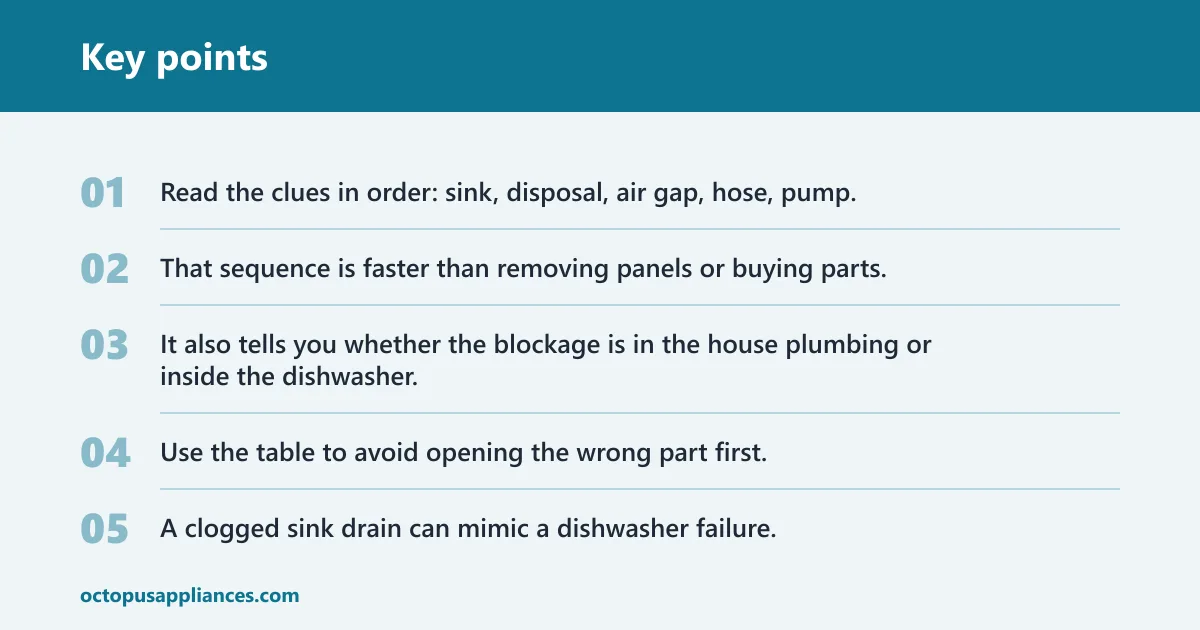
Read the clues in order: sink, disposal, air gap, hose, pump. That sequence is faster than removing panels or buying parts. It also tells you whether the blockage is in the house plumbing or inside the dishwasher.
Use the table to avoid opening the wrong part first. A clogged sink drain can mimic a dishwasher failure. A blocked dishwasher hose can mimic a plumbing issue. The symptom pattern separates them.
What should you check first if your dishwasher won’t drain and the sink is full?
Start with the shared drain path, then move to the dishwasher filter. Whirlpool advises turning off power at the circuit breaker, not just the control panel, before checking a draining dishwasher. Do not use drain-opening chemicals inside the dishwasher.
Clean the dishwasher filter at the sump area
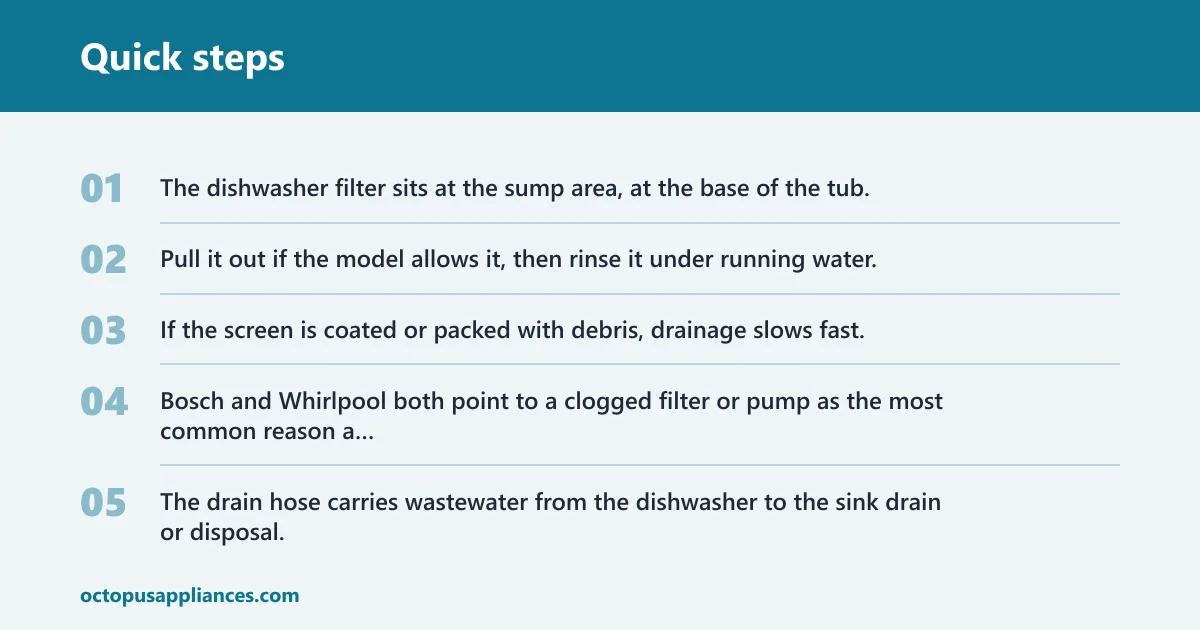
The dishwasher filter sits at the sump area, at the base of the tub, where it catches food scraps, labels, and grease. Pull it out if the model allows it, then rinse it under running water. If the screen is coated or packed with debris, drainage slows fast.
Many drainage complaints start there. Bosch and Whirlpool both point to a clogged filter or pump as the most common reason a dishwasher stops draining, and Whitegoods Help lists a blocked or dirty filter as the single most common cause.
Inspect the drain hose for kinks, crushing, or blockage
The drain hose carries wastewater from the dishwasher to the sink drain or disposal. Check it for sharp bends, flattened spots, trapped debris, or a low loop that lets water roll back. A hose that slips out of position can fail even when the machine itself is fine.
The same source says the hose must match the installation instructions for height. If the setup requires a high loop or an air gap, the hose routing has to match that layout. A hose that was shifted during a remodel can fail even if the dishwasher itself is fine.
Check the drain path at the sink and disposal
Look at the sink drain path before opening the dishwasher further. If the sink is slow or gurgling, the restriction may be in the disposal branch or trap. That shared path can send water back into the appliance.
Say your dishwasher finishes a cycle with a shallow pool of clean water in the bottom, but the kitchen sink still drains normally. That pattern points away from the main sink drain and toward the dishwasher filter, hose, air gap, or pump.
Could the garbage disposal be the cause?
Yes. A clogged garbage disposal connection can send water back toward the dishwasher. That shared drain path is a common cause of sink backup into the appliance. If the disposal or its branch is restricted, the dishwasher may appear to be the problem when the line is the issue.
After a new disposal install, check the knockout plug
GE and Whirlpool both flag a missing disposal knockout plug after replacement as a drainage problem. If the dishwasher hose connects to a new disposal, the plug inside the dishwasher inlet must be removed. If it stays in place, water cannot exit properly.
A common first-timer mistake is replacing the disposal, reconnecting the hose, and assuming the drain is ready. The disposal can run and still block the dishwasher branch if the plug was never removed.
Look for slow sink drainage and backup at the shared branch
If the sink drains slowly after a disposal replacement, the problem may be in the disposal path, not the dishwasher. Water that backs up only during dishwasher drain cycles is a strong clue that the shared branch is restricted.
Suppose the sink drains in a few seconds when run by itself, but the dishwasher causes a brief surge and water appears in the sink. That points to the disposal branch, the air gap, or the hose routing, not a full sink clog.
How do you tell if the air gap is blocked?
If your installation has an air gap, treat it as a separate check. The air gap is a small fitting on the sink or countertop that can collect debris. A blocked cap can stop flow and send water where it should not go.
Find the air gap on the sink or countertop
Not every installation has one, but when it is present it is usually easy to spot near the sink. It sits above the counter and connects to the dishwasher drain hose and the drain line. If water spurts from it during draining, that is a clue that the line beyond it may be restricted.
Remove the cap and clear visible debris
Take off the cap and look for buildup inside. Food debris, grease, and labels can collect there. Cleaning the cap and the visible passage may restore flow if the blockage is local to the fitting.
Do not assume the pump is bad first. A spurting air gap can mean the hose or disposal path is blocked upstream of the dishwasher.
Watch for water spurting during drain attempts
Water spurting from the air gap during a drain attempt often means the downstream path is restricted. The air gap is trying to protect against backflow, so the water exits at the top instead of moving through the line. That is a plumbing-path clue, not proof of a bad pump.
Drain hose and high loop checks
The hose is one of the easiest places to find a restriction, but it is also easy to overlook. A dishwasher may run normally while the hose is pinched behind the cabinet, crushed under the sink, or blocked by debris.
Look for a kinked or crushed hose under the counter
Trace the hose from the dishwasher to the sink area. Look for tight bends, flattened sections, or points where it has slipped behind storage items. A small crush can stop drainage without causing any other obvious symptom.
Check the section near the cabinet wall and under the sink. That is where rerouted plumbing and disposal work often leave the hose in a bad position.
Confirm the hose rises in a high loop where required
A high drain loop is an installation safeguard under the counter that helps prevent backflow from sink plumbing. If the installation instructions call for a high loop or air gap, the hose height has to match that requirement. The same source says the hose must match the installation instructions for height.
If the hose hangs too low, sink water can move back toward the dishwasher. That can leave dirty water in the tub after a drain cycle.
Check whether the hose routing matches the installation instructions
Routing matters as much as the hose condition. A hose can be clear and still fail if it was installed below the proper loop height or tied to the wrong port on the disposal. Compare the visible routing with the model instructions.
Drain pump and dishwasher drain clues
If the sink drain, disposal, air gap, and hose all check out, the problem moves toward the dishwasher’s drain pump or an internal blockage. A drain pump that hums, grinds, or runs without moving water can point to a blocked impeller path or a pump failure.
A humming or grinding pump can point to a blocked impeller or failed pump
Listen near the end of a drain cycle. A hum without water movement can mean the pump is trying to run against debris. A grind can point to a damaged impeller or object in the pump path.
That is still different from a sink-side restriction. A sink backup with a quiet pump leans toward plumbing. A loud pump with no drainage leans toward the appliance.
Water that stays in the tub after the pump runs is a warning sign
If the pump sounds active but the tub still holds water above the filter or across the bottom, the dishwasher is not clearing the line. Water in the sump can be normal on some models, but water that remains after a drain cycle is not the same thing.
Know when pump access is model-specific and best left to service
Some pump assemblies are easy to reach. Others require partial disassembly and model-specific access steps. If the filter is clean, the hose path is clear, and the pump still hums or grinds, appliance service is usually the better next call.
Frequently asked questions
Why is my dishwasher not draining and my sink backing up?
That pattern usually points to a shared drain restriction, not just a dishwasher fault. Start with the sink drain, disposal, air gap if present, and the hose connection. If the sink also drains slowly or gurgles, the blockage is often in the plumbing path rather than the appliance.
Could a clogged garbage disposal make the dishwasher back up into the sink?
Yes. A clogged disposal connection can block the shared drain path and push water back toward the dishwasher. If the disposal was recently replaced, confirm the knockout plug was removed. That single mistake can stop drainage even when the dishwasher itself is working.
How do I tell if the dishwasher drain hose is kinked or blocked?
Trace the hose under the counter and behind the sink base. Look for flattened sections, sharp bends, or a hose that dips too low. If the sink drains normally but the dishwasher does not, a bad hose route or blockage is more likely than a full plumbing clog.
Does a clogged sink drain stop the dishwasher from draining?
Yes. The same source says a blocked sink drain can stop the dishwasher from emptying. If the sink drains slowly, gurgles, or backs up during the dishwasher cycle, the restriction may be in the kitchen drain or disposal branch. That shared path can affect both fixtures at once.
What does it mean if the dishwasher pump runs but water stays in the tub?
That usually means the pump is not moving water effectively, or the drain path is blocked. Listen for humming or grinding, then check the filter first. If the tub still holds water above the filter after a drain cycle, service is often the next step.
Is a little water in the bottom of the dishwasher normal?
Sometimes, yes. Some dishwasher models can have 1 to 2 cups of clean water at the bottom and still be normal, and some models with an Ultra Fine filter normally keep water in the sump. Water above the filter or covering the tub floor is the point where it becomes a problem.
