Why Is My AC Not Cooling Below 75 Degrees?
If your AC reaches about 75°F but will not go lower, the likely causes are restricted airflow, low refrigerant, a dirty coil, or an undersized system; a thermostat set below that point will not fix those problems. If you ignore it, bills can rise, compressor life can shorten, and rooms can stay damp and unevenly cooled. This guide shows how to tell a simple filter or airflow issue from a service-level refrigerant or sizing problem.
Why 75 degrees is a clue
75°F sits at the upper edge of the ideal room temperature range, which is between 68 and 75 degrees Fahrenheit. If the system can hold at 75°F but stalls there, that often points to a limit in airflow, heat removal, or cooling capacity rather than a thermostat that simply needs a lower setting.
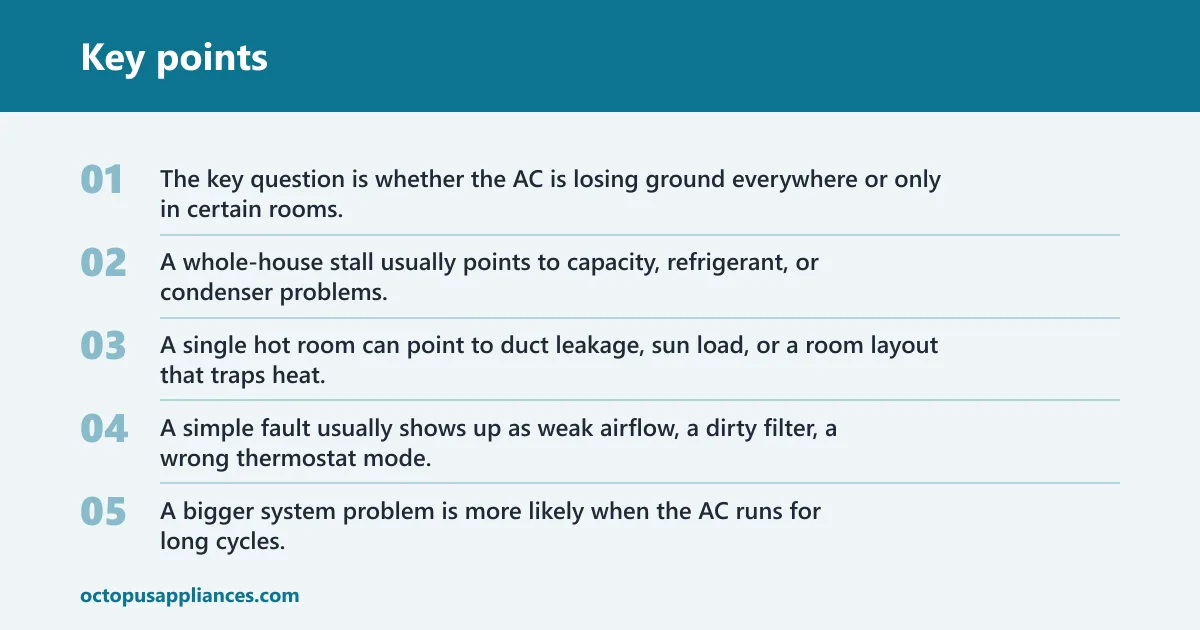
The key question is whether the AC is losing ground everywhere or only in certain rooms. A whole-house stall usually points to capacity, refrigerant, or condenser problems. A single hot room can point to duct leakage, sun load, or a room layout that traps heat.
When 75 degrees points to a simple fault versus a bigger system problem
A simple fault usually shows up as weak airflow, a dirty filter, a wrong thermostat mode, or a blocked outdoor unit. A bigger system problem is more likely when the AC runs for long cycles, the air stays cool but never cold enough, or the temperature settles at the same ceiling no matter what you set.
Hot weather matters too. Performance can drop in weather above 92 degrees, and an AC is made to cool only 20 degrees below outdoor temperature. If it is 98°F outside, reaching 75°F indoors may be near the edge of what the system can do, especially with high indoor load.
Thermostat and filter checks
Check the thermostat first, then the filter, before you assume a major repair. Verify the thermostat is set to COOL, then check whether the fan is on AUTO rather than ON. If the fan runs constantly, it can keep blowing room air across the coil and make the home feel less dry and less cold.
Also look at thermostat placement and calibration. A thermostat near a supply register, sunny wall, lamp, or kitchen can read warmer or cooler than the rest of the house. If the setpoint is 72°F but the sensor reads room conditions badly, the AC can cycle at the wrong time and miss the target.
Can a dirty filter keep an AC from cooling below 75?
Yes. A dirty air filter can restrict airflow and reduce efficiency, and This Old House notes that a blocked return air filter can cut cooling power. In severe cases, this restriction can freeze the evaporator coil, which drops cooling power even further and may force the system to shut down for protection.
The practical check is simple: remove the filter and hold it up to light. If you cannot see much light through it, airflow is likely restricted. If the filter is visibly loaded with dust, replacement is due even if the unit still runs.
What to check first at the thermostat
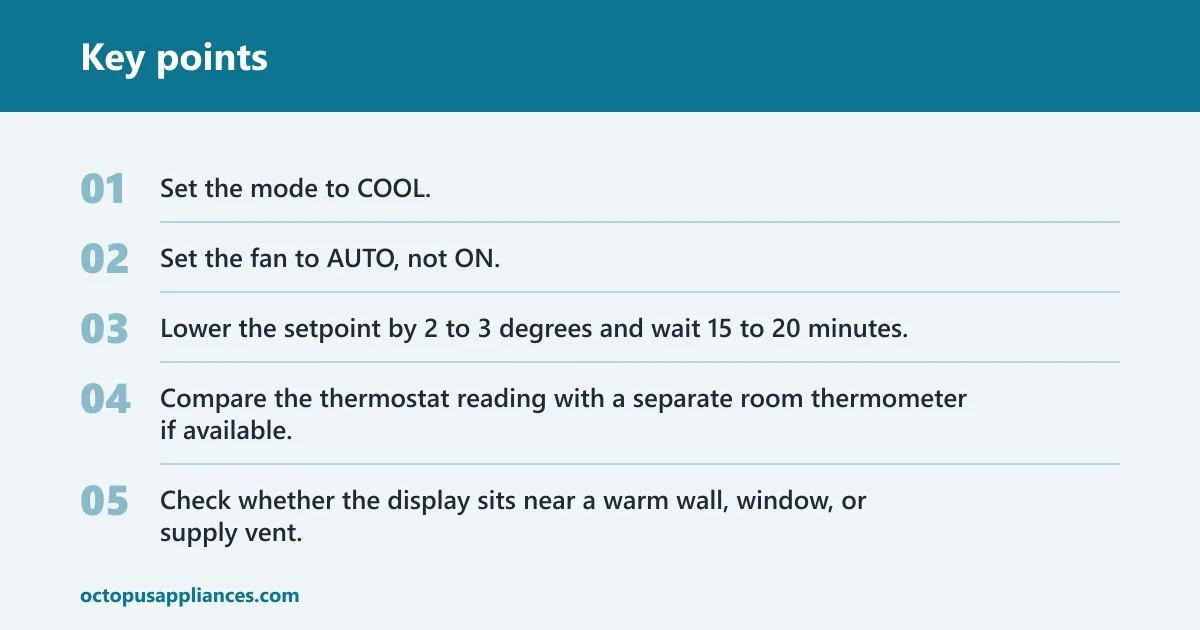
- Set the mode to COOL.
- Set the fan to AUTO, not ON.
- Lower the setpoint by 2 to 3 degrees and wait 15 to 20 minutes.
- Compare the thermostat reading with a separate room thermometer if available.
- Check whether the display sits near a warm wall, window, or supply vent.
If the thermostat is wrong by a few degrees, the AC may stop early. If the thermostat is set correctly but the room never drops below about 75°F, the problem may be farther downstream.
Outdoor unit problems to inspect
The outdoor condenser must reject heat to the outside air. Leaves or debris can obstruct the outdoor unit, and dirty condenser coils can reduce heat rejection. Keep the cabinet clear so air can move freely through the coil and around the fan.
There should be open clearance on all sides. If the condenser is boxed in by shrubs, fencing, or piled yard debris, hot air can recirculate. That raises head pressure and makes the system work harder for less cooling.
What a homeowner can verify outside
Check the coil face for grass clippings, leaves, plastic, or lint. Make sure the fan is running and warm air is leaving the top of the unit. If the cabinet is hot, noisy, or cycling oddly, the outdoor side may be struggling to move heat out of the house.
For example, a condenser in a narrow side yard with a hedge about 6 inches away from the cabinet can have blocked discharge air. Even if the indoor unit is clean, blocked discharge air can keep the system from dumping heat, and the house may stall at 75°F on mild days.
Why is my AC still stuck at 75?
When the thermostat, filter, and outdoor clearance all look normal, the next layer is refrigeration and mechanical fault. Low refrigerant can stop the system from cooling properly, and a refrigerant leak usually needs professional repair only. A failing compressor can also interrupt cooling or cause cycle problems that leave the house stuck near one temperature.
Low refrigerant and leak clues
Low refrigerant often shows up as longer run times, lukewarm supply air, ice on the evaporator line, or a system that cools better early in a cycle than late in the day. It is not a homeowner refill task. Find and repair the leak before the charge is corrected.
Cooling loss from low refrigerant can look like a capacity problem, but the root cause is different. A correctly sized system with low charge will often struggle suddenly or behave unevenly. An undersized system usually shows the same weakness every hot afternoon.
Frozen evaporator coil and restricted airflow
A clogged filter, blocked return, dirty coil, or weak blower can reduce airflow enough to freeze the evaporator coil. Once that coil ices over, heat transfer drops, airflow falls again, and cooling power declines in a loop. This can lead to shutdown risk if the ice spreads.
If you see frost on the refrigerant line or ice on the indoor coil cover, shut the system off and let the ice melt before restarting. Then check the filter and return path. If the icing returns, service is needed.
Compressor trouble that can limit cooling
A failing compressor is a major repair signal. If the compressor struggles to start, short-cycles, or runs without producing strong cooling, the system may never get past 75°F. Compressor issues can also appear as loud electrical buzzing, tripped breakers, or weak temperature drop during long run times.
Because the compressor drives the refrigeration cycle, a fault there can look like many other problems. If the outdoor fan runs but the home barely cools, the compressor deserves prompt diagnosis.
Ductwork and room load limits
Leaky ductwork can reduce efficiency and delivered cooling. If cold air leaks into an attic, crawlspace, or wall cavity before it reaches the room, the system may seem weak even though the equipment is running. Poor sealing and undersized ducts both reduce delivered cooling.
Room load matters too. Sun exposure, top-floor rooms, west-facing windows, kitchens, and rooms over garages can hold more heat than interior bedrooms. The AC may cool the house to 75°F overall but stall in one or two hot zones that need more supply air or better insulation.
How room type changes the load
A bedroom on the shaded side of the house may cool quickly. A top-floor bonus room with afternoon sun can behave differently because the ceiling, roof deck, and glazing add heat all day. The thermostat may read fine while that room stays warm.
Check whether the problem room is above a garage, on the top floor, or facing strong afternoon sun. Those conditions raise the load without changing the equipment itself.
Could your AC be undersized?
Yes. An old or undersized air conditioner may struggle to meet demand, especially if the square footage no longer matches the original cooling load. Capacity has to fit both the home size and the heat load from insulation, windows, occupancy, and sun exposure.
An undersized system often runs constantly on hot days and may still fail to pull the house below the setpoint. That is different from a dirty filter or low refrigerant, which usually changes how the system performs from day to day. Capacity problems are steadier and more predictable.
How to separate capacity from maintenance problems
If the AC cools better at night or on cloudy days but stalls at 75°F during afternoon heat, capacity may be part of the issue. If the same stall happens after a filter change, condenser cleaning, and thermostat check, the system may simply be too small for the load.
Replacement becomes more likely when repair costs stack up. This Old House lists HVAC repair costs from $100 to $2,000 and HVAC installation costs from $500 to $2,000. If the unit is old, undersized, and needing repeated service, replacement can become the better long-term move.
75-degree troubleshooting table
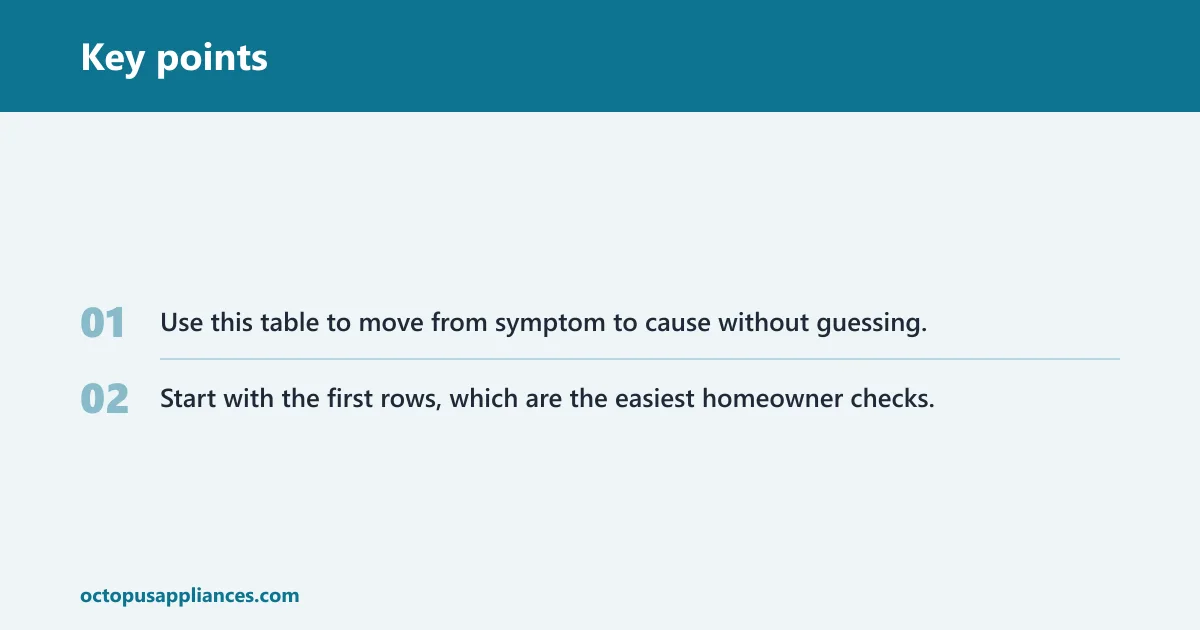
Use this table to move from symptom to cause without guessing. Start with the first rows, which are the easiest homeowner checks, then move to service-level issues if the first checks pass.
| Symptom | Likely cause | Quick homeowner check | Normal result | When to call a pro |
|---|---|---|---|---|
| AC runs, but room stalls at 75°F | Thermostat set wrong or fan on ON | Confirm COOL mode and AUTO fan | Mode shows COOL; fan cycles with cooling | If settings are correct and the stall remains |
| Weak airflow from vents | Dirty filter | Remove filter and inspect for dust loading | Light passes through or filter is recent | If airflow stays weak after replacement |
| Indoor coil or line shows ice | Restricted airflow or low refrigerant | Check filter and return grille first | No ice after thawing and restoring airflow | If ice returns or tubing ices again |
| Outdoor unit feels hot and loud | Debris obstruction or dirty condenser coil | Clear leaves, grass, and debris around the cabinet | Air leaves the top freely | If coil cleaning is needed or fan seems weak |
| Cool air at first, then less later | Low refrigerant | Look for long run times or icing clues | Cooling remains steady through the cycle | If a leak is suspected |
| One room stays much warmer than others | Duct leaks or poor sealing | Check visible ducts for gaps or disconnected joints | Supply air reaches the room well | If ducts are in attic or crawlspace and need sealing |
| Whole house cools slowly on hot afternoons | Outdoor temperature above limit or high heat load | Compare indoor and outdoor conditions | Indoor setpoint is reachable on normal days | If cooling fails mainly above 92 degrees |
| System runs nonstop but never hits setpoint | Undersized AC | Note whether the problem repeats every hot day | Unit cycles off after reaching target | If the system never catches up in normal weather |
| Breaker trips, buzzing, or short cycles | Compressor trouble | Watch whether the outdoor unit starts and stops erratically | Start-up is smooth and sustained | Right away; this is a major repair signal |
| Home is warm but thermostat is satisfied | Placement or calibration problem | Compare thermostat reading to another room thermometer | Readings are close | If the reading is off enough to affect cycling |
Frequently asked questions
Why is my AC not cooling below 75 degrees?
The most common reasons are restricted airflow, low refrigerant, dirty coils, blocked condenser airflow, or an undersized system. If the thermostat is set correctly and the filter is clean, the next step is to sort out whether the limit is maintenance-related or tied to the system’s cooling capacity.
Why won’t my AC cool below 75?
Because 75°F can sit at the edge of what the system can handle on hot days. If outdoor temperature is above 92 degrees, performance can drop, and an AC is made to cool only 20 degrees below outdoor temperature. That makes heat load and system size part of the answer.
Why isn’t my AC cooling down?
If the unit runs but the home barely changes, check airflow first, then the outdoor condenser, then refrigerant and ductwork. Weak airflow, a clogged filter, or ice on the coil can block cooling power. If those checks pass, capacity or compressor trouble becomes more likely.
Is my thermostat set wrong if the AC won’t go below 75?
It might be. The thermostat should be on cool or auto, and the fan should usually be on AUTO rather than ON. Also check placement and calibration. If the thermostat is near a hot wall, a window, or a supply vent, it can misread the room and stop cooling too early.
Could low refrigerant be why my AC won’t cool below 75?
Yes. Low refrigerant can stop the system from cooling properly and often shows up as long run times, poor temperature drop, or icing on the indoor coil or refrigerant line. Refrigerant problems require a pro, because the leak has to be found and repaired before the charge is corrected.
When should I call an HVAC technician for this problem?
Call a technician if the filter and thermostat checks pass, the condenser is clear, and the system still stalls at 75°F. Also call right away for ice on the coil, suspected refrigerant leaks, breaker trips, loud compressor behavior, or repeated short cycling. Those signs point beyond basic maintenance.