
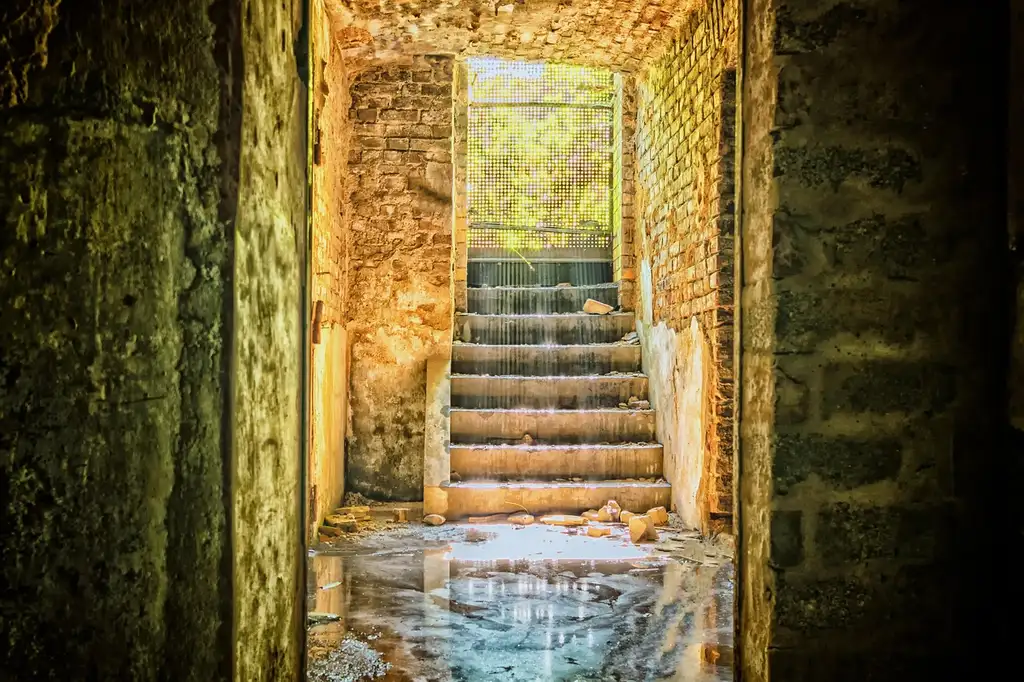
How to Choose a Dehumidifier for Basement Use
Choose a basement dehumidifier by starting with the space, moisture load, and temperature: for many basements, about 50 pints is a baseline, 60–70 pints may suit damper or larger spaces, and a low-temperature unit is a good choice if the room drops below 65°F. Pick the wrong size and you can waste electricity, leave damp air in place, or keep fighting musty odor, mold growth, and condensation. This guide shows how to match basement conditions to capacity, drainage, auto-defrost, and control features that will actually work.
What should you measure first?
Start with square footage, ceiling height, and a humidity reading. Measure length × width × height so you understand the air volume, then use a hygrometer to check repeated relative humidity readings in the middle of the basement, away from vents and corners. That gives you the baseline before you compare features or pint ratings.
Measure the room, not the label
Square footage matters, but taller basements hold more air and often need more drying capacity than a low-ceiling room with the same floor area. If the basement has finished rooms, a laundry area, or storage walls that limit air movement, treat it as a larger moisture load than a bare open space of the same size.
A hygrometer is the simplest way to avoid guessing. Place it in a central spot, wait for a stable reading, and check it more than once during the day. One reading can miss a humid corner, a cool slab edge, or a short burst of moisture from laundry or showers above.
Look for moisture clues
Cold walls, a musty smell, visible condensation, or damp spots near the floor often point to a higher load than the area alone suggests. That matters because a basement that is only slightly damp can get by with a smaller unit, while a basement with seepage, seasonal humidity, or laundry moisture usually needs more capacity and better drainage.
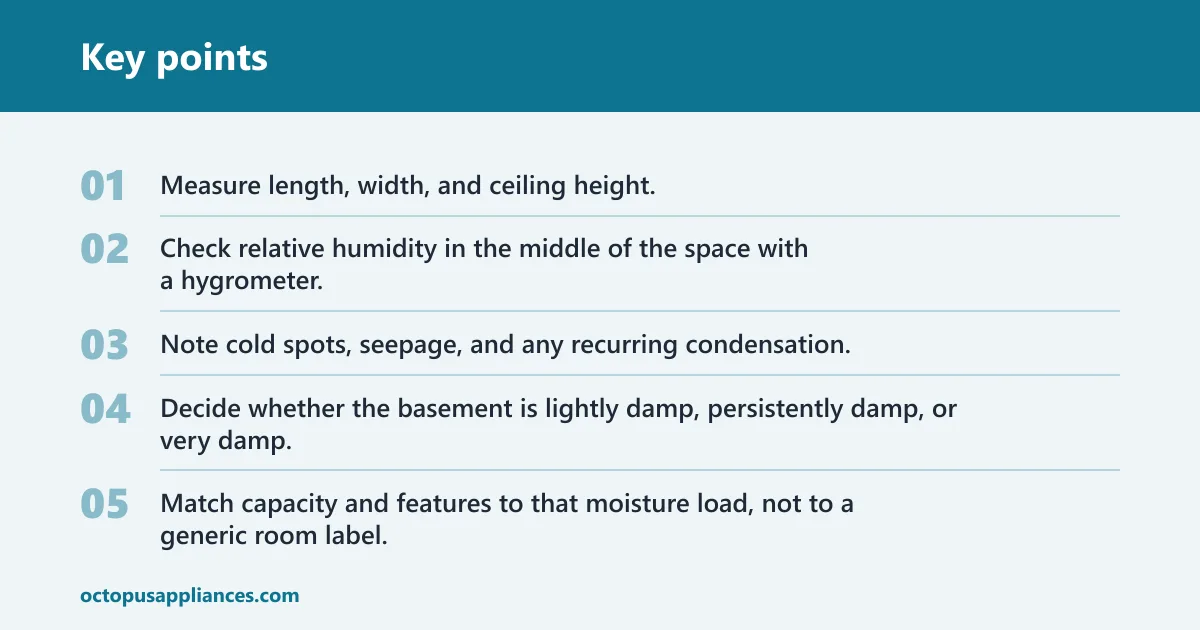
- Measure length, width, and ceiling height.
- Check relative humidity in the middle of the space with a hygrometer.
- Note cold spots, seepage, and any recurring condensation.
- Decide whether the basement is lightly damp, persistently damp, or very damp.
- Match capacity and features to that moisture load, not to a generic room label.
How much dehumidifier capacity do you need?
Use DOE pints per day, not just the older marketing label, because capacity varies with operating temperature. Many basements fall in the 20–60 pint range, but the right choice depends on room volume and moisture load. Cooler basements and persistently damp spaces often need more capacity than a small, finished, lightly damp basement.
Match capacity to basement conditions
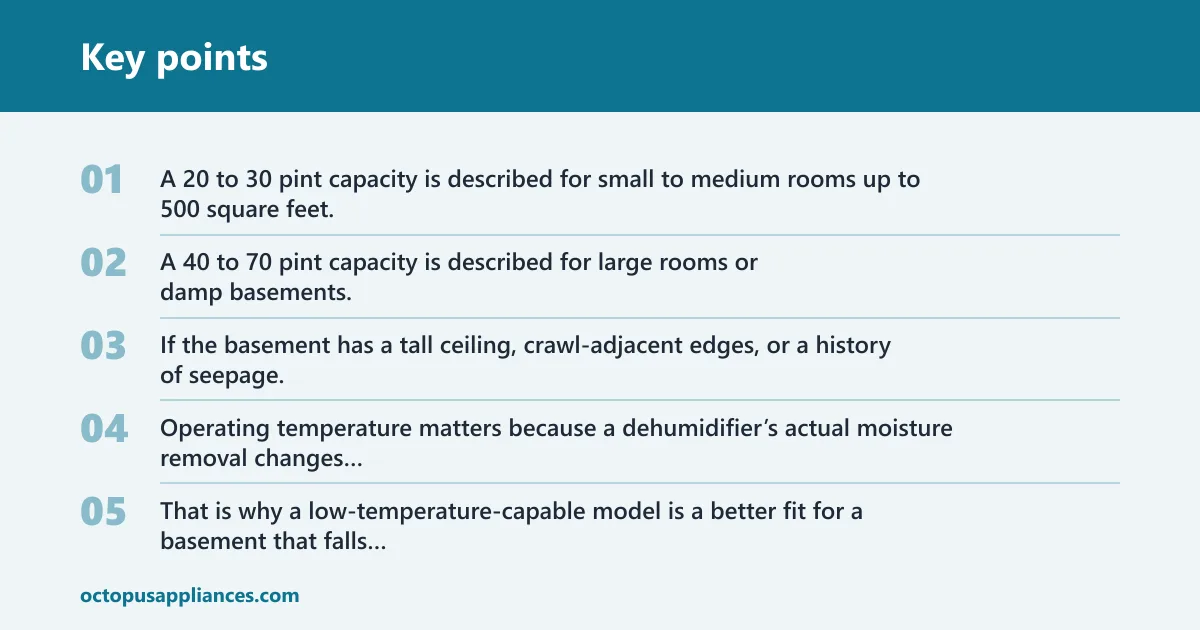
A 20 to 30 pint capacity is described for small to medium rooms up to 500 square feet. A 40 to 70 pint capacity is described for large rooms or damp basements. If the basement has a tall ceiling, crawl-adjacent edges, or a history of seepage, size up rather than down.
Operating temperature matters because a dehumidifier’s actual moisture removal changes as the room gets colder. That is why a low-temperature-capable model is a better fit for a basement that falls below 65°F. Without that match, the unit can struggle even if the printed pint number looks adequate.
When a smaller unit is enough
A smaller portable unit can work in a drier, divided basement where humidity stays close to target and the room is not exposed to frequent water intrusion. It is a practical fit when the goal is to trim mild dampness, not dry out a space after seepage, laundry use, or long cold spells.
Say your basement is 420 square feet, stays around the target humidity, and has no drain line available. A 20 to 30 pint unit may be enough if you are comfortable emptying the tank and the space is not cold for long periods. The same size would be a poor bet for a laundry-heavy basement with recurring damp corners.
Should you get continuous drainage?
Yes, if you want less manual emptying or the basement is large, damp, or used often. Continuous drainage is recommended to reduce regular emptying, and it becomes more useful as moisture load rises. If a drain line, floor drain, or compatible outlet setup is available, it can make the unit far easier to live with.
Tank or hose
A tank works for smaller or drier spaces, but it can fill fast when humidity is high. That is where continuous drainage matters most. It helps the unit run longer without interruption, which is especially useful when you need consistent control rather than occasional drying.
When a basement has no easy drain access, check whether the dehumidifier includes a pump or can send water to a higher outlet point. A pump is worth considering when gravity drainage is not practical, but it only helps if the hose route and discharge point are actually workable.
Check the route before you buy
Make sure the hose can reach a suitable drain without crossing a walkway or kinking behind stored items. Also confirm that the outlet and drain location will not force the unit into a cramped corner. If the hose path is awkward, continuous drain may be more trouble than it is worth.
Basement dehumidifier decision table
This table turns basement conditions into a buy decision. Use it to compare capacity, feature priority, and common mistakes before you pay for extras you do not need.
| Basement condition | Recommended capacity range | Feature priority | Common buy mistake |
|---|---|---|---|
| Small, lightly damp basement under 500 square feet | 20 to 30 pints | Simple humidity control, hygrometer, basic airflow clearance | Buying a high-capacity unit that cycles too often and is harder to place |
| Large or unfinished basement with steady dampness | 40 to 70 pints | Continuous drainage, Energy Star, strong airflow | Choosing a unit sized for a bedroom instead of the basement volume |
| Cold basement that drops below 65°F in winter | Mid to high capacity with low-temperature support | Auto-defrost, reliable compressor performance, humidity control | Buying a standard unit that freezes up and stops pulling moisture |
| Laundry-heavy or occupied basement | Higher capacity than a basic dry basement | Continuous drainage, variable-speed fans, easy access for upkeep | Ignoring added moisture from washer, dryer, showers, or frequent use |
| Drainage-limited basement with no easy tank-emptying route | Size to the space, then choose a drain-friendly model | Continuous drainage or pump, proper hose path, dedicated outlet | Buying a tank-only unit for a large or persistently damp basement |
What features matter in a basement?
For most buyers, the most useful features are Energy Star certification, auto-defrost, humidity control, and placement that leaves enough airflow around the cabinet. Add continuous drainage if the basement is large or persistently damp. The best feature set is the smallest one that fits the room’s temperature, drainage, and moisture load.
Energy Star and variable-speed fans
Energy Star models are explicitly prioritized for efficiency, which matters because basement units often run for long stretches. Variable-speed fans are also presented as an efficiency feature, especially when the basement does not need maximum airflow all the time. That can help match operation to changing humidity instead of running flat-out unnecessarily.
Auto-defrost for cold basements
Auto-defrost is important when the basement gets cold enough for coils to freeze. If the room drops below 65°F, this feature becomes especially useful rather than just a convenience. It helps the unit keep working when a standard compressor might ice up and lose drying ability.
Humidity control and airflow clearance
A basement dehumidifier should let you set a humidity target between 30% and 50%. A common basement target is in that range because it helps keep moisture down without making the space uncomfortably dry. Keep the unit 30 to 50 cm away from walls and furniture so intake and exhaust stay open.
Placement matters more than many shoppers expect. Put the unit centrally when possible, or close to the wettest area if the basement has one clear problem zone. Do not block the grilles with storage bins, drywall stacks, or a tight corner installation.
Suppose a finished basement has a small mechanical room tucked behind a door, but the doorway creates a choke point for airflow. Parking the dehumidifier there may look tidy, yet it can shorten cycling efficiency and leave the rest of the basement damp. A more open spot usually performs better.
Safe power setup
A dedicated outlet is recommended for basement dehumidifier installation. Larger-capacity units can draw enough power to trip a shared circuit if they are plugged in with other heavy loads. If the basement also runs a freezer, washer, or sump equipment, verify the circuit before you buy.
How do you know the unit is too small?
If relative humidity stays above the target after several days of run time, the unit may be undersized or may be placed poorly. A tank that fills too often, lingering condensation, or musty odors that do not improve are also warning signs. In those cases, capacity, drainage, or placement needs to change.
Read the signs together
Do not rely on one clue alone. A full tank can mean the dehumidifier is working hard, but it can also mean the space is too damp or the tank is too small for the load. Repeated high readings from the hygrometer give a clearer answer than the tank level by itself.
A common first-timer mistake is buying for square footage alone and ignoring winter temperature. A 600-square-foot basement with cold slab edges and laundry use can need a more capable, low-temperature unit than a warmer 800-square-foot storage room. The room’s moisture behavior matters as much as its size.
Frequently asked questions
How do I choose the right size dehumidifier for my basement?
Start with square footage, ceiling height, humidity readings, and how damp the basement actually is. Many basements need a 20–60 pint range, but a cold or persistently damp space may need more than a lightly damp finished basement of the same size. Match capacity to the moisture load first.
What pint capacity do I need for a basement?
A 20 to 30 pint unit is often enough for small to medium rooms up to 500 square feet, while a 40 to 70 pint unit is better for large rooms or damp basements. If the basement is colder than 65°F, favor a unit made for low-temperature operation.
Should I get a basement dehumidifier with continuous drain?
Continuous drainage is the better choice when the basement is large, persistently damp, or used often. It reduces regular emptying and keeps the unit running without tank interruptions. If a floor drain, sink, or pump-friendly route is not available, check the setup before you buy.
What humidity level should I set a basement dehumidifier to?
A practical basement setting is between 30% and 50% relative humidity. Start in that range and confirm it with a hygrometer placed away from vents and corners. If the basement still feels damp or shows condensation, adjust gradually rather than chasing a single low reading.
Do I need a hygrometer before buying a basement dehumidifier?
Yes. A hygrometer is recommended to track basement humidity, and it helps you avoid oversizing or undersizing the unit. Use repeated readings from the middle of the space, not one quick check in a corner, because basements can vary a lot from one area to another.
What features matter most in a basement dehumidifier?
The most useful features are the right pint capacity, Energy Star efficiency, auto-defrost for cold basements, continuous drainage when needed, and a layout that allows proper airflow. A dedicated outlet is also important, especially for larger-capacity units that may run for long periods.
