
Why Did My Dehumidifier Stop Collecting Water Suddenly?
If your dehumidifier stopped collecting water suddenly, first check the humidity setting, mode, filter, and room temperature; a bucket can stay nearly dry in cool air or when the unit is set too high. Ignoring the change can waste power, leave moisture in the room, and hide a fault that gets worse. This guide gives you about a 10-minute sequence to separate normal low-output behavior from airflow, control, winter, drain, and component problems.
Quick checks for settings and airflow
A sudden stop is often a setting, airflow, or temperature change rather than a broken machine. Start by comparing the set humidity with a separate hygrometer across the room, then separate fan operation from compressor operation, and finally check for bucket seating or drain issues. That order avoids guessing.
Start with the humidity reading
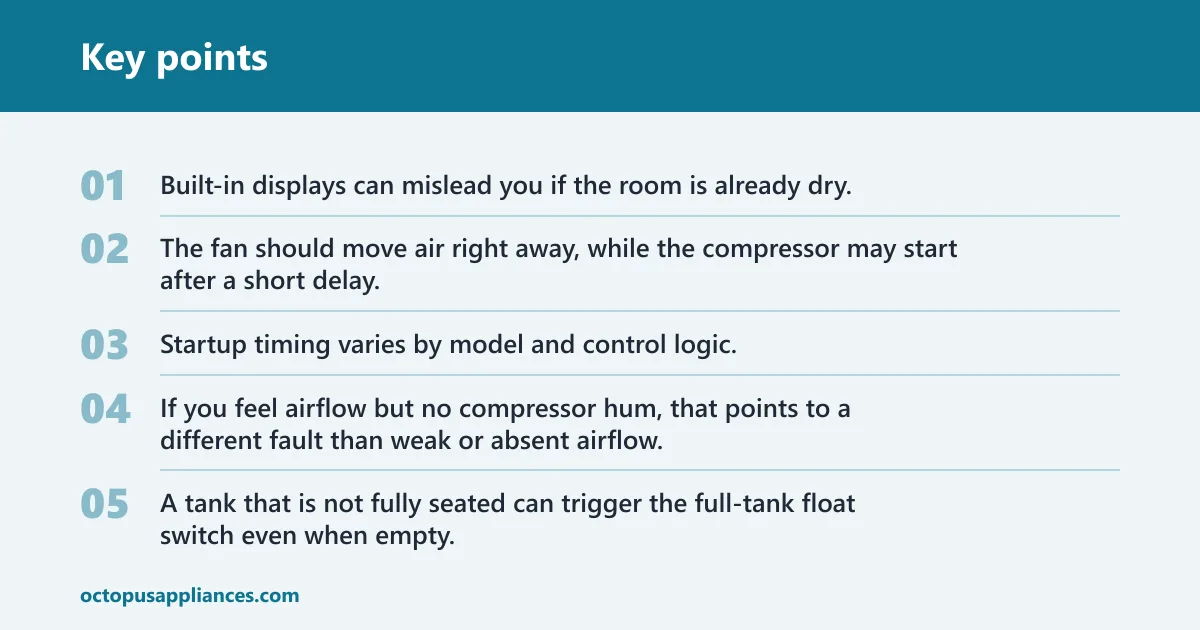
Built-in displays can mislead you if the room is already dry. A separate hygrometer placed across the room is the first test because a low room humidity level can mean the unit is working correctly and won’t collect water.
Separate fan operation from compressor operation
Listen and feel for two different things. The fan should move air right away, while the compressor may start after a short delay. Startup timing varies by model and control logic. If you feel airflow but no compressor hum, that points to a different fault than weak or absent airflow.
Check for a simple control or seating issue
A tank that is not fully seated can trigger the full-tank float switch even when empty. A humidistat set above the room’s actual humidity can also stop water production by preventing the compressor from running. Those are quick checks with no tools.
Dehumidifier diagnosis matrix
Use this text-only matrix to sort the symptom pattern before you open anything up. It separates normal low-output behavior from cold-room limits, float or drain problems, airflow restriction, and likely component failure. The first test is the one that gives the fastest yes-or-no answer.
| Observed symptom pattern | Most likely cause | First test | Likely fix cost band |
|---|---|---|---|
| Fan on, no water, room feels dry | Humidity setpoint is too high or room RH is already low | Compare setpoint to a separate hygrometer after 30 minutes | Free |
| Fan on, bucket empty, full light on | Tank not seated or float switch is stuck | Remove and reseat the tank, then tap the float gently | Free to low |
| Fan weak, little exhaust air | Dirty filter or blocked airflow | Hold the filter up to light and inspect the exhaust | Free to low |
| Coils frosted or iced, water stops | Cold room or restricted airflow causing frost | Unplug and thaw fully before restart | Free to low |
| Fan runs, compressor never starts | Compressor, start circuit, or control fault | Listen for compressor hum after 5–10 minutes | Moderate to high |
| Continuous drain setup, bucket empty, no water flow | Kinked or clogged drain hose | Trace hose slope and clear the line | Free to low |
Could the room already be too dry?
Yes. A dehumidifier may run little or not collect water at all if the room humidity is already at or below the setpoint. Compare the humidistat setting with a separate hygrometer reading, not the built-in display alone. Wait 30 minutes after moving the hygrometer before judging the room.
Compare the setpoint to a separate hygrometer
Set the dehumidifier to 30% only as a temporary test if you need to see whether the compressor will be allowed to run, and keep in mind that some models may not be able to reach or hold that setting in a normal room. If the room reading is already near that number, the unit may correctly idle or collect very little water.
What low humidity looks like in practice
A common first-timer mistake is assuming the tank should always fill at the same rate. If the room has cooled, windows have been opened, or another system already dried the air, the bucket may stay nearly dry while the unit behaves normally.
When the unit is working normally
If the separate hygrometer shows room humidity at or below the setpoint and the fan blows steadily, lack of water is usually not a failure. In that case, lower the setpoint only for testing, then return it to a realistic target once you confirm the room conditions.
Check the tank, float, and drain hose
Water collection can stop when the bucket sensor thinks the tank is full or when a continuous drain path cannot move water away. Empty and reseat the tank first, then inspect the float switch and drain hose. These checks matter even when the bucket looks empty.
Empty and reseat the water tank
Pull the bucket out completely, empty it, and reinstall it with firm pressure. A misseated tank can trigger the full-tank float switch even when empty, so the unit may run without collecting water until the bucket clicks into the correct position.
Look for a stuck float switch
Check whether the float moves freely and returns under its own weight. A stuck float switch can hold the unit in a full-tank safety shutoff, which prevents compressor operation. If it hangs up, clean the area around it and test again after reseating.
Inspect continuous-drain hoses for kinks or clogs
If you use continuous drainage, follow the hose from the outlet to the drain point. Look for a kink, a sag that traps water, or a clog that blocks flow. A hose problem can look like “empty bucket, no water” because water bypasses the bucket in continuous-drain mode.
- Remove and reset the tank. Take the bucket out, empty it, and reinstall it until it sits flush. If the full light clears, the problem was likely seating or the float path.
- Move the float gently. If the float is accessible, lift and release it to see whether it returns freely. Any drag or sticking can keep the safety switch engaged.
- Trace the drain line. On continuous drain setups, confirm the hose slopes to the drain and is not pinched behind the unit. Clear any visible blockage before restarting.
Can a dirty filter stop water collection?
Yes. A dirty dehumidifier air filter can restrict airflow enough to cut condensation, especially if dust has packed the intake or exhaust path. The filter should be checked with a light test, then cleaned or replaced before you restart the unit. Poor airflow can also contribute to coil icing.
Use a light test on the filter
Remove the filter and hold it to a bright light. If light barely passes through, airflow is restricted. Clean the filter roughly every 250 hours of runtime, and heavy dust can justify earlier cleaning.
Why restricted airflow cuts condensation
The evaporator coil depends on steady airflow to pull moisture from the room air. When the filter is clogged, less air reaches the condensation surface, so the unit may run but produce less water. In severe cases, the coil can frost faster.
Clean or replace before restarting
Wash or replace the filter, then let the unit run again. If airflow improves and water starts collecting, the issue was probably restriction rather than a sealed-system fault. If the fan still feels weak, keep checking the intake path and fan motor.
Why is my dehumidifier not collecting water in winter?
Winter often changes the answer more than any other season. A room under 60°F can sharply reduce compressor performance, and below 65°F frost risk rises on the evaporator coil. In very cold rooms, some units may produce little water because the coil can frost.
Cold-room limits on compressor models
Cold air carries less moisture, so there is less water to condense. That alone can make the bucket stay nearly empty. At lower room temperatures, capacity can drop sharply.
What frost on the evaporator coil means
Ice or frost on the evaporator coil usually means the unit is operating in conditions that are too cold, or airflow is restricted enough to chill the coil below normal. If you see frost, unplug the unit and let it thaw fully before restarting.
Thaw before you restart
Do not restart a frozen unit right away. Let the coil return to room temperature, then restore airflow and retest. If frost returns quickly, the room may be too cold for the model or the filter and intake path may still be restricted.
Picture a basement kept near 58°F with the humidistat set at 45%. The fan runs, but a separate hygrometer shows the room is already near that target. In that case, very little water is not a fault. Now change only one variable, such as a clogged filter, and the result can shift from low output to visible frost.
Fan, compressor, or sealed-system failure?
If the fan runs, the filter is clean, the tank is seated, and the room is warm enough, a no-water result can point to compressor or sealed-system trouble. A humming compressor suggests the refrigeration cycle is trying to start. No hum after a short delay points more strongly to a start or compressor fault.
How to check for airflow at the exhaust
Feel the exhaust stream with your hand a few inches away from the outlet. Strong airflow means the fan motor is likely working. Weak or absent airflow points to a fan motor problem, a blocked intake, or a severe filter restriction rather than a pure compressor issue.
What a humming or silent compressor suggests
A soft hum after startup means the compressor is at least attempting to run. Silence after the fan has had time to start suggests the compressor may not be engaging. That can be a control fault, but sealed-system or compressor repair usually needs professional service.
When repair usually stops making sense
If the unit is older, parts are hard to find, or the repair involves the sealed system, replacement often makes more sense than a major service call. Compressor repairs are rarely DIY-friendly, and labor can exceed the value of a basic dehumidifier quickly. A unit with multiple faults is a stronger replacement candidate.
- Verify fan airflow. Turn the unit on and feel for a strong, steady exhaust stream. Weak flow points you back to filter, intake, or fan motor issues.
- Listen after startup. Give the unit a short period from a cold start and listen for a compressor hum. No hum after that window makes compressor or control failure more likely.
- Decide on service. If the coil is clear, the room is warm enough, and the fan works but there is still no water, professional diagnosis is the next step.
Frequently asked questions
Why did my dehumidifier stop collecting water suddenly?
The most common reasons are a room that is already dry, a setpoint that is too high, a misseated tank, a clogged filter, cold room air, or frost on the coil. Start with a separate hygrometer, then check airflow, tank seating, and room temperature before assuming a failed compressor.
Why is my dehumidifier running but not collecting water?
If it runs but makes no water, separate fan operation from compressor operation. Strong airflow with no water can mean the room is already near the target humidity, the coil is frosted, or the compressor is not starting. Weak airflow points more toward the fan or filter path.
Why does my dehumidifier run but the bucket stays empty?
An empty bucket can be normal if the room is already at or below the set humidity. It can also happen when the drain hose is kinked, the float switch is stuck, or the coil is too cold to condense much moisture. Compare the setpoint to a separate hygrometer first.
Could the room humidity already be too low for the dehumidifier to run?
Yes. That is one of the first things to check. Use a separate hygrometer across the room, wait 30 minutes for a stable reading, and compare that reading to the dehumidifier’s setpoint. If the room is already dry enough, little or no water is expected.
Can a dirty filter make a dehumidifier stop collecting water?
Yes. A dirty filter cuts airflow, and reduced airflow lowers condensation on the evaporator coil. Check the filter with a light test, clean or replace it, and then restart the unit. If airflow improves and water returns, the filter was the cause.
What if the coils are frozen or iced over?
Unplug the unit and let it thaw completely before restarting. Frost on the evaporator coil often appears in cold rooms, especially below 65°F, and performance can drop sharply below 60°F. If frost returns quickly after thawing, check airflow and room temperature again.
Should I repair or replace a dehumidifier that stopped making water?
Repair makes sense for simple fixes like a dirty filter, a misseated tank, or a drain hose kink. Replace the unit if the problem points to the compressor or sealed system, the unit is older, or parts are scarce. Those repairs usually need professional service and can cost more than a new unit.