Why Is My Refrigerator Not Cooling Enough?
If your refrigerator is running but the food is only a little warm, check the temperature first: aim for about 37°F, and treat temperatures above about 40°F after 24 hours as a cooling problem. Left alone, that raises food-safety risk and can waste food before the fridge quits completely. This guide separates normal startup behavior, airflow fixes you can do, and sealed-system faults that need service.
How cold should your refrigerator be?
Use 37°F as the target and 33°F to 40°F as the normal refrigerator range. If the fridge is a little warm but the freezer is still near 0°F, the problem often sits in airflow, seals, or defrost parts rather than the sealed system. If both compartments are warm, start with power and controls.
Temperature targets that matter
Whirlpool lists about 37°F as the ideal refrigerator temperature and 33°F to 40°F as the usable range. A freezer target near 0°F is commonly used to help separate a fridge-airflow issue from a whole-system cooling problem. If food feels only mildly warm, the cabinet may be underperforming rather than completely dead.
What mildly warm food usually means
“Not cold enough” often means the refrigerator is running but not moving enough cold air through the fresh-food section. That can happen when vents are blocked, the evaporator fan is weak, the door seal leaks, or frost is choking the evaporator. It can also happen after a recent power outage or a door left open.
When the freezer reading changes the diagnosis
If the freezer is cold but the refrigerator is warm, the compressor is often still making cold air and the problem is distribution. If both compartments are warm, look first at power, settings, installation, or a deeper cooling fault. A fridge that is running but not cooling enough is not the same as a full no-power failure.
What the symptom usually points
A refrigerator can hum, light up, and still fail to hold temperature. That usually narrows the problem to airflow, seals, controls, or defrost parts before you suspect a sealed-system fault. Normal recovery after a power outage or door left open is another common explanation, especially in the first 24 hours.
Why the fridge can run but still stay warm
The compressor may be making cold air while the cabinet loses it faster than it can circulate. Dirty condenser coils, a blocked evaporator fan, or a leaking door gasket can all create that gap. Family Handyman notes that a compressor-running fridge that still won’t cool may have frost-clogged evaporator coils or a bad evaporator fan.
Normal recovery after interruption
After a recent power outage, a long door opening, or a new installation, the fridge may need time to return to target temperature. Bob Vila notes that new refrigerators may take up to 24 hours to get cold. If the unit is still above 40°F after that window, stop treating it as normal recovery.
Cooling triage table
This table starts with the symptom you can see and moves toward the most likely cause. Use it with a simple readiness rule: aim for about 37°F in the refrigerator and 0°F in the freezer. If the fridge stays above 40°F after 24 hours, move from quick checks to repair territory.
| Symptom | Likely cause | Quick check | Next action |
|---|---|---|---|
| Fridge light on but compartments warm | Power issue, control issue, compressor problem, or severe airflow failure | Check outlet, breaker, display, and whether the compressor or fan ever starts | Confirm settings and airflow first; call a pro if it never cools or only hums |
| Freezer cold but fridge warm | Blocked vents, weak evaporator fan, or defrost problem | Listen for the fan, inspect vents, and look for frost on the rear freezer wall | Clear airflow problems; service the fan or defrost system if frost keeps returning |
| Compressor runs continuously | Dirty coils, leaky gasket, warm location, refrigerant problem, or weak compressor | Check coil dust, seal leakage, and room heat around the cabinet | Clean, reseat, and retest; if cooling stays weak, call a technician |
| Frost on rear freezer wall | Defrost system failure or airflow restriction | Look for heavy white frost behind the panel or around the evaporator area | Defrost and inspect the fan, timer, heater, or thermostat; repeated frost needs service |
| Door seal fails dollar-bill test | Worn, dirty, or brittle gasket | Close a dollar bill in several spots and tug gently | Clean the seal first; replace it if grip is weak or the gasket is cracked |
| Recent power outage or door left open | Temporary warm-up, not always a fault | Check elapsed time since the outage or open door | Give it time to recover; if it stays warm past 24 hours, continue diagnosis |
| Call a pro | Refrigerant leak, sealed-system fault, or compressor failure | Unit runs but still cannot reach 37°F and 0°F targets after basic checks | Stop DIY repair and schedule service |
Why is my fridge not cold enough on the coldest setting?
If the fridge is on its coldest setting and still not getting cold enough, the setting may not be the real issue. Digital controls can be in the wrong mode, and dial controls can be misread or bumped. If the cabinet is still warm after a reset and a full day, the fault is usually elsewhere.
Digital controls and dial controls
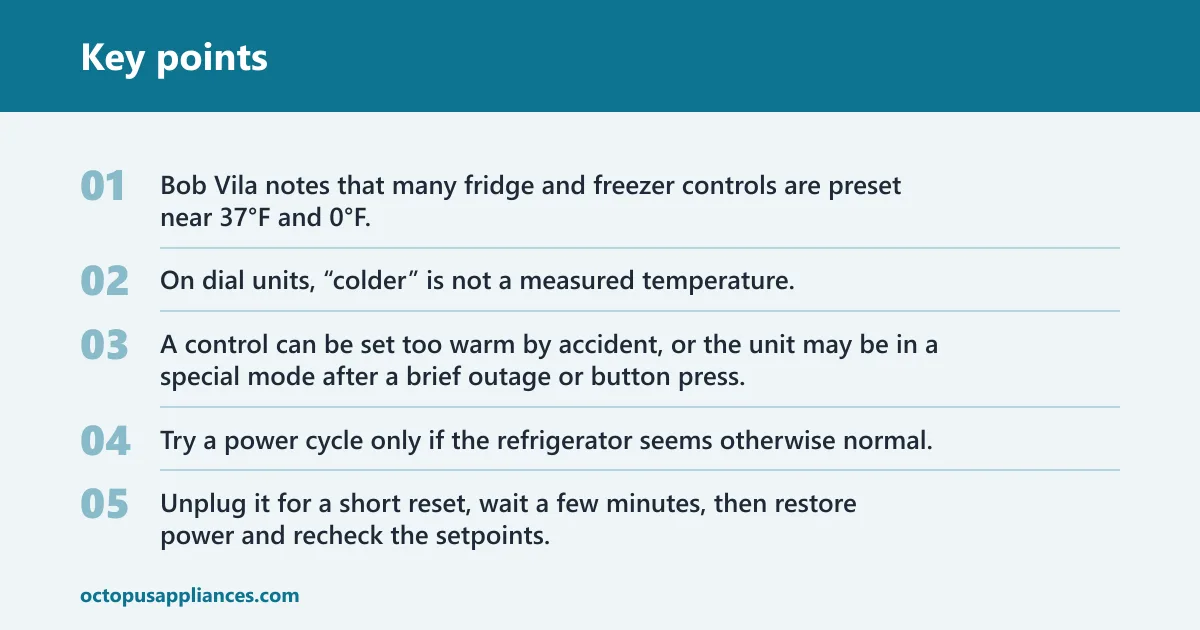
The same source notes that many fridge and freezer controls are preset near 37°F and 0°F. On some digital models from LG, Samsung, Frigidaire, or GE, the screen may show a setpoint, a feature mode, or a child lock that keeps you from changing the actual target. On dial units, “colder” is not a measured temperature.
Mis-set setpoints and accidental mode changes
A control can be set too warm by accident, or the unit may be in a special mode after a brief outage or button press. If the display uses icons or numbers, confirm that the setpoint still matches the target range rather than assuming the visible level means the compartment temperature. This matters most when the freezer seems fine but the fridge section drifts warm.
When a reset is worth trying
Try a power cycle only if the refrigerator seems otherwise normal. Unplug it for a short reset, wait a few minutes, then restore power and recheck the setpoints. If the temperature still does not move toward 37°F, stop treating the controls as the only cause.
Check the airflow path
Airflow problems are one of the most common reasons a refrigerator runs but does not cool evenly. Blocked vents, overpacked shelves, and tight cabinet clearance can keep cold air from reaching the fresh-food section. TCL notes that blocked air vents and ducts can hinder air circulation.
Blocked vents and overpacked shelves
Do not stack food against the back wall, side ducts, or top return vents. Cold air needs a clear path through the refrigerator compartment, and a packed shelf can create warm pockets even when the evaporator is working. Leave space around items so air can move across the cabinet.
Clearance around the cabinet and rear wall
The same source says some manufacturers recommend at least 1 inch of clearance behind and above the appliance. Too little space can trap heat around the condenser area and reduce efficiency. Make sure the refrigerator is not pressed tight against a wall, cabinet panel, or another heat source.
Say your top-freezer refrigerator reads 42°F in the fresh-food section but the freezer is still near 0°F. If the middle shelf is jammed with containers and the rear vents are hidden, clearing the shelf can improve airflow without touching any parts.
Clean the condenser coils
Dirty condenser coils are a straightforward cause of weak cooling. The same source lists dirty condenser coils among cooling causes, and Family Handyman notes that clogged coils can cause poor cooling. Dust reduces heat release, which makes the compressor work longer for less result.
Dust buildup and cooling loss
Coils near the floor or behind a kick plate often collect lint, pet hair, and kitchen dust. When that buildup thickens, heat stays in the system and the refrigerator may run continuously without reaching target temperature. This is a cheap fix compared with a compressor or sealed-system repair.
How to clean them
- Disconnect power. Unplug the refrigerator or switch it off at the breaker before opening the rear or lower access area. This keeps the fan and compressor from starting while you clean.
- Remove loose debris. Use a vacuum with a brush attachment or a coil brush to lift dust from the coils and surrounding grilles. Go slowly so you do not bend the fins or push debris deeper into the cabinet.
- Recheck airflow. Clear dust from the condenser fan area if it is accessible, then restore power and listen for normal operation. If the fridge still cannot reach 37°F after a full day, move on to other causes.
How often to check the coils
A common rule of thumb is to check them at least a couple of times a year, and more often if the unit sits low to the floor, near a pet area, or in a dusty room. If the refrigerator is already running warm, coil cleaning is worth doing early because it is simple and can restore efficiency quickly.
Why is my refrigerator not cooling but the freezer is working?
When the freezer is cold but the fridge is warm, the problem usually sits in the air path between the two compartments. The evaporator fan may not be moving cold air, the vents may be blocked, or frost may be choking the evaporator. That pattern points away from a full compressor failure.
Evaporator fan clues
The evaporator fan circulates cold air from the freezer side into the refrigerator section. If it is working, you may hear a steady fan sound when the compressor runs. If the fan is quiet, rattling, or blocked by ice, the fridge compartment may warm even while the freezer stays cold.
When cleaning is not enough
A fan blocked by spilled food or a loose panel may only need cleaning or repositioning. A motor that does not start, starts slowly, or stops after brief running usually needs replacement. If the fan area is clear but the refrigerator still warms, look harder at defrost parts.
Frost on the rear freezer wall
Heavy frost on the rear freezer wall is a sign that the defrost system may not be clearing the evaporator. The same source says a compressor-running fridge that still won’t cool may have frost-clogged evaporator coils or a bad evaporator fan. A defrost timer, defrost heater, or defrost thermostat can fail and leave the coil buried in frost.
Picture a side-by-side model where the freezer is still solid at 0°F but the fresh-food side rises to 46°F. If the rear freezer panel shows white frost and the fan seems quiet, that is a stronger defrost or fan clue than a thermostat clue.
Door seal and location problems
A leaky gasket can look minor and still ruin cooling. Whirlpool includes faulty or dirty gasket seals among cooling causes. Location matters too, because heat around the cabinet makes the system work harder and can turn a borderline issue into a warm fridge.
Dollar-bill test and gasket leakage
The same source describes the dollar-bill test for checking a door gasket. Close a bill in several spots around the seal and tug gently; if it slides out too easily, the seal may not be gripping well. Clean dirt from the gasket first, because grime can mimic failure.
Brittle seals and replacement signs
A gasket that is cracked, flattened, or brittle will not press evenly against the cabinet. If the seal is torn or hard at the corners, replacement is usually better than repeated cleaning. A bad seal can also explain why the compressor runs longer than it should.
Hot garages and other location issues
The same source says improper installation can affect cooling. A refrigerator in a hot garage, tight enclosure, or sun-warmed room may struggle to hold temperature even when the parts are working. Check rear and side clearance, and make sure the compressor compartment can dump heat efficiently.
When to call a technician
Call a technician when the fridge still cannot hold 37°F after the simple checks, or when the symptom points to sealed-system work. Refrigerant leaks, compressor failure, and some defrost or control faults are not good DIY targets. The same source notes that refrigerant leaks require professional service.
Compressor and sealed-system problems
If the compressor runs continuously and the cabinet remains warm, the system may have a refrigerant leak, a weak compressor, or another sealed-system fault. Those repairs require tools and handling that go beyond normal homeowner maintenance. At that point, cleaning and reset steps are no longer enough.
Cheap fixes versus service-call territory
Cleaning coils, clearing vents, correcting settings, and checking the gasket are low-cost or no-cost moves. Fan replacement and gasket replacement are usually parts-and-labor repairs. Refrigerant work, compressor replacement, and internal sealed-system diagnosis belong in service-call territory.
- Verify power first. Check that the refrigerator is plugged in, the light comes on, and the breaker has not tripped. If the unit has no power at all, temperature checks and part checks do not help yet.
- Confirm the setpoint. Make sure the controls are near the normal target range, not accidentally turned warm. On many units, the useful reference is about 37°F in the fridge and 0°F in the freezer.
- Open the airflow path. Remove food blocking vents, back panels, or return ducts, and leave space around items. This can fix a “running but warm” complaint without parts replacement.
- Clean the coils. Vacuum or brush the condenser coils if they are dusty. Dirty coils waste efficiency and can keep the fridge from reaching temperature.
- Inspect the seals. Run the dollar-bill test around the door and look for cracks, stiffness, or gaps. Replace a failing gasket if the seal will not hold.
- Watch the freezer pattern. If the freezer is cold but the fridge is warm, listen for the evaporator fan and look for frost on the rear wall. That pattern often points to airflow or defrost trouble rather than a full cooling failure.
- Schedule service if needed. If the compressor runs nonstop and the temperature still stays above 40°F after 24 hours, call a technician. Refrigerant leaks and compressor faults need professional repair.
Frequently asked questions
Why is my refrigerator not cooling enough?
Start with temperature, not guesswork. If the refrigerator is above 40°F after 24 hours, it is out of range. The usual causes are airflow blockage, dirty coils, a weak seal, a mis-set control, or a defrost problem. If both compartments are warm, check power and compressor operation first.
Why is the fridge not cooling enough?
The fresh-food section can warm up even when the freezer still looks normal. That usually means cold air is not moving where it should. Look at vents, the evaporator fan, the door gasket, and the condenser coils before assuming the sealed system has failed.
Why is my refrigerator not cooling properly?
Improper cooling often means the refrigerator is running but cannot hold the correct temperature range. The target is about 37°F in the fridge and 0°F in the freezer. If the unit is still above 40°F after basic checks, the cause is likely mechanical rather than a simple setting issue.
Why is my refrigerator not staying cold enough?
A fridge that cools for a while and then warms again often has a seal problem, intermittent fan issue, or defrost fault. It can also struggle in a hot garage or tight enclosure. If the temperature keeps drifting above 40°F, stop relying on temporary recovery and inspect the cause.
When should I call a technician for a refrigerator that is not cooling enough?
Call for service when the compressor runs constantly and the cabinet still will not reach temperature, when you suspect a refrigerant leak, or when frost keeps returning on the rear freezer wall. Those signs can point to sealed-system or compressor trouble, which is not a routine homeowner repair.
Why is my freezer not cooling enough?
If the freezer itself is warm, check power, settings, coils, and the condenser fan first. A freezer that cannot reach 0°F may have airflow problems, dirty coils, a defrost issue, or a compressor fault. If the freezer and refrigerator are both warm, move quickly to service-level diagnosis.