Portable Dishwasher vs Built-in: Which Should You Buy?
A portable dishwasher can be a practical choice if you rent, cannot add plumbing, or may move within about 3 to 5 years. Buy a built-in if you own the home, want higher capacity, and can connect permanent water and drain lines. Pick the wrong type, and you may end up with a unit that does not fit your kitchen or your plans.
| Decision factor | Portable dishwasher | built-in | Winner |
|---|---|---|---|
| Upfront cost | Usually lower purchase cost, with no permanent plumbing work in many kitchens. | Usually higher once installation and cabinet fit are included. | Portable dishwasher |
| Installation effort | Connects temporarily to a sink faucet and can roll away when not in use. | Needs permanent water, drain, and under-counter installation. | Portable dishwasher |
| Daily convenience | Must be rolled to the sink and stored when not in use. | Always ready under the counter. | built-in |
| Capacity | Commonly 8 to 12 place settings, which is enough for many households. | Usually offers more cabinet-integrated capacity. | built-in |
| Noise | Quieter portable units are around 55 dBA, but many dishwashers are louder overall. | Typical dishwashers are 63 to 66 dBA, though surrounding cabinetry often helps. | Portable dishwasher |
| Cleaning performance | Portable dishwashers can wash as much as built-in dishwashers. | Also capable of full-load cleaning. | tie |
| Flexibility for renters | Moves on rollers or wheels and disconnects when you leave. | Usually stays with the home. | Portable dishwasher |
| Resale and remodel fit | Useful as a temporary solution, but less integrated with a remodel. | Matches permanent kitchen updates and owner-occupied homes. | built-in |
Portable dishwasher vs built-in at a glance
The main trade-off is flexibility versus permanence. A portable dishwasher fits kitchens that cannot take permanent plumbing, while a built-in fits owner-occupied kitchens that can support installation and benefit from an under-counter setup. If you plan to stay put, built-in usually wins on convenience. If you may move, portable usually wins on practicality.
Capacity, hookup, and storage
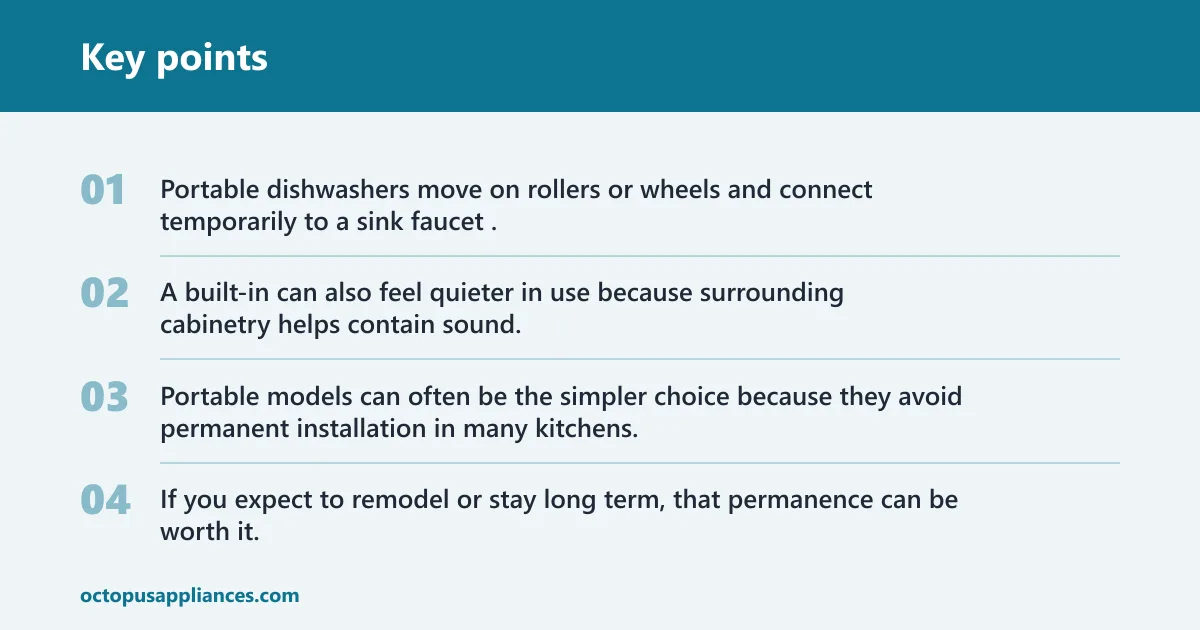
Portable dishwashers move on rollers or wheels and connect temporarily to a sink faucet. They commonly come in 18-inch or 24-inch widths, and many handle about 8 to 12 place settings. That makes them a real family appliance, but you still need a place to park it when it is not running.
Noise, cleaning, and daily use
Built-in dishwashers are often quieter than portable models, and many modern built-ins are well below the 63 to 66 dBA range. A built-in can also feel quieter in use because surrounding cabinetry helps contain sound. On cleaning, portable dishwashers can handle everyday loads well, but built-ins usually offer more capacity, so the choice is usually about fit and convenience rather than wash power alone.
Cost, installation, and long-term fit
Portable models can often be the simpler choice because they avoid permanent installation in many kitchens. Built-ins usually require more installation work because they need plumbing and cabinet integration, but they also fit more cleanly into an owned home. If you expect to remodel or stay long term, that permanence can be worth it.
Which dishwasher fits your kitchen setup?
Start with housing status, then check plumbing, then think about how long you expect to stay. A portable dishwasher is the better match for renters, apartments without a dishwasher opening, and homes where permanent hookups are not practical. A built-in is the better match when you own the home and can support a fixed installation.
Apartment and rental kitchens
Portable dishwasher is usually the right answer in apartments and rentals because it connects temporarily to a sink faucet and does not require permanent installation. It is also easier to take with you when you move. If the lease limits changes to plumbing or cabinets, portable is the safer buy.
Owner-occupied kitchens with plumbing access
built-in is usually the better choice in an owner-occupied home with available plumbing. You get a fixed setup under the counter, less daily handling, and a more integrated layout. If you want the dishwasher to feel built into the kitchen, built-in makes more sense.
Small kitchens with limited cabinet space
Portable dishwasher can still work in a small kitchen if you have floor space for storage and enough clearance to roll it to the sink. But if the kitchen is tight enough that storing a 36-inch-tall unit would block traffic, a built-in may be better only if the kitchen can be modified for one. When neither condition is true, the space itself is the limiting factor.
How much dish capacity do you need?
Place settings are the capacity metric that matters most. Portable models commonly handle 8 to 12 place settings, which is enough for many couples, small families, and daily cooking loads. If you cook large meals often, or clean a full family load plus pots and pans, built-in capacity is usually the better fit.
Place settings and real meal volume
Place settings are easier to judge than vague “small” or “large” labels. If your sink pile usually includes plates, bowls, glasses, utensils, and a few pans from one day of cooking, 8 to 12 place settings can be enough. If you routinely run two day’s worth of dishes, built-in capacity reduces how often you need to start a cycle.
When 8 to 12 place settings is enough
A portable dishwasher is often enough for a household that washes one main load per day, or for a smaller home where dishes build up slowly. It can also suit a home that needs a second dishwasher during a remodel. The key is whether the load size matches your cleanup rhythm.
When built-in capacity is the better fit
Choose built-in if your kitchen regularly handles full-family cooking, larger dinnerware sets, or heavy pots and pans. Built-in models usually offer more cabinet-integrated capacity, so you are less likely to split dishes across multiple loads. That matters if you want the dishwasher to keep pace with daily cooking, not just weekend use.
Can a portable dishwasher hook up to your faucet?
Yes, but not always without an adapter. Portable dishwashers connect temporarily to a sink faucet, and if the faucet spout is not threaded, a faucet adapter may be needed. Some kitchens with pull-down or pull-out faucets can be incompatible even before you get to installation, especially if the faucet cannot accept the connector cleanly. In some kitchens, the aerator must come off first. Faucet clearance and sink hardware can turn a “fits” decision into a no-go.
-
Check the faucet threads.
Look at the spout end and confirm whether it is threaded for the dishwasher connector. If it is not threaded, you may need a faucet adapter, and in some cases the aerator must be removed before hookup.
-
Measure sink clearance.
Make sure the hose can reach the sink and that the faucet area has room for the connector to lock in place. Tight clearance can make a temporary hookup annoying even if the adapter technically fits.
-
Confirm quick connect access.
Portable models are designed for quick hookup and disconnection, but the faucet still has to match the connection hardware. If the connector cannot seat cleanly, the machine stops being a practical choice.
Threaded spouts and faucet adapters
Some faucets accept the connector directly. Others need an adapter to create a usable connection. That small detail matters more than the dishwasher brand or finish, because a unit that cannot hook up cleanly becomes a storage problem instead of an appliance.
Aerators, sink clearance, and quick-connect setup
If the spout has an aerator, removing it may be part of the process. That is why buyers should check the faucet before purchase, not after delivery. A common first-time mistake is buying a portable unit for a kitchen with a decorative faucet that cannot accept the adapter without extra parts.
When faucet compatibility becomes a dealbreaker
Say your kitchen has a pull-down faucet with a fixed, non-threaded spray head and no easy adapter path. In that case, the portable dishwasher may not be a good buy even if the floor space works. The plumbing connection is the limiting factor, not the machine size.
What do noise and cleaning performance mean in practice?
Noise and wash quality matter, but they do not separate portable from built-in as much as many buyers expect. Built-in dishwashers are often quieter than portable models, and many modern built-ins are well below 63 to 66 dBA. On cleaning, portable dishwashers can handle everyday loads well, but built-ins usually offer more capacity, so the louder or quieter choice does not automatically mean better cleaning.
Decibel ratings and kitchen noise
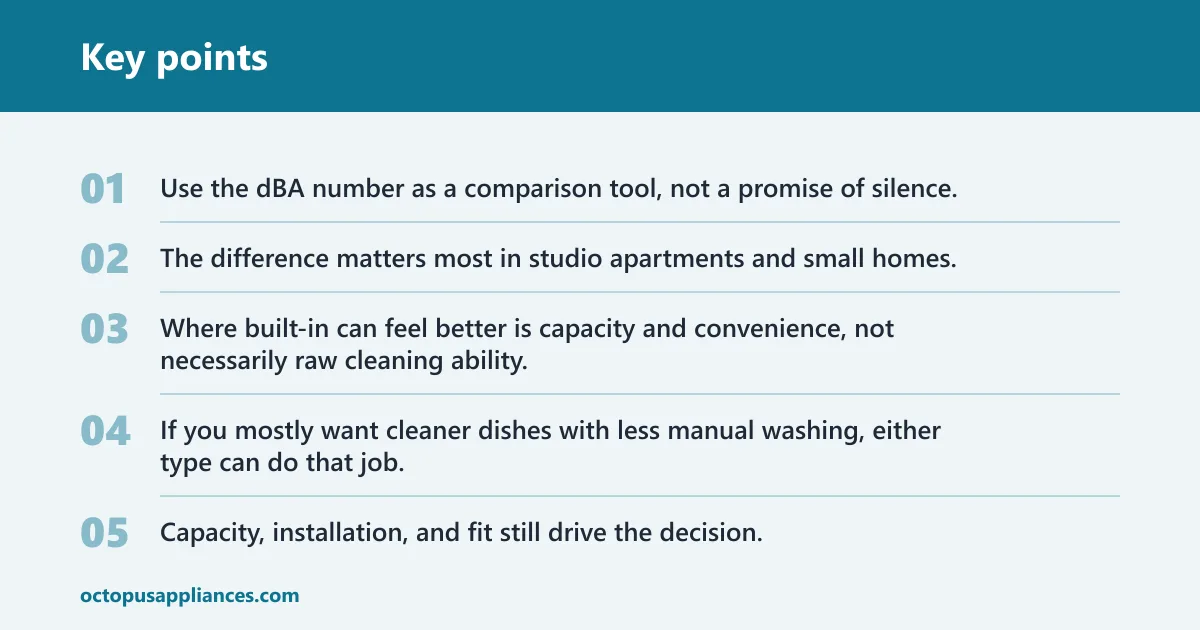
Use the dBA number as a comparison tool, not a promise of silence. A quieter portable unit is easier to live with in an open kitchen than a louder dishwasher, while a built-in can sound quieter because the cabinet enclosure muffles some of the noise. The difference matters most in studio apartments and small homes.
Wash results for everyday loads
For normal dishes, both categories can clean well when the load is arranged correctly and the cycle matches the soil level. Where built-in can feel better is capacity and convenience, not necessarily raw cleaning ability. If you mostly want cleaner dishes with less manual washing, either type can do that job.
ENERGY STAR models in both categories
ENERGY STAR certification is available on some portable and built-in models, so efficiency is not limited to either type. That means you should compare certified models within the category you need rather than assuming one format is always more efficient. Capacity, installation, and fit still drive the decision.
Choose Portable dishwasher if… / Choose built-in if…
Portable dishwasher is the better buy when flexibility matters more than permanence. built-in is the better buy when your kitchen can support a permanent install and you want the dishwasher to act like a fixed part of the home. The right choice depends on your housing, plumbing, and how long you plan to stay.
Choose Portable dishwasher if…
- You rent and need a temporary hookup to a sink faucet.
- Your kitchen cannot support permanent plumbing or cabinet changes.
- You may move within 3 to 5 years and want to take the appliance with you.
- You need a full dishwasher but want to avoid a permanent installation.
Choose built-in if…
- You own the home and can install permanent water and drain lines.
- You want higher integrated capacity for daily family cooking.
- You value always-ready convenience more than portability.
- You are planning a remodel and want the dishwasher to match the kitchen long term.
Portable dishwasher is a bad buy when the faucet cannot accept the connector, when you have nowhere to store it, or when rolling it to the sink would be a daily hassle. built-in is worth the installation when you plan to stay, can modify the kitchen, and want the appliance to fit the home instead of sitting beside it.
Frequently asked questions
Should I buy a portable dishwasher or a built-in dishwasher?
Buy portable if you rent, expect to move, or cannot add plumbing. Buy built-in if you own the home, want a permanent installation, and have the space and plumbing to support it. The best choice is the one that matches your housing setup and how long you plan to stay.
How many dishes can a portable dishwasher wash compared with a built-in?
Portable dishwashers commonly hold about 8 to 12 place settings, which is enough for many households. Built-in dishwashers usually offer more cabinet-integrated capacity, so they are better when you routinely wash large family loads, pots, pans, and several days of dishes at once.
Do portable dishwashers clean as well as built-in dishwashers?
Portable dishwashers can handle everyday loads well. The difference is usually convenience, capacity, and installation, not cleaning ability. If the load is arranged well and the cycle is appropriate, a portable unit can do the same cleaning job as a built-in.
How much space do I need for a portable dishwasher?
Portable dishwasher sizes commonly range from 18 inches wide to 24 inches wide, and most are about 36 inches tall and 26 to 30 inches deep. You also need storage space when it is not in use, plus a path to roll it to the sink for hookup.
Can a portable dishwasher be hooked up to any kitchen faucet?
No. Portable dishwashers connect temporarily to a sink faucet, but some faucets need an adapter, and some require removing the aerator. If the spout shape or clearance does not work with the connector, the unit may not be practical in that kitchen.
Is a portable dishwasher worth it if I own my home?
It can be, but only in specific cases. A portable dishwasher makes sense if you own the home but cannot add permanent plumbing, are between remodels, or need a temporary solution. If you can install a built-in, the permanent model usually makes more sense for long-term convenience.
Which dishwasher is better for an apartment?
Portable dishwasher is usually better for an apartment because it can connect temporarily to a sink faucet and move with you. A built-in only makes sense if the apartment already has the right opening and plumbing, and you are allowed to install a permanent unit.