How to Use a Dehumidifier Size Chart

Use a dehumidifier size chart as a starting point: match the room or home square footage to pint capacity, then move up one size for very damp spaces or steady moisture. Undersizing leaves rooms clammy and can let mold keep growing, while oversizing costs more and may short-cycle. This guide shows how to read the chart and adjust for humidity level, moisture source, and drainage setup.
What does the dehumidifier size chart tell you?
A dehumidifier size chart turns room area and dampness into a starting pint rating. Most portable units are labeled in pints per day, and many manufacturers also list liters per day as the metric equivalent. A common conversion is 1 pint per day = about 0.47 liters per day, so a 20-pint unit is about 9.5 L/day.
Pints per day and liters per day
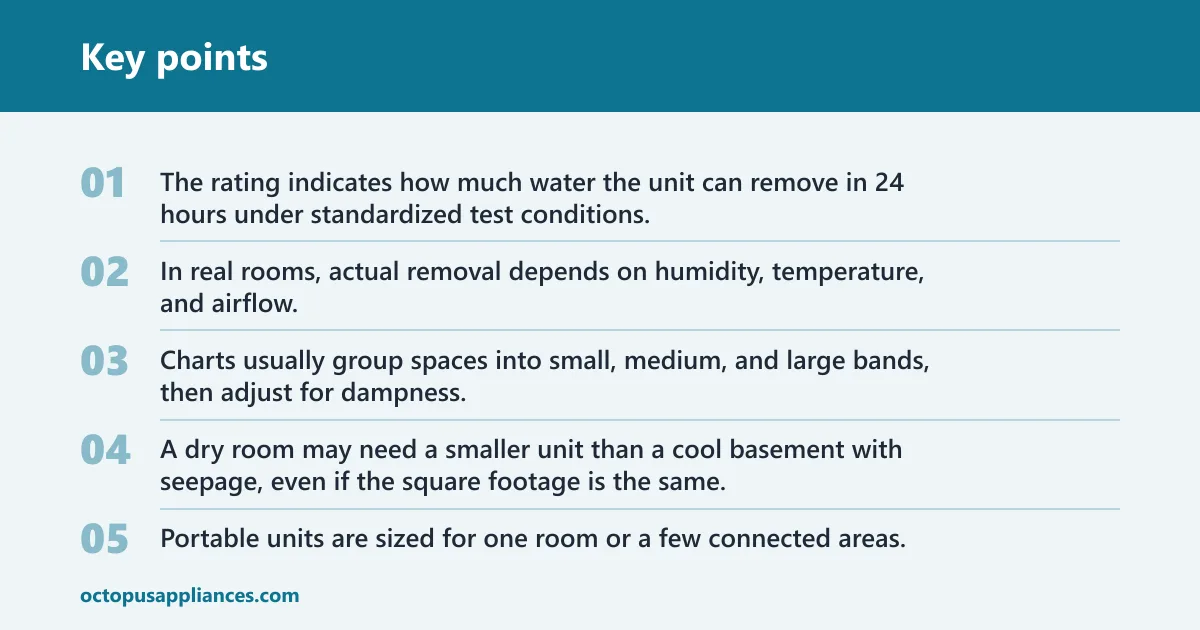
The rating indicates how much water the unit can remove in 24 hours under standardized test conditions. In real rooms, actual removal depends on humidity, temperature, and airflow. That is why a 50-pint label does not mean 50 pints will disappear from every basement every day.
Room-size bands and dampness levels
Charts usually group spaces into small, medium, and large bands, then adjust for dampness. A dry room may need a smaller unit than a cool basement with seepage, even if the square footage is the same. The chart is a guide, not a final answer.
Portable and whole-home use
Portable units are sized for one room or a few connected areas. Whole-home systems are tied into the HVAC or ductwork and are sized differently because they serve a much larger air volume. Do not use a portable chart as if it were a whole-house chart.
How do you measure the room correctly?
Measure length and width in feet, then multiply them to get square footage. That gives you the starting point for the chart, but square footage alone does not capture moisture load. A 200-square-foot bedroom and a 200-square-foot basement often need different pint ranges.
Length × width to get square footage
-
Measure the room.
Use a tape measure to find the longest and widest usable dimensions in feet. Multiply length by width to get square footage; for example, 12 feet by 12 feet equals 144 square feet. -
Note connected areas.
Open hallways, closets, and adjoining rooms can increase the space the unit must dry. If the door stays open most of the time, include that effect in your sizing choice.
Why square footage alone can miss the mark
Square footage tells you the air volume only indirectly. Moisture source matters more than many buyers expect. A low-ceiling laundry room with constant dryer exhaust and damp clothes may need more capacity than a larger but drier bedroom.
Suppose two rooms both measure 150 square feet. One is a spare bedroom with normal ventilation. The other is a basement room with a cool slab and visible seepage after rain. The second room usually needs the larger pint range, even though the floor area is the same.
Small, medium, and large room bands
For portable units, a practical starting split is small rooms under about 300 square feet, medium rooms from about 300 to 700 square feet, and large rooms above that. These are starting bands only. Moisture severity can push you up a size within the same band.
How do you check actual humidity?
Use a digital hygrometer to confirm the room’s relative humidity before you buy. A common indoor target is about 30% to 50% relative humidity. If the room sits above that range for long periods, or climbs quickly after showering or laundry, size for the higher load.
Using a hygrometer
-
Place the sensor correctly.
Put the hygrometer away from supply vents, dehumidifier discharge air, exterior doors, and direct sunlight. Those spots can skew the reading and make the room seem drier than it is. -
Wait for a stable reading.
Leave the device in place long enough to reflect the room, not a passing draft. A quick reading right after a shower or window opening can miss the normal moisture level. -
Check more than once.
Recheck during a humid afternoon, after rain, or after laundry drying. Seasonal variation matters, especially in basements and older homes with limited ventilation.
The 30% to 50% indoor target
Readings above 50% relative humidity often suggest the need for more capacity or better drainage. Readings below 30% may mean the unit is oversized for the space or that the room is already well controlled. A chart estimate should always be checked against a real humidity reading.
How does moisture source change the size you need?
Moisture source changes the recommendation as much as room size does. Basement seepage, bathroom steam, laundry drying, cooking, and heavy occupancy all add water to the air. Weak ventilation lets that moisture linger, so a chart recommendation may need to move up one or even two capacity bands.
Basement seepage and cool slab spaces
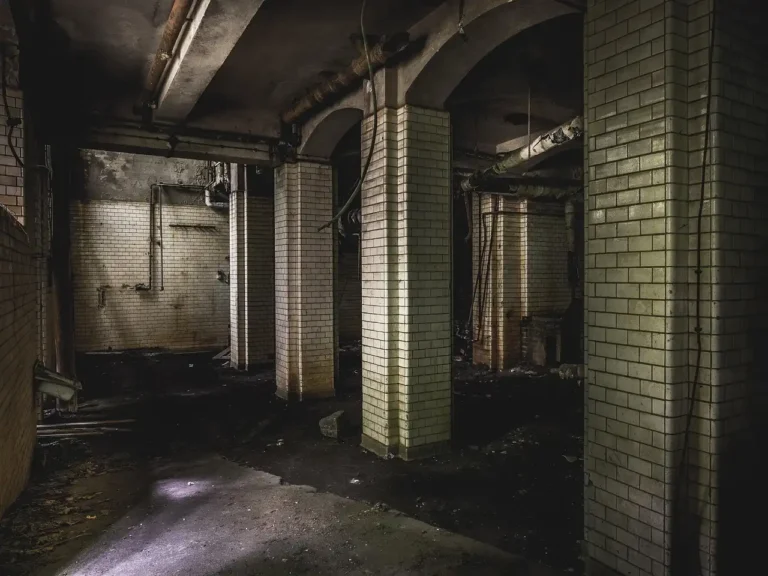
Basements often need more capacity because the air stays cooler and moisture can enter through concrete, walls, or floor joints. If the basement smells musty, shows condensation, or takes on water after rain, treat it as a high-load space. That usually points toward the 50- or 70-pint range, even when square footage looks modest.
Bathroom steam and laundry drying
Bathrooms and laundry areas create short but intense moisture spikes. A bathroom that is used daily without strong exhaust ventilation may need a larger unit than its floor area suggests. Laundry rooms with indoor drying are similar, especially if wet loads stay in the room for hours.
Cooking, occupancy, and ventilation
Cooking and occupancy add moisture too, though usually less than seepage or laundry. Poor ventilation matters because it traps that moisture in the room. If windows stay closed and airflow is weak, size up rather than trusting square footage alone.
Dehumidifier capacity chart
The table below gives a practical starting point for how to use a dehumidifier size chart. It combines room size, measured humidity, moisture source, and drainage setup so you can land on a final pint range instead of stopping at square footage alone.
| Room size band | Measured RH | Moisture source | Drainage setup | Recommended pint range |
|---|---|---|---|---|
| Under 300 sq ft | 30% to 50% | Light use, normal ventilation | Bucket is fine | 20 pints/day, about 9.5 L/day |
| Under 300 sq ft | Above 50% | Bathroom steam or laundry drying | Continuous drain preferred | 30 pints/day, about 14.2 L/day |
| 300 to 700 sq ft | 30% to 50% | General living space | Bucket or drain hose | 30 pints/day, about 14.2 L/day |
| 300 to 700 sq ft | Above 50% | Poor ventilation, repeated moisture | Continuous drain preferred | 50 pints/day, about 23.7 L/day |
| Over 700 sq ft | 30% to 50% | Open-plan area | Drain hose helpful | 50 pints/day, about 23.7 L/day |
| Over 700 sq ft | Above 50% | Basement seepage or heavy load | Continuous drain or pump | 70 pints/day, about 33.1 L/day |
These ranges are starting points, not universal rules. A room can move up a band if humidity stays high after doors are closed and the unit has run for several days. That is the failure case to watch for: the chart looked right, but the room still feels damp.
What size dehumidifier do you need for special cases?
Special cases often need more capacity than a basic room chart suggests. Damp basements, laundry rooms, and whole-house setups have continuous or repeated moisture loads. In those spaces, size for the moisture source first, then verify with room area and humidity reading.
Damp basements
For a damp basement, start with the next larger pint range if seepage, cold walls, or recurring condensation are present. A basement with seepage, cool walls, or recurring condensation may need about a 50-pint unit, or about 70 pints if the space is large or stays wet after storms. If the space is large or visibly wet after storms, 70 pints is a safer match.
Bathrooms and laundry rooms
Bathrooms and laundry areas can be small but still need strong capacity. If steam lingers after showers or wet laundry stays indoors, size up one band from the square footage chart. These rooms also benefit from continuous drain options because the moisture load appears often.
Whole-house use
For whole-house use, do not size from one room alone. Consider the total conditioned area, ventilation quality, and whether the unit will connect to ductwork or serve a central basement area. Portable units can support a whole house only when the layout is open and the moisture load is modest.
-
Start with room area.
Calculate square footage and find the matching band on the chart. Use that as the baseline instead of guessing from appearance. -
Check humidity level.
If the room is above 50% relative humidity, move up one size. If it is a basement with seepage or a laundry room with frequent wet loads, move up again if needed. -
Match the drain setup.
Choose a bucket only if someone can empty it often. For steady moisture, pick continuous drain or pump support so the unit can run long enough to matter.
A common first-timer mistake is choosing a 20-pint unit for a 12×12 basement bedroom because the floor area looks small. If humidity stays near 60% and the wall remains cool to the touch, that unit may run constantly without drying the space. A 30- or 50-pint unit is usually the better starting point.
How does drainage affect the size choice?
Drainage does not change the room’s moisture load, but it changes how practical the unit is in real use. A bucket works for low-load spaces or occasional use. Continuous drain and pump options matter more in basements and large-capacity units because they reduce overflow risk and let the unit run longer without interruption.
Bucket versus continuous drain
A bucket needs regular emptying. That is fine for a lightly damp room, but it can interrupt performance in a wetter space. Continuous drain sends water to a floor drain, sink, or condensate line, which is a better fit when the unit must run for many hours.
When a pump helps
A built-in pump helps when gravity drainage is not possible, such as a basement without a nearby floor drain. It can move water upward to a sink or out a window in some setups. That convenience matters most on higher-capacity units that collect water quickly.
Overflow prevention and runtime
Overflow protection is worth checking because a full bucket stops dehumidification until it is emptied. In high-load rooms, that pause can erase progress. A continuous drain or pump keeps runtime steady, which is often the difference between “sort of drier” and actual humidity control.
Frequently asked questions
How do you know what size dehumidifier to buy?
Start with square footage, then adjust for measured humidity and moisture source. A hygrometer reading above 50% relative humidity, plus basement seepage, laundry drying, or weak ventilation, usually means you should move up one pint band. Drainage choice matters too, because a bucket can limit runtime.
What size dehumidifier for a 12×12 room?
A 12×12 room is 144 square feet, which usually falls in the small-room range. If humidity stays near 30% to 50% and the room is lightly used, a common rule of thumb is that 20 pints per day is often enough. If the room is damp, lacks ventilation, or sits over a basement, move up to 30 pints.
Can a dehumidifier be too big for a room?
Yes. An oversized unit may short-cycle, remove moisture in bursts, and turn off before it runs long enough to balance the room evenly. That can reduce control and convenience. In a small, only mildly damp room, choose the lower size that still matches the humidity reading and moisture source.
What size dehumidifier do I need in liters or pints?
Use pints per day as the main sizing label, then convert if needed. A common conversion is about 0.47 liters per pint, so 20 pints is about 9.5 L/day, 30 pints is about 14.2 L/day, 50 pints is about 23.7 L/day, and 70 pints is about 33.1 L/day.
What size dehumidifier should I choose for a whole house?
Whole-house sizing depends on total area, layout, and whether the unit is portable or ducted. Open floor plans with moderate moisture may work with a large portable unit, often 50 pints or 70 pints. For connected rooms with ongoing humidity issues, a whole-home system is often the better match.
How do you use a dehumidifier size chart
Read the room-size band, then check whether the chart assumes dry, normal, or damp conditions. Use your measured relative humidity to adjust up if the room is above 50%, and move up again for basements, bathrooms, or laundry areas. The chart starts the choice; the moisture load finishes it.