Best Pet Hair Vacuum for Hardwood Floors
The best pet hair vacuum for hardwood floors is usually a canister or stick with a soft roller and sealed suction path. Choose brush-roll shutoff if you also clean rugs. Bad picks scatter dander, push hair into corners, and wrap fibers around the brush. This guide compares vacuum types by the problem they solve best: hair wrapping, edge pickup, and debris scatter.
Top pick for hardwood floors
A canister with a hard-floor nozzle is the safest starting point for pet owners who clean mostly bare floors. Consumer Reports says canister vacuums do a better job on bare floors than upright or stick vacuums, and that advantage matters most when pet hair gathers along baseboards, around chair legs, and in seams. (Consumerreports)
The best-fit design is a soft roller or hard-floor head, plus a hose and wand long enough to reach under furniture without dragging the main body across the floor. That setup pulls up surface hair without kicking it into a second pass across the room.
Quick picks
| Best for | Vacuum type | Key features | Why it fits |
|---|---|---|---|
| Heavy shedding and lots of edges | Canister | Hard-floor nozzle, hose and wand reach, corded runtime | Handles corners, furniture legs, vents, and baseboards well |
| Mixed flooring and rugs | Upright | Brushroll shutoff, head height adjustment, steady suction | Moves from hardwood to carpet without changing machines |
| Quick daily cleanup | Stick | Soft roller, light weight, short hair-wrap path | Good for fast pickups and small messes |
| Allergy control | Canister or upright with sealed filtration | HEPA filter, sealed suction path | Helps trap fine dander instead of redistributing it |
| Small spaces and stairs | Stick or handheld pairing | Crevice tool, dusting brush, low weight | Useful for trim, steps, and quick touch-ups |
Best for heavy shedding
Choose a canister with a hard-floor nozzle when hair builds up in seams, around vents, and along cabinet kick plates. The hose keeps the floorhead small and precise, which helps with edge pickup and lowers the chance of pushing fur into a corner.
Best for mixed flooring
Choose an upright with brushroll shutoff and height adjustment if the home switches often between hardwood and carpet. Popular Mechanics notes upright vacuums can work on hardwood if the brushroll can be turned off, which matters when you do not want stiff bristles to scratch a floor.
Best for quick cleanups
Choose a cordless stick for daily surface hair, crumbs, and light dander scatter. Good Housekeeping includes cordless sticks among the best hardwood vacuums, and that fits the use case: short sessions, fast setup, and easy storage.
What features matter most for pet hair on hardwood floors?
Brushroll shutoff, a soft floorhead, and a sealed suction path matter most. On hardwood, pet hair fails in three different ways: it wraps around the brush, slides past the edge of the nozzle, or gets blown into a wider trail of dander. The right design should address all three.
Brushroll shutoff and soft floorheads
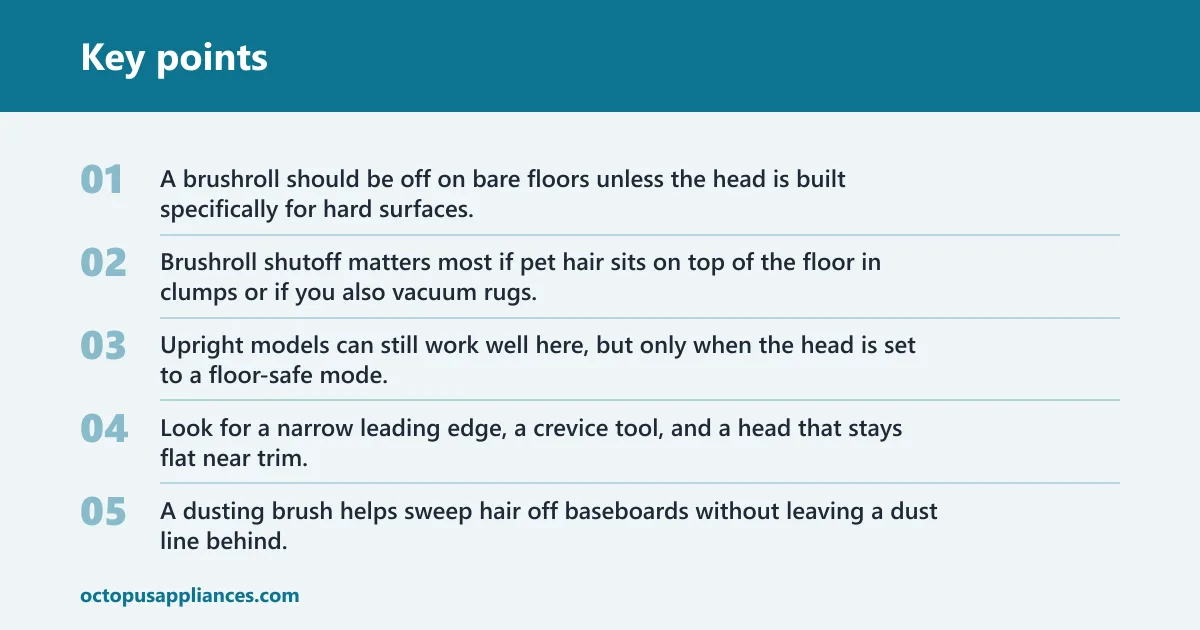
A brushroll should be off on bare floors unless the head is built specifically for hard surfaces. The same source says a stiff brush head may scratch hardwood floors, so look for a soft roller, felt strips, or a hard-floor head made for direct contact.
Brushroll shutoff matters most if pet hair sits on top of the floor in clumps or if you also vacuum rugs. Upright models can still work well here, but only when the head is set to a floor-safe mode.
Edge pickup, seams, and baseboards
Hardwood floors collect hair in places a wide floorhead misses: along baseboards, in expansion gaps, and around table legs. Look for a narrow leading edge, a crevice tool, and a head that stays flat near trim. A dusting brush helps sweep hair off baseboards without leaving a dust line behind.
Suppose a long-haired dog leaves a strip of fur beside the sofa and a trail around the radiator. A wide head may get the center of the pile but miss the border. A canister with a crevice tool and a hard-floor nozzle is better for that kind of cleanup.
HEPA filtration and filter maintenance
HEPA filtration helps capture fine particles, including dander, instead of recirculating them. Architectural Digest lists a hardwood pick with HEPA filtration, and that is a useful feature for homes where pet allergens matter. If the vacuum is sealed, it is more likely to keep fine dust inside the machine.
Check the maintenance interval for filters before you buy. A clogged filter can reduce suction consistency, which hurts pickup on seams and along edges. Replace or wash filters on the schedule the manufacturer gives, not only when suction drops.
Are cordless vacuums good for pet hair on hardwood floors?
Yes, cordless vacuums can be a good fit for hardwood pet hair if you want quick cleanup and can live with limited runtime. They work best on surface hair and daily maintenance, not on a house-wide shedding event or a deep clean around furniture legs, vents, and baseboards.
When cordless makes sense
A cordless stick makes sense in smaller homes, apartments, and rooms that need frequent touch-ups. The same source says one top hardwood pick runs up to 60 minutes, which is enough for many maintenance passes if the floorhead stays clear and the battery is healthy.
Good Housekeeping also includes cordless sticks among the best hardwood vacuums. That said, the right use case is quick pickup, not long sessions across multiple rooms with heavy shedding.
Where runtime becomes the limit
Runtime matters more when you clean slowly around furniture, rugs, and pet beds. If the vacuum needs repeated boosts or a second battery to finish the house, the convenience gap closes fast. A corded canister often wins when the goal is one full cleaning pass without stopping.
What hair-wrap maintenance to expect
Hair-wrap risk still exists on cordless machines, especially with long dog hair and cat hair. Check the roller design, because a narrow or aggressively bristled head can trap strands quickly. If you see hair winding around the brush after every session, that model is working against the problem you bought it for.
Should you buy a canister, stick, or upright vacuum?
Pick the format based on where the pet hair lands and how often you clean. Canisters usually win on edges and corners, uprights make sense for mixed flooring, and sticks fit quick cleanup. The best choice is the one that matches your shedding level, room size, and maintenance habits.
Canister vacuums
Canisters are strong on hardwood because the nozzle stays light and precise while the motor stays out of the way. That helps with maneuverability around furniture legs, under chairs, and beside baseboards. The same source says canisters do a better job on bare floors than uprights or sticks, which matches their floor contact and reach.
They are often the best answer for homes with large open rooms, lots of trim, or pet hair that collects in corners. The hose and wand make it easier to clean vents and stairs without carrying a heavy body from room to room.
Upright vacuums
Uprights are a smart buy when you need one vacuum for carpets and hardwood. The key is brushroll shutoff, plus height adjustment so the head does not drag or bounce. The same source notes the Miele Complete C3 Marin has a brush on/off switch, which is the kind of control upright users should look for.
Weight and storage matter too. An upright can be easier to keep ready in a closet, but it may be less nimble than a canister around chair legs and pet beds.
Stick vacuums
Sticks are the best quick-clean option when the mess is light and frequent. They are easy to grab, easy to store, and useful for daily surface hair. The tradeoff is clear: less runtime, smaller bins, and more frequent brush maintenance than a corded machine.
Best canister vacuum for pet hair on hardwood floors
A canister is the best format when pet hair is spreading along edges, collecting under furniture, or drifting toward vents. It gives you better reach and more control at the nozzle, which matters more on hardwood than raw suction alone.
Why canisters handle edges and corners well
The floorhead is lighter and easier to steer into narrow spaces. That improves pickup along baseboards and around furniture legs, where pet hair tends to hide. The hose also lets you pause at a stubborn patch without lifting the whole machine.
What to look for in the nozzle and wand
Look for a hard-floor nozzle with soft bristles or felt strips, plus a crevice tool and dusting brush. A soft head is safer on hardwood, while the crevice tool reaches the seams where fur packs in. A dusting brush is useful for trim and low ledges where dander settles.
Good Housekeeping identifies the Bissell Hard Floor Expert Canister Vacuum at about $236.98, which is a useful reference point if you want a lower-cost canister category pick without moving into premium pricing. For allergy control, a sealed design with HEPA filtration is worth considering.
Best fit for larger homes
Choose a canister if the home has multiple rooms, open sight lines, and a lot of boundary cleanup. Corded runtime is an advantage here because you can keep working without watching a battery gauge. That is especially useful after a heavy shedding day.
Best upright vacuum for pet hair on hardwood floors
An upright is the better buy when you need one machine for rugs and hard floors, and you want brush control rather than a separate floor tool. It is not the default winner for bare floors, but it can be the right compromise in mixed-floor homes.
Why brushroll shutoff matters
Brushroll shutoff prevents stiff bristles from scattering debris or scrubbing a finish more than needed. The same source says an upright can work on hardwood if the brushroll can be turned off. That single feature changes the machine from risky to workable on bare floors.
Height adjustment and suction consistency
Head height adjustment helps the nozzle sit flat on different surfaces. Suction consistency matters because pet hair on seams and at transitions needs steady airflow, not a head that stalls when it reaches a rug edge. A machine that holds suction better is easier to use across rooms with mixed flooring.
When an upright is the better buy
Choose an upright if you have area rugs, runners, and hardwood in the same path of travel. If you want one vacuum for the whole house and you are willing to check the brushroll setting before each pass, it can be practical and efficient.
Hardwood pet hair decision matrix
Use this matrix to match the mess to the machine. It is designed for pet owners deciding between canister, upright, and stick vacuums based on shedding level, room size, flooring mix, and how much hair-wrap maintenance they want to deal with.
| Shedding level | Home size | Mixed flooring | Hair-wrap risk | Preferred floorhead | Runtime needs | Best use case | Avoid if |
|---|---|---|---|---|---|---|---|
| Heavy | Large | Light to moderate | High | Hard-floor nozzle | Unlimited corded runtime | Canister for full-house cleaning, corners, and baseboards | Avoid if you want the lightest possible lift for stairs only |
| Heavy | Medium | High | Moderate | Upright head with shutoff | Long sessions across rugs and hardwood | One-vacuum solution for carpets plus hard floors | Avoid if the brushroll cannot be shut off |
| Light to moderate | Small | Low | Low to moderate | Soft roller | Short daily sessions | Cordless stick for fast pickup and storage | Avoid if you need one charge for a whole-house deep clean |
| Moderate | Large | High | Moderate to high | Canister hard-floor nozzle | Unlimited corded runtime | Detailed cleaning around furniture legs, vents, and trim | Avoid if you want a grab-and-go machine only |
| Light | Apartment | Low | Low | Soft roller | 20 to 60 minutes of practical use, depending on model | Quick cleanup of visible fur and dust | Avoid if you regularly clean up large shedding piles |
Scenario examples
Say your golden retriever sheds heavily across a roughly 1,600-square-foot home with hardwood and a couple of area rugs. A canister with a hard-floor nozzle and brushroll control is the safer fit, because it can clear the edges first and then move to the rugs without changing tools.
Suppose a cat leaves fine hair along kitchen baseboards in a roughly 700-square-foot apartment. A cordless stick may be enough if the goal is about a 10-minute daily sweep, but a narrow crevice tool will matter more than extra suction in the middle of the room.
How to choose
Start with the failure mode, not the brand. If the problem is hair wrapping, choose a floorhead with less aggressive bristles and an easy-clean roller. If the problem is edge pickup, prioritize a canister or a vacuum with a narrow hard-floor head. If the problem is dander scatter, choose sealed filtration and a path that keeps debris inside the machine.
Then check the floor mix. A canister usually wins on hardwood only. An upright makes sense when rugs are part of the same route. A stick fits quick cleanup, but runtime and bin size can turn it into a maintenance tool rather than a deep-cleaner.
- Match the mess first. Heavy shedding and corner buildup point to a canister. Light daily fur points to a stick. Mixed flooring points to an upright with brushroll shutoff.
- Check the floorhead. Look for a soft roller, felt strips, or a hard-floor nozzle. Avoid stiff brush heads on bare wood, especially if the vacuum will cross seams and finish transitions often.
- Verify the controls. Confirm brushroll shutoff on uprights and see whether suction stays consistent as the bin fills. If the machine has floor-type sensors, they can adjust brush speed automatically and make transitions easier.
- Confirm the filtration. If allergies matter, look for HEPA filtration and a sealed suction path when available. Replace or clean filters on the stated interval so fine dust does not reduce performance.
- Choose the attachments. A crevice tool handles edges, a dusting brush handles baseboards, and a hard-floor attachment handles pet hair on stairs and trim. Those pieces matter more than many buyers expect.
Frequently asked questions
What is the best vacuum for pet hair on hardwood floors?
The best vacuum is usually a canister or a stick with a soft roller and a sealed suction path. If you also clean rugs, choose brushroll shutoff. That setup handles surface hair, edge pickup, and dander scatter better than a stiff-brush design on bare wood.
Do I need a vacuum with a brushroll shutoff for hardwood floors?
If the vacuum has a brushroll, shutoff is strongly preferred on hardwood. It lowers the risk of scratching and keeps hair from flinging forward. The same source says upright vacuums can work on hardwood if the brushroll can be turned off, which is the key detail to check.
Should I buy a canister, stick, or upright vacuum for hardwood and pet hair?
Choose a canister for heavy shedding, corners, and baseboards. Choose an upright if you need one machine for rugs and hardwood and it has brushroll shutoff. Choose a stick if you mainly want fast daily pickup and have modest shedding. The best choice depends on where the hair collects most.
Can a cheap vacuum still work well for pet hair and hardwood floors?
Yes, if it has the right floorhead and does not scatter hair. A lower-cost model can still work on hardwood when it includes brushroll shutoff, a hard-floor nozzle, or a soft roller. The risk is usually weaker edge pickup, poorer filtration, or more hair-wrap cleanup over time.