Why Is My AC Not Cooling to the Set Temp at Home?
If your AC runs but the house will not reach the set temperature, the cause is usually one of three things: lost cooling capacity, bad temperature sensing or control, or airflow that is too weak to move enough cooled air. Ignoring it can waste power, increase wear on the system, and let a small fault become a major repair. This guide shows how to tell which of those three is most likely and what to check first.
A unit can run constantly and still miss the target when the cooling load is higher than the system can handle, when the thermostat is reading the wrong area, or when air cannot move freely through the system. That is why the same symptom can point to an airflow issue, a control issue, or a true equipment fault.
Why your AC misses the set temp
AC cooling diagnosis table
| Symptom pattern | Most likely cause | Simple homeowner check | Escalation threshold |
|---|---|---|---|
| Runs continuously but never reaches set temp | Capacity problem, low refrigerant, dirty condenser coils, or a weak compressor | Check the filter, outdoor coil, and whether the outdoor fan is running; compare indoor temp drop with the thermostat target | Call for service if the system runs for hours with clean filters and normal settings, or if ice, loud noises, or short cycling appear. |
| Cycles normally but house feels humid | Airflow problem, oversized system, or control issue that ends cooling too soon | Check filter condition, fan setting, and whether supply vents are blocked; note whether the thermostat is near a kitchen, sunny wall, or supply register | Schedule service if humidity stays high after basic airflow checks and thermostat placement looks correct |
| Some rooms stay warm | Duct leaks, duct imbalance, or weak blower output | Compare room-by-room airflow at the registers and look for disconnected or damaged ducts in accessible areas | Call an HVAC pro if several rooms are consistently warmer than the rest of the house |
| Temperature drops at night but not midday | Extreme heat load, strong sun, or an undersized system for the current conditions | Compare outdoor temperature, sun exposure, and indoor heat gains during the hottest part of the day | Get a load and system check if the set temp is only missed during the hottest hours |
| Thermostat says cool but supply air is weak | Blower motor issue, clogged filter, evaporator coil problem, or electrical fault | Hold a tissue at a supply vent to judge airflow, then inspect the filter and listen for the indoor fan | Stop troubleshooting and schedule service if airflow is weak across multiple vents. |
That table separates three broad paths. A capacity problem means the system is running but cannot beat the load. A control problem means the AC may be cooling the wrong area or reading the room poorly. An airflow problem means the cold air is made, but too little of it reaches the rooms that need it.
What the three failure paths look like
Capacity problem. The AC may be sized well for mild weather and still lose the race during strong sun, high humidity, or a heat wave. In that case, the system can run almost nonstop and still leave the home a few degrees above the setpoint.
Control problem. The thermostat can be accurate in one spot and wrong in another. If it sits near a return grille, a sunny wall, a lamp, a kitchen, or a supply vent, it may stop the system too early or keep asking for cooling when the house already feels uneven.
Airflow problem. Dirty filters, weak blowers, iced evaporator coils, or duct leaks can reduce the amount of cooled air reaching the rooms. The AC may still blow cold at the register, yet the house as a whole stays warm.
Thermostat checks
Thermostat problems are a common reason an AC seems to miss the target. Placement, calibration, and settings can all create a mismatch between what the thermostat thinks the house needs and what the rooms actually need.
-
Check thermostat placement.
Look for direct sun, lamps, appliances, supply vents, or a warm wall nearby. Even a small heat source can bias the reading and make the system shut off too early or run too long. -
Confirm the settings.
Make sure the system is set to cool, the fan is not locked on in a way that confuses room feel, and the target temperature is not unrealistically low for the outside conditions. A large gap between indoor and outdoor temperatures increases runtime. -
Compare with a separate thermometer.
Put a simple room thermometer near the thermostat, away from windows and vents, and compare the readings after the system has run for at least 15 minutes. A noticeable difference points to a sensing or placement issue.
Suppose the thermostat is set to 72 degrees, but the wall it sits on gets afternoon sun and reads warmer than the rest of the hall. The AC may keep running because the sensor sees a hot spot, even though the occupied rooms are already near the target.
What to check inside the house
Inside the home, start with the parts that affect air delivery. A dirty or clogged air filter, weak blower motor, or duct leakage can all make the system look underpowered even when the refrigeration side is still working.
-
Inspect the air filter.
Pull the filter and hold it to the light. If light does not pass through easily or the media is loaded with dust, replace it right away. A clogged filter restricts airflow and can also contribute to evaporator coil icing. -
Check supply vents.
Make sure furniture, rugs, and curtains are not blocking the registers. Open dampers on closed-off branches and note whether one room has much weaker airflow than the others. -
Listen for the blower.
The indoor blower motor should move a steady stream of air. If airflow is weak, uneven, or noisy, the motor, capacitor, control board, or wheel may need service. -
Look for duct losses.
In accessible attic, crawlspace, or basement sections, check for disconnected ducts, obvious tears, crushed flex runs, or loose joints. Air leaks can leave some rooms warm even when the air leaving the coil is cool.
Air leakage is not always dramatic. A small gap in the duct path can still steal enough delivery to keep the farthest rooms from reaching the thermostat setting, especially during peak heat.
What to check outside
The outdoor section handles heat rejection. If the condenser coils are blocked by dirt, leaves, lint, or grass clippings, the system cannot release heat well and cooling drops. The compressor and electrical system also live here or connect here, so problems outside can stop the system from reaching setpoint.
-
Clear the outdoor unit.
Remove leaves, weeds, and debris from around the condenser. Leave enough open space for air movement on all sides so the outdoor fan can push heat away from the coil. -
Inspect the condenser coils.
Look for matted dirt, cottonwood, or grease on the coil surface. Dirty coils reduce heat transfer, and improper cleaning may not solve the issue if the coil is damaged or bent. -
Watch the compressor behavior.
The compressor is part of the outdoor equipment and changes refrigerant pressure so the system can cool. If the unit hums, trips off, struggles to start, or cools poorly despite clean filters and coils, the compressor may need a pro-level diagnosis. -
Check for electrical trouble.
Look for a tripped breaker, a shutdown disconnect, or repeated reset behavior. Electrical issues can affect the outdoor fan, compressor, contactor, or control wiring, and those faults often need a licensed technician.
Low refrigerant is another common cause of inadequate cooling. It is not a homeowner fix, and it usually means there is a leak or another sealed-system issue that requires licensed repair. If the evaporator coil is icing, or if the AC runs for long periods with weak cooling, low charge is one possible cause.
A common first-timer mistake is to clean the outdoor cabinet but ignore the coil fins. The cabinet can look fine while the heat-transfer surface remains packed with dirt. That is why the coil itself matters more than the visible shell.
Why is my AC not cooling the house to set temperature?
Your AC may miss the set temperature because it has less cooling capacity than the home currently needs, because the thermostat is reading the wrong spot, or because airflow is restricted. The key distinction is whether the unit is failing mechanically or simply facing a heavier cooling load than it can beat during the day.
Start by deciding where the symptom shows up. If the whole house stays above the target, think capacity, refrigerant, compressor, or major airflow loss. If only one room stays warm, the problem is more likely ductwork or balancing. If the thermostat seems satisfied too soon, look at placement and calibration first.
Common load conditions that can overwhelm the system
Extreme outdoor heat, strong direct sun, poor insulation, open doors, cooking, many occupants, and high indoor humidity all increase the load on the AC. On very hot afternoons, it is normal for a system to run longer than it does at night. A house that cools after sunset may still be under control, just overmatched at peak heat.
That does not mean every midday miss is normal. If the setpoint is usually reached at night but never during the day, the home may be exposing a capacity limit. If the temperature falls only when outdoor conditions ease, the issue may be load rather than a major failure.
Why does my AC run constantly but never satisfy the thermostat?
Constant runtime with no setpoint satisfaction usually points to one of three things: the AC has lost cooling capacity, the thermostat is sensing the wrong temperature, or airflow is too weak to deliver enough cooled air. That pattern is more concerning than a short miss, because the system is working hard without getting the job done.
Check the filter first, then the outdoor coil, then the thermostat location. If all of those are acceptable and the house still will not cool, the next suspects are low refrigerant, compressor trouble, duct losses, or a blower motor that cannot move enough air. At that point, service is the right next step.
When continuous runtime is still not enough
Continuous runtime does not prove the AC is healthy. A compressor can run while producing weak cooling, a dirty evaporator coil can limit heat absorption, and a clogged filter can choke airflow enough to keep supply air weak. The thermostat may keep calling because the room never reaches the target.
If the system runs for hours, the filter is clean, and the supply air is still barely cooler than room air, the fault is beyond basic maintenance. That is especially true if the outdoor unit is noisy, short cycling, or frosting over.
Could a dirty filter keep my AC from reaching set temp?
Yes. A dirty or clogged air filter can reduce airflow enough to keep the system from reaching the set temperature, especially on hotter days. It can also cause the evaporator coil to get too cold and ice up, which cuts cooling even further.
The fix is simple: replace the filter if it is visibly dirty or overdue. If the new filter helps for a short time and the system still struggles, the filter was part of the problem, not the only one. Weak blower output or duct leakage can still limit delivery.
When does an AC not reaching set temp mean compressor trouble?
Compressor trouble becomes more likely when the system runs, the outdoor unit seems active, but cooling is weak, erratic, or absent despite clean filters and clear coils. The compressor is the outdoor component that changes refrigerant pressure, so a failure there can stop the system from moving heat properly.
Signs that point toward compressor trouble include hard starting, loud mechanical noise, repeated shutdowns, or a system that no longer cools after other simple checks look normal. This is not a DIY repair. A licensed HVAC pro should diagnose it, along with refrigerant and electrical issues that can mimic compressor failure.
When cooling load is the real issue
Sometimes the AC is working, but the house is asking for more cooling than the system can supply at that moment. Midday sun, hot attic spaces, high humidity, and an unusually high indoor load can keep the home above set temperature even while the system runs correctly.
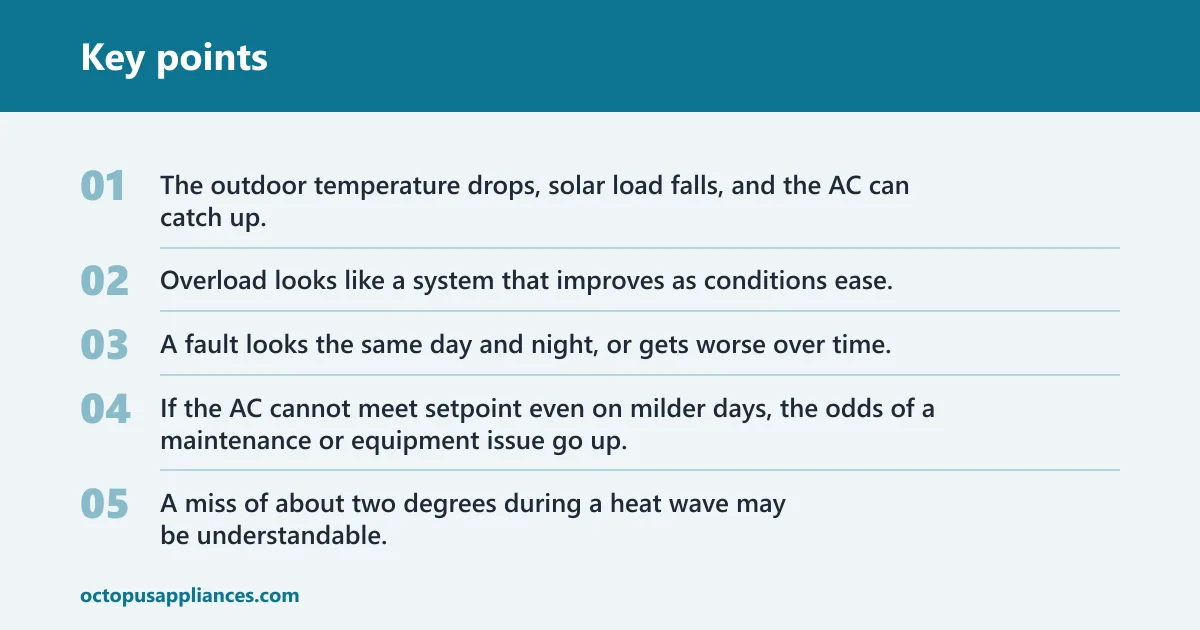
That is why a house may cool better at night. The outdoor temperature drops, solar load falls, and the AC can catch up. If the setpoint is only missed during the hottest hours, the problem may be normal capacity limits rather than a broken part.
How to tell overload from a fault
Overload looks like a system that improves as conditions ease. A fault looks the same day and night, or gets worse over time. If the AC cannot meet setpoint even on milder days, the odds of a maintenance or equipment issue go up.
Use the pattern, not just the number. A miss of about two degrees during a heat wave may be understandable. A miss of about five degrees on a mild day, especially with weak airflow or frost, needs service.
What to check before you schedule service
Use a simple order so you do not miss the easy fixes. Start with the indoor air path, then move to the outdoor unit, then look at the thermostat. That approach catches many homeowner-level causes before you pay for a truck roll.
-
Replace the air filter.
Install a clean filter of the correct size and orientation. This is the fastest way to remove a common airflow restriction. -
Verify thermostat settings.
Confirm cool mode, a reasonable set temperature, and a stable location away from heat sources. Compare the thermostat reading with a separate room thermometer. -
Inspect vents and ducts.
Open blocked registers, check visible ducts for damage, and note any room that stays warm while others cool normally. -
Clean the outdoor area.
Remove debris around the condenser and look through the coil fins for dirt buildup. The outdoor unit needs clear air to release heat. -
Watch for warning signs.
Ice on the indoor coil, repeated breaker trips, loud compressor noise, or very weak airflow mean the issue is beyond routine maintenance.
Regular maintenance helps prevent many of these problems. Clean condenser coils twice a season, ideally in spring and fall. If cleaning is done incorrectly, it may not solve the issue and can sometimes make diagnosis harder, so severe buildup or damaged fins are better left to a pro.
Should you call a pro if your AC is blowing cool air but the house stays warm? Yes, if the basic checks do not explain it. When cool air is present at the register but the house still will not reach setpoint, the problem may be duct leakage, low refrigerant, a weak compressor, or a control issue that needs HVAC service.
Frequently asked questions
Why is my ac not cooling my house to set temperature?
That usually means the AC is losing capacity, the thermostat is reading the wrong area, or airflow is too weak to move enough cooled air. Start with the filter, thermostat placement, and outdoor coil. If the system still misses the target after those checks, the issue may be refrigerant, compressor, ductwork, or electrical.
Why won’t my ac reach the set temperature
If the AC will not reach the set temperature, compare whole-house behavior with room-by-room airflow. A single warm room points toward ducts or balancing, while a whole-house miss points toward capacity, refrigerant, coils, or controls. Hot sun, high humidity, and poor insulation can also make the target harder to reach.
Why is my air conditioner not cooling the house?
An air conditioner can fail to cool the house because of a dirty filter, blocked condenser coils, thermostat issues, duct leaks, low refrigerant, or compressor trouble. The key is to identify whether the fault is in control, airflow, or the refrigeration system before assuming the unit has failed completely.
Why is my AC not cooling below the thermostat setting?
If the AC will not cool below the thermostat setting, the thermostat itself may be misreading the room, or the system may be running at its limit. Poor placement, calibration drift, and nearby heat sources can all distort the reading. If the indoor air is weak or uneven, airflow and duct losses may be part of the problem too.
Is low refrigerant why my AC cannot cool enough?
Low refrigerant can absolutely cause inadequate cooling, but it is not something you can confirm by looking at the unit alone. It usually requires licensed repair because the system may have a leak or another sealed-system fault. If the AC runs continuously and cooling remains poor, refrigerant should be on the short list.
Should I call a pro if my AC is blowing cool air but the house stays warm?
Yes, if the basic checks do not explain the gap between cool supply air and a warm house. That pattern often points to duct leaks, airflow loss, low refrigerant, or a compressor issue. If the thermostat is fine and the filter is clean, professional diagnosis is the safest next step.