Robot Vacuum vs Cordless Vacuum: Which Should You Buy?

Buy a robot vacuum first if daily dust and pet hair are the main problem and you want floor care that runs on its own; buy a cordless vacuum first if you need quick spot cleaning, stairs, cars, or mixed surfaces. Choosing by specs alone often leaves the most common mess unsolved. This guide compares cleaning reach, time savings, upkeep, floor types, and budgets so you can pick the first vacuum that fits your home.
| Decision factor | Robot vacuum | cordless vacuum | Winner |
|---|---|---|---|
| Daily maintenance | Runs fully autonomously and automatically; some models can follow a schedule. | Requires manual handling, but you control the exact area and timing. | Robot vacuum |
| Incident cleanup | Better for a planned pass, not for sudden spills or one-room messes. | Best for quick spills, crumbs, and small messes that need immediate cleanup. | cordless vacuum |
| Stairs and upholstery | Cannot climb stairs and has limited reach on furniture. | Lightweight portability and handheld conversion make stairs and upholstery easier. | cordless vacuum |
| Floor prep and clutter tolerance | Needs cord management, toy pickup, and fewer threshold problems. | Works with clutter because you move it around obstacles. | cordless vacuum |
| Total ownership cost | Can start around $200, but self-emptying docks, filters, and dock space add cost. | Usually fewer accessories and less dock space, though batteries and filters still matter. | cordless vacuum |
| Hands-off use | Can charge itself and keep cleaning with scheduling and app control. | Stops when the battery runs out and needs you to restart it. | Robot vacuum |
Automation vs reach
The core trade-off is automation versus reach. A robot vacuum keeps floors on a schedule with little input, while a cordless vacuum gives you speed, reach, and control for stairs, furniture, cars, and odd corners. Pick the one that solves your most common mess first.
Daily maintenance versus incident cleanup
A robot vacuum fits routine dust, crumbs, and pet hair on open floors. A cordless vacuum fits a spilled cereal bowl, tracked-in dirt at the door, or a sofa that needs a quick pass before guests arrive.
Room prep changes the job
Robot vacuums generally work better after you remove cords, small toys, and other loose items that can snag brushes or block navigation. Cordless vacuums need less prep because you steer them around trouble spots and lift the nozzle when needed.
Floor plan matters more than sticker price
An open, low-clutter floor plan usually favors a robot vacuum. A home with stairs, tight furniture gaps, mixed surfaces, and frequent spot cleanups usually favors a cordless vacuum first.
2-minute chooser
If you want a fast answer, use this rule: choose a robot vacuum if you mostly want daily floor upkeep on open rooms and can keep floors fairly clear; choose a cordless vacuum if your cleaning is usually small, immediate, and spread across stairs, furniture, and different surfaces. If your home has both jobs in equal measure, start with the one you will use three or more times each week.
Check your most common mess. If it is dust, pet hair, and crumbs that return every day, lean robot vacuum. If it is spills, stairs, couch debris, and car cleanup, lean cordless vacuum.
Measure your prep tolerance. Robot cleaning works best when you are willing to pick up cords, toys, and loose laundry before it starts. If that sounds like a burden, cordless is the safer first buy.
Match the floor plan. Large open rooms and simple transitions favor robot automation. Mixed flooring, thresholds, and multilevel homes favor manual reach.
Robot and cordless vacuum comparison matrix
Use this matrix as a buying filter, not a feature checklist. The right answer changes with the task, and the same home can favor each vacuum type in different rooms.
| Scenario | Robot vacuum | cordless vacuum | Buy first |
|---|---|---|---|
| Daily crumbs | Good for scheduled upkeep on open floors. | Faster if you want one pass right now. | Robot vacuum |
| Pet hair | Strong for repeat pickup if the floor stays clear. | Stronger for furniture, corners, and full-room resets. | cordless vacuum |
| Stairs | Not suitable for carrying cleaning power up and down stairs. | Designed for moving with you between levels. | cordless vacuum |
| Upholstery | Limited use on furniture surfaces. | Handheld conversion makes seats, cushions, and fabric easier. | cordless vacuum |
| Under-sofa access | Can reach low furniture if clearance and mapping are good. | Can reach with attachments, but not as hands-off. | Robot vacuum |
| Quick spills | Too slow for most fresh spills. | Best for immediate spot cleanup. | cordless vacuum |
| Mixed flooring | Works well when transitions are simple and thresholds are modest. | Easy to move from hardwood to carpet to rugs. | cordless vacuum |
| Clutter tolerance | Needs a floor that is ready before each run. | Handles clutter better because you direct the path. | cordless vacuum |
| Maintenance burden | Lower day-to-day effort, higher prep and dock upkeep. | More hands-on work, but less floor prep. | Robot vacuum |
| Total ownership cost | Higher once you add docking, filters, and optional self-emptying base stations. | Usually lower to start and simpler to maintain. | cordless vacuum |
How a robot vacuum fits everyday cleaning
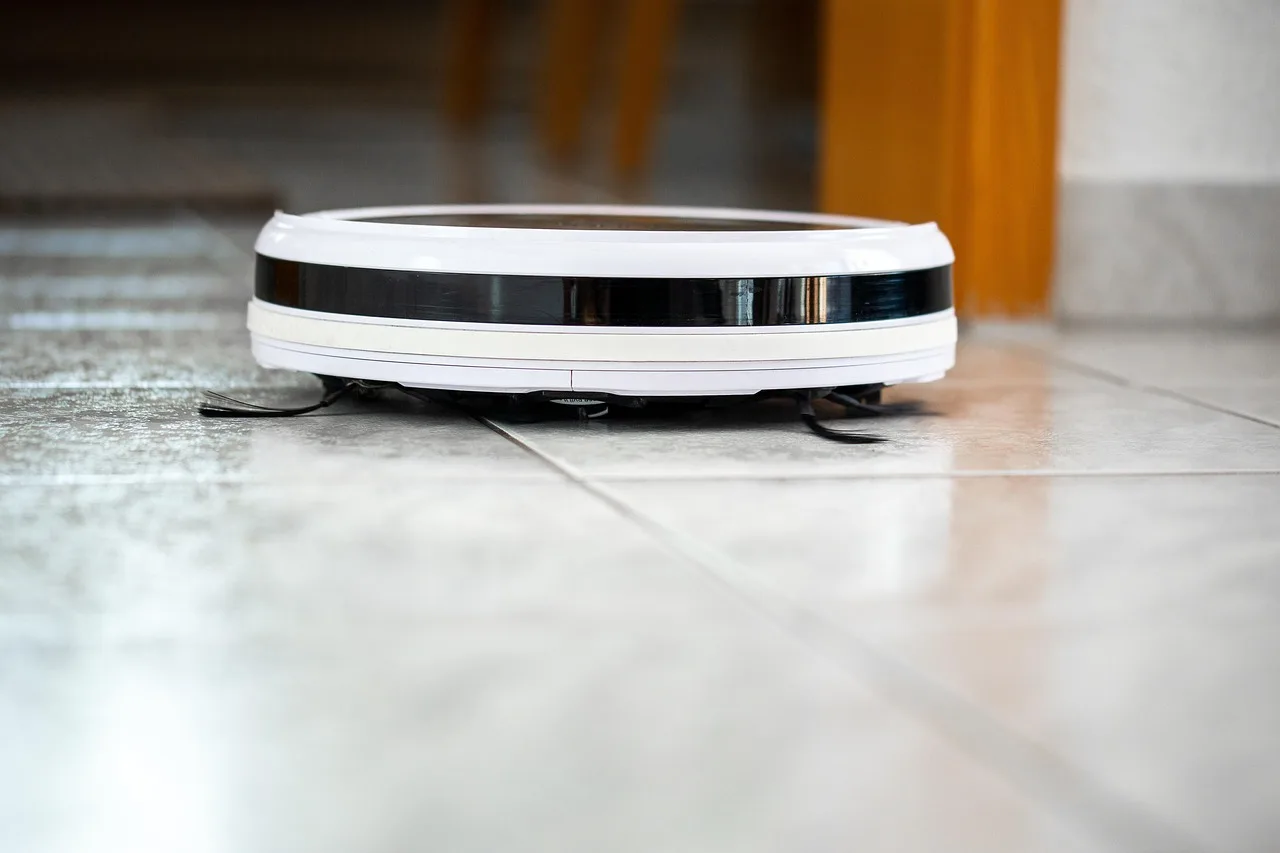
A robot vacuum is built for autonomous floor cleaning. It can charge itself in a dock, follow a mapped route, and in some cases run on a schedule or connect to a smartphone or smart home device. That makes it a fit for repeat upkeep, especially on hard floors and low-pile carpet.
Mapping, scheduling, and self-charging docks
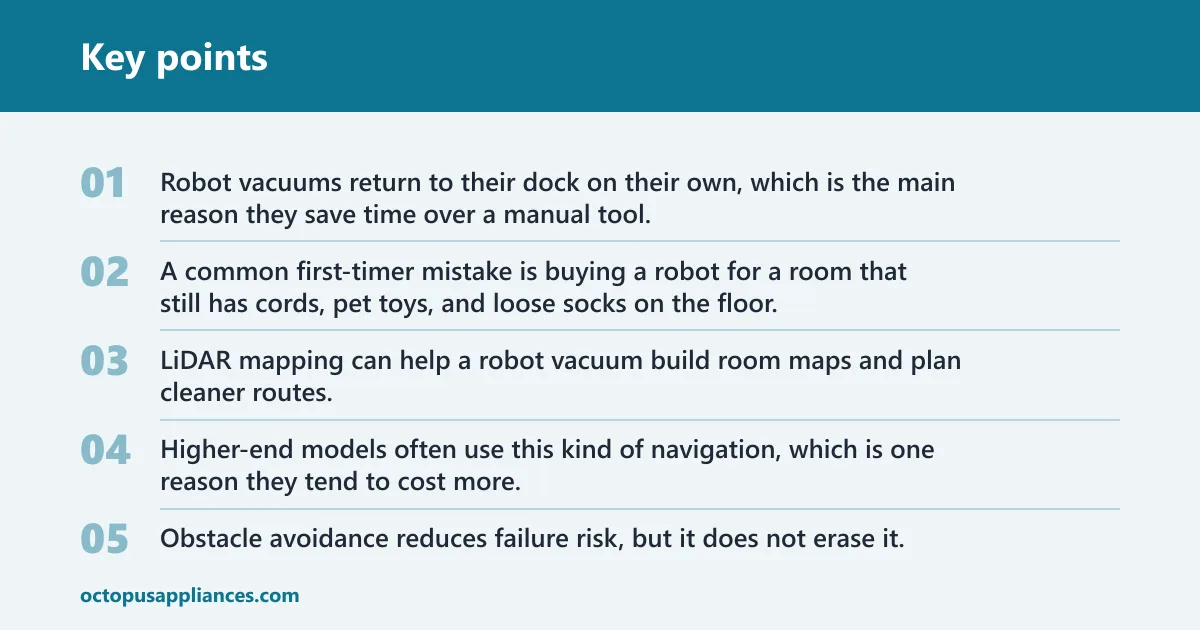
Robot vacuums return to their dock on their own, which is the main reason they save time over a manual tool. Some robot vacuums can be programmed with a cleaning schedule, so the floor gets attention even when you are not actively thinking about it.
A common first-timer mistake is buying a robot for a room that still has cords, pet toys, and loose socks on the floor. In about a 400-square-foot living area, that prep can take longer than the cleaning run itself if the space is not kept tidy.
LiDAR mapping and obstacle avoidance
LiDAR mapping can help a robot vacuum build room maps and plan cleaner routes. That matters in homes with furniture islands, multiple rooms, and repeated paths, because the robot can move with less wandering. Higher-end models often use this kind of navigation, which is one reason they tend to cost more.
Obstacle avoidance reduces failure risk, but it does not erase it. Cords, toys, thick thresholds, and some pet messes still create trouble. Some robot vacuums can detect and avoid solid pet waste, which matters in pet-heavy homes, but that feature is not universal.
Self-emptying base stations
A self-emptying base station can reduce how often you need to empty the robot’s dustbin, depending on the model and how much dirt it collects. That can stretch hands-off use for weeks or months, depending on the model and how much dirt it collects. The trade-off is extra cost and extra floor space near the dock.
For apartments, the footprint can matter as much as the feature itself. For busy households, the lower emptying frequency can be worth the added dock size if the robot is used every day.
How a cordless vacuum fits fast cleanups
A cordless vacuum is a manual cleanup tool with finite battery runtime and lightweight portability. It is usually faster for room-by-room cleaning, easier on stairs, and more useful on upholstery, cars, and awkward corners. The benefit is control: you decide where it goes and what gets cleaned first.
Battery runtime and cleaning mode
Battery runtime is limited, and cleaning mode changes the result. Robot vacuum batteries often last between 120 and 180 minutes on average, but runtime can drop to about 60 minutes on thick carpet. A cordless vacuum may be done cleaning in about an hour, depending on room size.
That difference matters less if you only need one kitchen pass and more if you want to clean several rooms in one session. On carpet, runtime shrinks faster because the motor works harder.
Stairs, upholstery, cars, and handheld use
Cordless vacuums usually convert to a handheld format, which makes them better for stairs, car interiors, and furniture. They are also faster when you need to clear one chair, one landing, or one corner without setting up a full cleaning cycle.
If your home has a basement, a second floor, or both, cordless portability often matters more than automated scheduling. Carrying a robot vacuum between floors is not the same as using it across them.
Which vacuum works better in your home?
The best pick depends on home type. A robot vacuum wins when the floor is mostly open and you want repeat upkeep. A cordless vacuum wins when the mess moves around, the house has stairs, or you need one tool that can jump from floor to furniture to car.
Apartment or smaller home
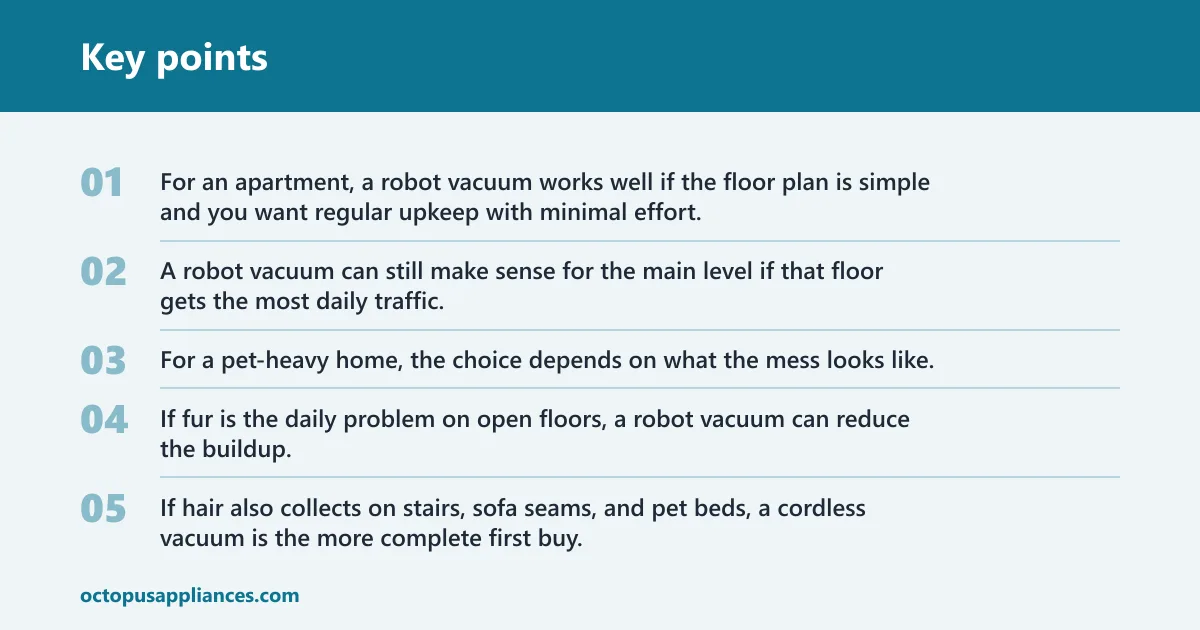
For an apartment, a robot vacuum works well if the floor plan is simple and you want regular upkeep with minimal effort. A cordless vacuum is the better first buy if storage is tight, clutter is common, or you need one tool for both the main floor and furniture.
Multi-level home
For a multi-level home, a cordless vacuum usually wins first because it handles stairs and separate levels without the need to move a dock or rely on one machine staying on one floor. A robot vacuum can still make sense for the main level if that floor gets the most daily traffic.
Pet-heavy home
For a pet-heavy home, the choice depends on what the mess looks like. If fur is the daily problem on open floors, a robot vacuum can reduce the buildup. If hair also collects on stairs, sofa seams, and pet beds, a cordless vacuum is the more complete first buy.
Mobility-limited household
For a mobility-limited household, a robot vacuum can be the better first purchase because it reduces the need to push a vacuum around every day. A self-emptying base station can help even more by lowering how often the bin needs attention.
At the same time, a cordless vacuum can still be useful if someone needs a lightweight way to reach a spill, a rug edge, or a chair. In that case, the robot covers routine floor work and the cordless unit handles exceptions.
Choose robot vacuum if… / Choose cordless vacuum if…
Choose Robot vacuum if your main job is routine floor upkeep, your rooms are fairly open, and you can keep cords and small objects out of the way. It is the better first buy for daily dust, repeat pet hair pickup on floors, and homes where automation saves more time than manual control.
Choose cordless vacuum if your main job is fast cleanup, stairs, upholstery, cars, or mixed surfaces that need immediate attention. It is also the safer first buy if your home has more clutter, more thresholds, or more incident cleanup than scheduled floor maintenance.
Buy both only when one tool would leave a major gap. A common pair is a robot vacuum for daily upkeep on the main floor and a cordless vacuum for stairs, furniture, and quick spills.
Choose robot vacuum or cordless vacuum first
Buy robot vacuum first if you want the floor to stay cleaner with less daily effort and your biggest mess is repeat dust or pet hair on open floors. Buy cordless vacuum first if your highest-value win is speed, reach, and handling the jobs that happen away from the floor.
Daily maintenance versus incident cleanup: daily maintenance cleaning and incident
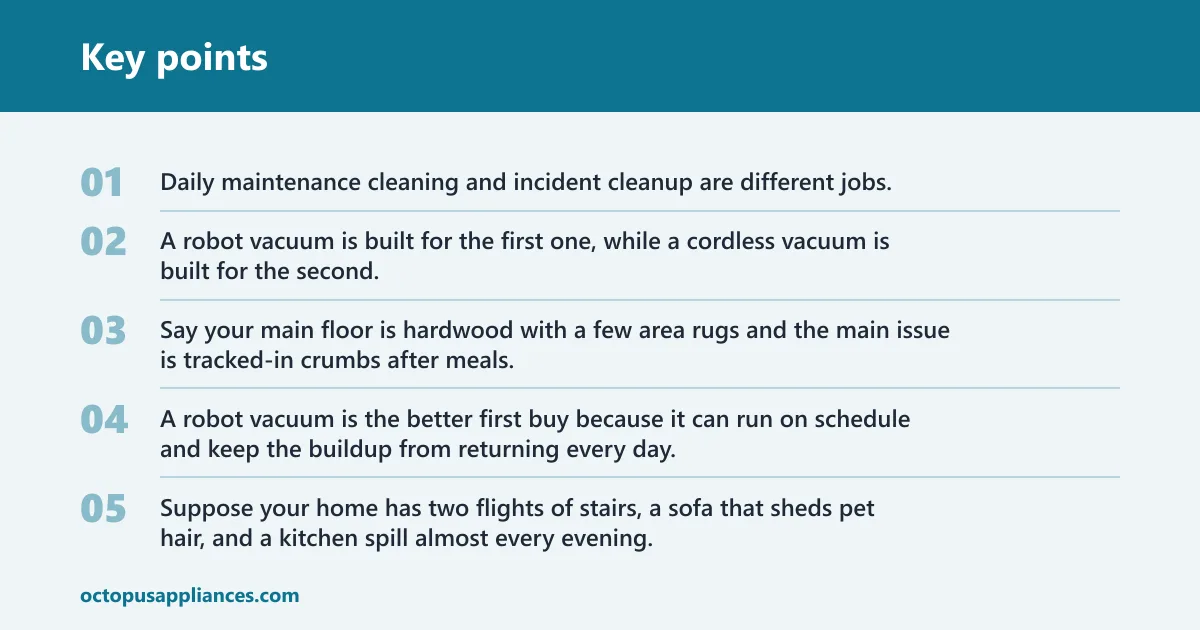
Daily maintenance cleaning and incident cleanup are different jobs. A robot vacuum is built for the first one, while a cordless vacuum is built for the second. That split is why many households should not use sticker price as the deciding factor.
Say your main floor is hardwood with a few area rugs and the main issue is tracked-in crumbs after meals. A robot vacuum is the better first buy because it can run on schedule and keep the buildup from returning every day.
Suppose your home has two flights of stairs, a sofa that sheds pet hair, and a kitchen spill almost every evening. A cordless vacuum is the better first buy because it solves the mess you see most often and reaches the places a robot cannot.
Mixed flooring and room layout
Mixed flooring often pushes the choice toward cordless when transitions are frequent and the layout changes from room to room. Robot vacuums can still work well on mixed floors, but only when the thresholds are manageable and the rooms do not need much prep.
In homes with one open living area and several tight side rooms, the strongest setup is often split by zone: robot for the open zone, cordless for the tight ones. If you are buying only one vacuum first, choose the tool that covers the most square footage of your regular mess.
Total ownership cost
Total ownership cost is more than the sticker price. A robot vacuum may cost around $200 at the entry level, while higher-end models can climb much higher; TechRadar listed the Eufy RoboVac 11S at $219.99 and the iRobot Roomba J7 Plus at $1,099.99. The Roomba J7 Plus was described as having a self-emptying base station and app support.
Also count bags, filters, batteries, dock space, and maintenance. A self-emptying base station reduces emptying chores, but it adds cost and footprint. A cordless vacuum usually costs less to support, though battery wear and filter replacement still matter over time.
Frequently asked questions
Should I buy a robot vacuum or a cordless vacuum first?
Buy a robot vacuum first if your biggest problem is repeat dust, crumbs, or pet hair on open floors. Buy a cordless vacuum first if you need fast cleanup on stairs, upholstery, cars, or mixed surfaces. The first buy should solve the mess you face most often, not the one with the best spec sheet.
Which is better for pet hair: robot vacuum or cordless vacuum?
Both can help, but they solve different parts of the problem. A robot vacuum handles daily fur on open floors, while a cordless vacuum is better for furniture, corners, stairs, and pet beds. For heavy shedding, the cordless option is often the better first buy.
Can a robot vacuum replace a cordless vacuum?
Not in every home. A robot vacuum can replace a cordless vacuum for routine floor maintenance if your floors are open and fairly clear. It usually cannot replace the reach, speed, and flexibility of a cordless vacuum for stairs, upholstery, cars, and quick spills.
Do cordless vacuums clean faster than robot vacuums?
Yes, cordless vacuums are quicker for cleaning rooms. They also let you target one spill or one area right away. Robot vacuums save effort because they run automatically, but they are not usually the fastest choice when the mess needs immediate hands-on cleanup.
Which vacuum is better for stairs and upholstery?
cordless vacuum is better for stairs and upholstery because it is portable and often converts to a handheld tool. Robot vacuums are built for floor travel, not vertical work. If stairs are part of your regular cleaning routine, cordless should usually come first.
Are robot vacuums worth it for busy households?
Yes, if the household has open floors and the main problem is keeping dust and pet hair from building up. A robot vacuum can run on a schedule and return to its dock on its own. Busy households with clutter, stairs, or frequent spills may still need a cordless vacuum too.
How much more expensive is a robot vacuum than a cordless vacuum?
Entry prices can overlap, but higher-end robot vacuums usually cost more once you add navigation, app control, and self-emptying docks. A basic robot vacuum can start around $200. Premium models can reach well above that, and the dock plus consumables raise the total cost further.
Do I need both a robot vacuum and a cordless vacuum?
Only if your home has two different cleaning jobs that matter equally. A robot vacuum is best for repeat floor upkeep, while a cordless vacuum is best for quick cleanup, stairs, and furniture. Many homes can start with one and add the other later if a clear gap remains.