
How Does a Basement Dehumidifier Work?
A basement dehumidifier pulls humid room air across cold coils, turns that moisture into water in a tank or drain line, warms the air slightly, and sends it back through the room until humidity falls. If the unit is too small or badly placed, you can keep paying for mold control, odors, and rot risk without drying the space. This guide explains the moisture-removal loop, why basements make it work harder, when it stops keeping up, and what that means for placement, drainage, and settings.
Why basements stay damp
Basements often hold moisture from seepage, small leaks, damp concrete, and weak air exchange. Summer air can enter through windows, gaps, or stairs, then cool on basement surfaces and raise relative humidity fast. Many basements reach 80% or even 90% relative humidity in summer, which is far above the range that helps keep mold risk down.
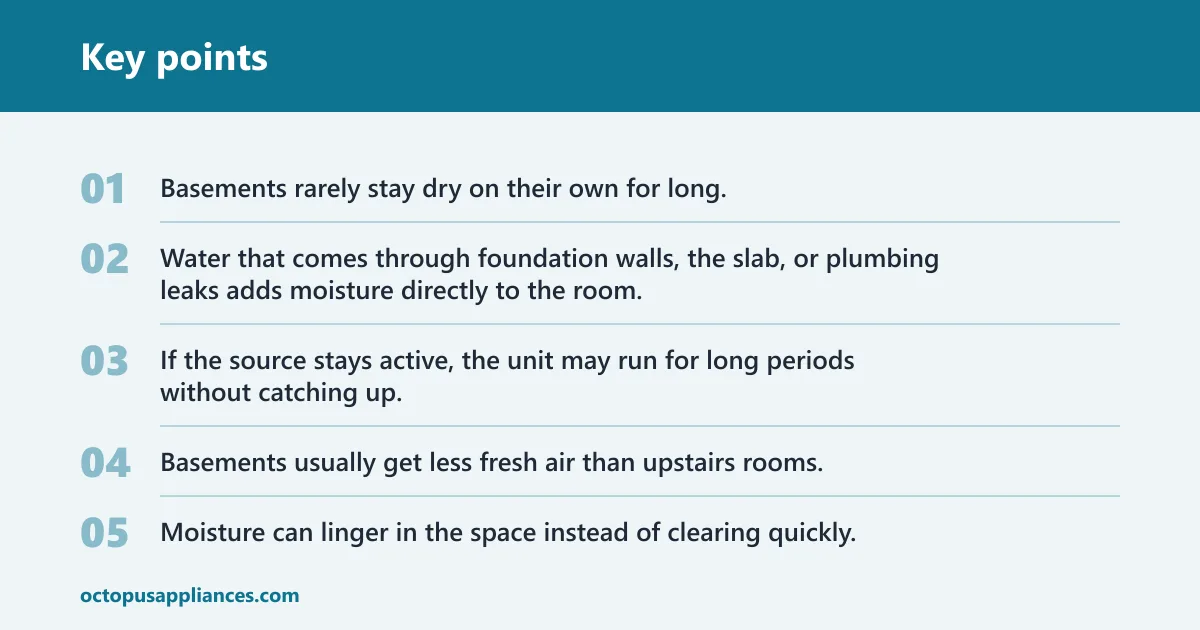
That matters because mold can begin to grow when conditions stay wet enough. Indoor relative humidity should stay below 60% to reduce mold risk, and many home dehumidifiers aim for the 30-50% range for comfort and control. Basements rarely stay dry on their own for long.
Moisture from seepage and leaks
Water that comes through foundation walls, the slab, or plumbing leaks adds moisture directly to the room. A dehumidifier can help with the air that stays in the basement, but it cannot fix standing water, active seepage, or a drainage problem. If the source stays active, the unit may run for long periods without catching up.
Poor air exchange in basements
Basements usually get less fresh air than upstairs rooms. Moisture can linger in the space instead of clearing quickly. A dehumidifier helps by removing water from recirculated air, but it works best when doors, vents, and leaks are not constantly feeding new damp air into the room.
What damp air means for mold risk
High humidity keeps surfaces closer to the point where condensation forms. That gives mold, musty odors, and wood damage a better chance to develop. A basement unit is not only about comfort. It controls the moisture level that feeds those problems.
How a basement dehumidifier removes moisture
A compressor-based dehumidifier is the most common home type. It uses a fan, cold evaporator coils, and a condenser coil. The fan pulls humid air across the cold coils, water condenses on them, and the unit sends slightly warmed, drier air back into the room. An Energy Star dehumidifier is worth noting because basement units may run for months, so efficiency affects operating cost over time.
The key idea is temperature change. Air can hold only so much water vapor at a given temperature. Once the coils cool the air below its dew point, moisture leaves the air as liquid water on the coil surface.
Fan and evaporator coil intake
The compressor fan draws surrounding air into the cabinet and moves it over two refrigerant-cooled coils. The first coil chills the air quickly. That drop in temperature is what makes the moisture separate from the air stream.
Condensation at the dew point
Dew point is the temperature at which moisture condenses. When the incoming basement air crosses that point on the cold evaporator coil, water forms on the coil and drips away.
Condenser coil and drier outlet air
After moisture is removed, the air passes over the condenser coil. That step warms the air slightly before it returns to the room. The air leaving the unit is drier, but often a bit warmer than the air that entered.
Humidistat control and setpoint cycling
A humidistat senses relative humidity and cycles the compressor on and off toward a set humidity level. If the basement is already at the target, the unit pauses. If humidity climbs again, it starts back up. That cycling is what keeps the room near the setpoint instead of running nonstop.
How does a basement dehumidifier work?
A basement dehumidifier works as a loop: pull in damp air, cool it below dew point, collect the water, and send drier air back out. If the basement keeps adding moisture faster than the unit can remove it, the space may never reach target humidity.
Say your basement sits at 70% RH and the unit is set to 45%. It may run for long stretches at first because the incoming air keeps carrying extra moisture from the walls and slab. Once the space gets closer to the target, the humidistat should shorten each cycle.
Picture a small basement with one unit near the center, doors left open, and a floor drain available. The same machine can keep running continuously with a proper drain setup instead of stopping when a tank fills.
One full moisture-removal loop
The full loop starts when the fan draws humid air into the cabinet. The evaporator coil cools the air below its dew point, water condenses, and the droplets collect in the tank or drain path. The air then passes the condenser coil, leaves the machine slightly warmer and drier, and mixes back into the basement air until the humidistat calls for another cycle.
Why the air may feel slightly warmer afterward
That warmer feel surprises many homeowners. The machine removes water, but the refrigeration process also adds some heat back into the air stream. The basement can still become more comfortable overall because lower humidity makes the same temperature feel less clammy.
Basement dehumidifier operating checklist
This checklist shows what happens in a normal cycle, what to check when a cold basement causes trouble, and how to choose a drain setup. It is a practical map for setup, not a sales list.
Airflow and moisture cycle
| Step | What happens | Why it matters |
|---|---|---|
| 1 | Fan pulls humid basement air into the unit. | Airflow is the start of moisture removal. |
| 2 | Air passes over cold evaporator coils. | The coil temperature drops the air below dew point. |
| 3 | Water condenses on the coils and runs off. | Liquid water leaves the air stream. |
| 4 | Collected water moves to a tank or drain path. | The unit needs a place for that water to go. |
| 5 | Drier air passes the condenser coil and returns to the room. | The room gets slightly warmer and less humid. |
Cold-basement troubleshooting tree
-
Check the room temperature.
If the basement is cool, coil icing can stop normal operation. Compressor units can struggle in colder spaces, and frost on the coil can reduce or stop water collection.
-
Inspect the coil surface.
Look for frost or a white icy layer on the evaporator coil. If you see it, let auto-defrost work if the unit has it, then check whether the room is simply too cold for the compressor design.
-
Confirm airflow is clear.
Leave the unit with enough open space around its intake and exhaust. Restricted airflow can make the coils colder than they should be, which worsens icing and short cycling.
-
Check the drain path.
A kinked hose, clogged outlet, or full tank can shut the unit down. If the water cannot leave the machine, the safety system may stop operation even if the coils are working.
-
Compare the setpoint to room humidity.
If the humidistat is set too low for the basement conditions, the unit may run almost constantly. That does not always mean failure, but it can point to a moisture load the machine cannot keep up with.
-
Switch technologies if needed.
If the basement stays cold and the compressor unit keeps icing up, a desiccant dehumidifier may be a better fit. Desiccant dehumidifiers can work in spaces below 65°F because they use moisture-absorbing material instead of refrigeration.
How basement dehumidifier work decision table
| Drain option | Best fit | Strength | Limit |
|---|---|---|---|
| Bucket | Small jobs, short-term use, or no drain access | Simple to set up | Requires manual emptying and may trigger auto-shutoff when full |
| Gravity drain | Basements with a floor drain or sump below the outlet | Works with a continuous drain hose and reduces manual work | Needs a downhill path and a clear discharge point |
| Pump | Basements where the drain is higher than the unit | Moves water upward or across a longer distance | Adds another component that can fail or need cleaning |
| Desiccant | Cold spaces where compressor icing is a recurring problem | Better behavior in low temperatures | Less common for full-room home basements |
When should you run one in the basement?
Run a basement dehumidifier when humidity stays above the target range, when walls or stored items feel damp, or when you can smell mustiness that does not clear on its own. A common target is 30% to 50% RH. If the basement keeps staying above about 60% RH, mold risk tends to climb and the unit may need to run more often or be resized.
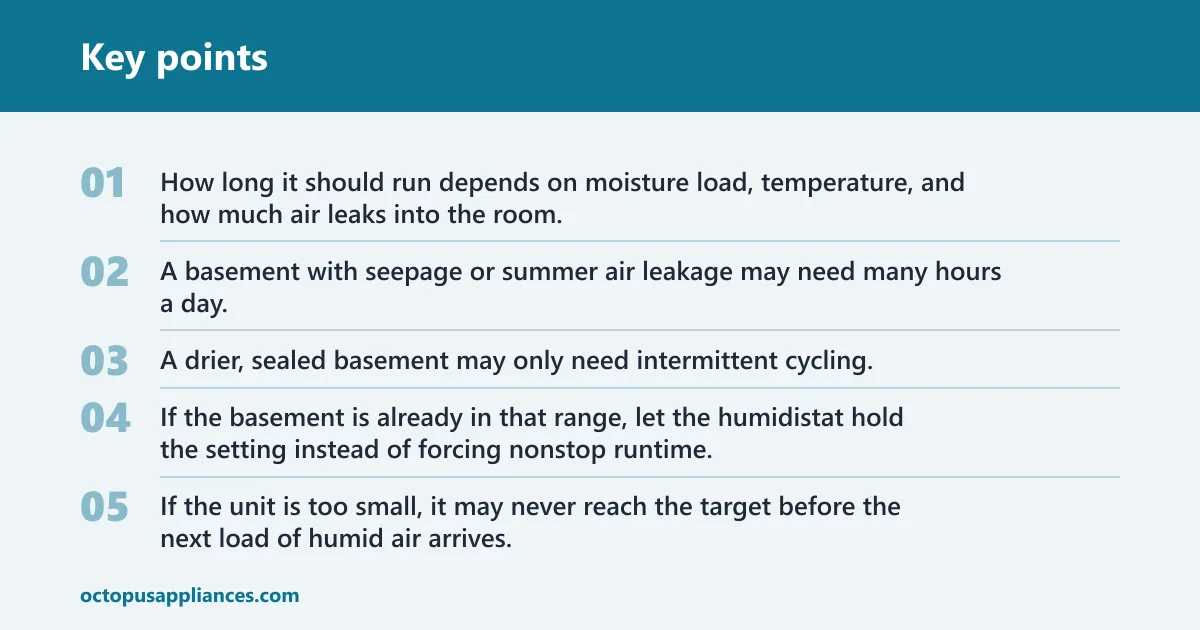
How long it should run depends on moisture load, temperature, and how much air leaks into the room. A basement with seepage or summer air leakage may need many hours a day. A drier, sealed basement may only need intermittent cycling.
Target humidity range for basements
Many home dehumidifiers should target a midrange humidity level that helps limit mold risk without making the room uncomfortably dry. If the basement is already in that range, let the humidistat hold the setting instead of forcing nonstop runtime.
How runtime changes with moisture load
Seepage, leaks, and poor ventilation increase runtime because the unit keeps replacing moisture that keeps entering the room. A 30- or 40-pint unit is often used for an average-sized basement, while a 50-pint dehumidifier is a better fit for a big basement. If the unit is too small, it may never reach the target before the next load of humid air arrives.
When upstairs humidity may still stay high
A basement unit can help the whole house only if basement air is part of the moisture problem and the upstairs is connected by open air paths. It will not reliably dry a closed upstairs zone with its own humidity source. If upstairs rooms still read high after the basement reaches target, the house likely needs separate control upstairs.
A common first-timer mistake is expecting a basement unit to dry the whole house through the stairwell alone. That can help a little if the doors stay open and air moves freely, but it will not fix bathroom steam, attic leakage, or other room-specific moisture sources.
Why does my basement dehumidifier stop working in cold weather?
Cold weather can cause frost on the coil, slow water collection, and make the compressor cycle off before the basement is dry. When the room is too cool, the evaporator coil may fall below the point where condensation forms normally, then ice builds up and blocks the process. Auto-defrost can help, but it cannot solve every low-temperature problem.
If the basement stays cool for long periods, a desiccant dehumidifier may be a better fit than a compressor-based unit. Compressor-based units are the most common for homes, but they are not the best match for every cool basement.
Coil icing and low-temperature limits
Frost on the coil can stop water from collecting. When that happens, the unit may still sound like it is running, but humidity does not drop the way it should. Cooler basements are the most common place for this problem.
Auto-defrost and what it can fix
Auto-defrost helps prevent or melt ice on the coils. That feature is useful in basements that dip into cooler temperature ranges, because it gives the unit a chance to keep operating instead of locking up under frost. It is a support feature, not a cure for the wrong technology in the wrong room.
When a desiccant model makes more sense
Choose desiccant when the basement is cold enough that a compressor unit keeps icing or short cycling. Desiccant dehumidifiers can work in spaces below 65°F, so they are often the better choice for cool utility basements, crawl-space-adjacent rooms, or other low-temperature spaces. They are less common for full-room home basements, but they fit the conditions better when cold is the main problem.
Frequently asked questions
How does a dehumidifier work in a basement?
It pulls humid basement air across cold coils, condenses water, collects the liquid in a tank or drain line, and returns slightly warmer, drier air to the room. A humidistat cycles the compressor on and off to stay near the chosen humidity level.
Do basement dehumidifiers work?
Yes, if the unit matches the room and the moisture source is manageable. They reduce humidity, help lower mold risk, and improve comfort, but they cannot fix active leaks or major seepage on their own. If the basement stays above 60% RH, the setup or capacity may need to change.
What humidity level should a basement dehumidifier target?
Most home basements should target a humidity level that supports comfort and mold prevention better than higher levels. If the basement stays above 60% RH, the air is still in a range that raises mold risk and can keep odors and condensation active.
How does a basement dehumidifier drain water?
Condensed water either collects in a water tank or moves out through a continuous drain hose. A bucket needs manual emptying and may trigger auto-shutoff when full. A gravity drain works when the outlet is lower than the unit, while a pump helps when the drain sits higher.
Will running a dehumidifier in the basement help the whole house?
Sometimes, but only to a point. It can lower moisture that drifts upward through open stairways or connected air paths, yet it will not dry separate upstairs rooms with their own sources of humidity. Think of it as one part of house moisture control, not a whole-house fix.
When should you run a dehumidifier in your basement?
Run it when relative humidity stays above 50% for long periods, when you notice musty odors, or when surfaces feel damp. If the basement sits above 60% RH, the risk of mold growth rises. In summer, many basements need longer runtime because outside air brings in more moisture.