
Garage Ready Refrigerator vs Regular: Key Differences
If a garage regularly drops below about 55°F or climbs above about 90°F, a garage-ready refrigerator is often the safer choice; a standard fridge can have trouble keeping food cold through those swings. Miss that, and you can end up with warm spots, spoiled food, or a compressor that works harder than it should. This guide explains the real differences in temperature range, humidity tolerance, and usage so you can decide which type fits your space.
| Decision factor | Garage ready refrigerator | regular | Winner |
|---|---|---|---|
| Ambient temperature tolerance | Designed for ambient temperatures between 38°F and 110°F. | Designed for climate-controlled indoor spaces with a narrower operating range. | Garage ready refrigerator |
| Cold-weather reliability | Built for better winter performance and more stable cycling in cold spaces. | Can warm up inside while the room stays cold, especially in an unheated garage. | Garage ready refrigerator |
| Energy use for year-round storage | Often available with Energy Star certification and compressors suited to variable conditions. | May cost more to run if it cycles poorly outside its rated range. | Garage ready refrigerator |
| Placement flexibility | Built for garages, basements, workshops, and similar variable environments. | Best kept in controlled indoor space where temperature stays steady. | Garage ready refrigerator |
| Purchase simplicity for a mild, insulated space | Usually more than you need if the garage stays close to indoor conditions. | Can be acceptable when the space stays climate controlled. | regular |
What makes garage-ready fridges different
The trade-off is plain: a Garage ready refrigerator stays steadier when the air around it swings hot or cold, while a regular fridge assumes an indoor room with more predictable conditions. If your garage behaves like an extra room in the house, regular can work. If it behaves like outdoors, garage-ready is the safer buy.
Operating temperature range
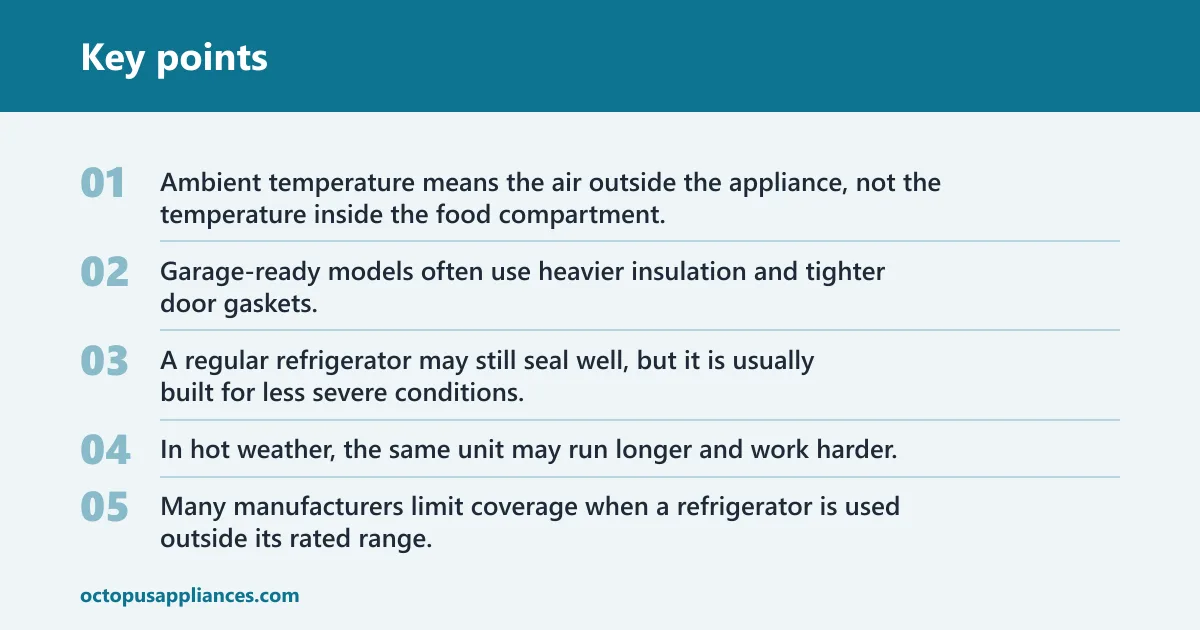
Ambient temperature means the air outside the appliance, not the temperature inside the food compartment. That spec matters most because the refrigerator has to move heat into the room around it. A model rated to 38°F to 110°F has more room to cope when winter nights or summer afternoons push the garage outside normal indoor conditions.
Cabinet insulation and door seals
Garage-ready models often use heavier insulation and tighter door gaskets. Those features help keep the cabinet closer to set temperature when the room changes quickly or dust gets into the space. A regular refrigerator may still seal well, but it is usually built for less severe conditions.
Compressor type and cycling
Adaptive or inverter compressors are common recommendations for garage use because they can adjust to changing ambient temperatures in real time. In a cold garage, a standard compressor may not cycle the way it should, which can leave the fresh-food section too warm even while the freezer seems normal. In hot weather, the same unit may run longer and work harder.
Warranty and placement limits
Many manufacturers limit coverage when a refrigerator is used outside its rated range. That makes the manual just as important as the label on the box. If the placement section says indoor use only, or gives a narrower ambient limit than your garage sees, plan on a garage-ready model instead.
📊 This Old House lists a 24 cu. ft. LG top freezer as best overall and garage ready. Source: Our 7 Best Garage Refrigerators (2026 Guide).
What a garage-ready refrigerator
A Garage ready refrigerator is built for variable ambient conditions rather than a steady indoor room. The category is commonly described as intended for garages and workshops, and modern models are often listed for about 38°F to 110°F. That wider range is the main difference, not the finish or the door style.
Built for variable ambient conditions
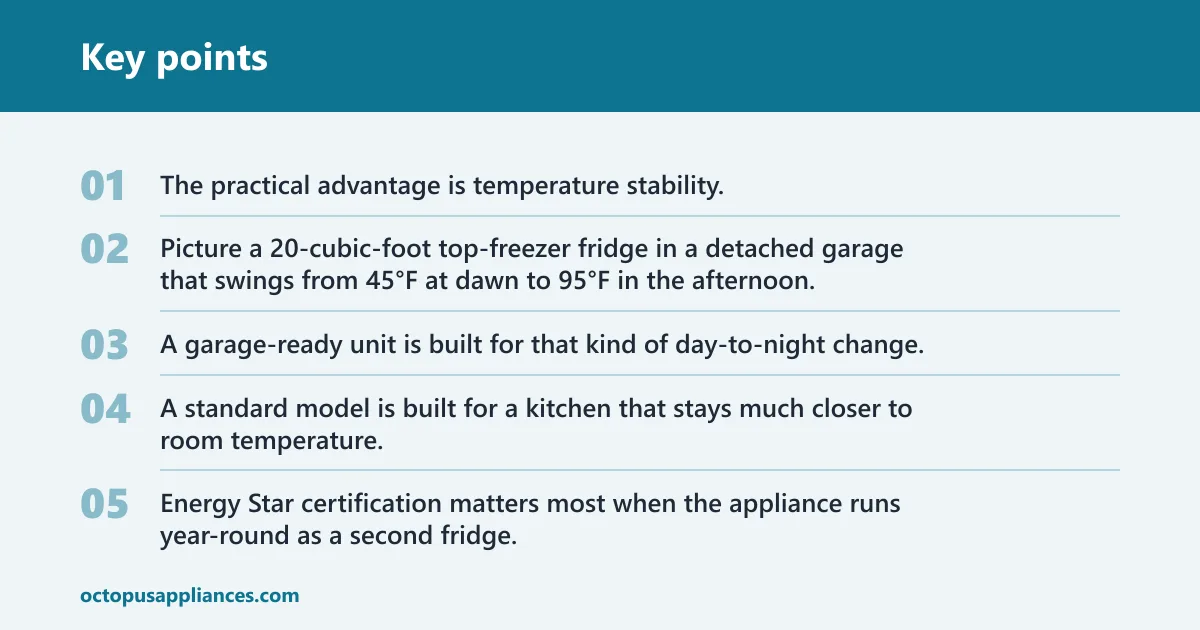
The practical advantage is temperature stability. In a garage that gets hot in summer and cold in winter, the refrigerator has a better chance of holding food-safe temperatures without odd cycling behavior. Country Living also points to adaptive or inverter compressors, heavy-duty insulation, and reinforced door gaskets as useful features in this setting.
Picture a 20-cubic-foot top-freezer fridge in a detached garage that swings from 45°F at dawn to 95°F in the afternoon. A garage-ready unit is built for that kind of day-to-night change. A standard model is built for a kitchen that stays much closer to room temperature.
Common features to look
Energy Star certification matters most when the appliance runs year-round as a second fridge. Tighter door seals and heavier insulation help in dusty, drafty spaces. An ice maker or water dispenser can be convenient, but both add failure points, and a water line can be vulnerable in cold garages.
Typical formats and capacities
Top-freezer refrigerators are a common garage-ready format because they are simpler and often more reliable in extreme conditions. They are commonly available in the 18 to 24 cubic foot range, which suits many full-size backup-storage needs. Smaller options also exist: compact models can be around 3.2 cubic feet, while mid-size units often sit around 14 to 18 cubic feet.
Can a regular refrigerator work in a garage?

Yes, but only when the garage stays close to indoor conditions and the manual does not prohibit that placement. A regular fridge can be fine in a mild, insulated garage. It is a poor bet in a hot, uninsulated, or unheated space because the ambient temperature can push it outside the range the appliance was built for.
Mild insulated garage
If the garage is insulated, attached, and stays near house temperatures most of the year, a regular refrigerator may be acceptable. Check the manual for any placement limit and compare it with the real temperature swing in that room. If the air rarely leaves a comfortable indoor band, the standard model may do the job.
If a garage is insulated and attached, and a thermometer with min/max memory shows a weekly range of about 58°F to 84°F, that can help judge whether the space stays within a suitable range. That is a very different setup from an unheated outbuilding. In that case, the standard fridge is not automatically wrong.
Hot uninsulated garage
A hot garage stresses both types of appliance, but a regular refrigerator is more likely to run inefficiently or lose cooling margin. The compressor may stay on longer, internal temperatures may drift, and energy use can rise. If the space often gets up past about 90°F, garage-ready is usually the more practical choice.
Cold winter garage
This is where standard refrigerators fail most often. The room can get cold enough that the thermostat does not call for cooling the way it should, so the fresh-food section warms while the freezer still looks fine. That mismatch is a common cold-garage failure mode, and it is why the lower ambient limit matters so much.
What temperature range should you check?
Check the ambient range listed in the manual before you buy. The lower bound matters in winter, and the upper bound matters in summer. If the garage falls below the rated minimum, the refrigerator may cycle poorly; if it rises above the max, the compressor may run too long and struggle to hold set temperature.
Why the lower bound matters
The lower limit is the one many buyers overlook. In a cold garage, the appliance may not call for cooling often enough, which can leave food in the refrigerator section too warm even while the freezer seems acceptable. That is a real risk for milk, leftovers, and any food stored on the door shelves.
Why the upper bound matters
High heat pushes the compressor harder and can raise operating costs. If the garage regularly tops 90°F, a fridge with a wider ambient rating is a better match. The higher ceiling matters most for summer afternoons, sun-exposed garages, and spaces with poor ventilation.
How to read the manual
- Find the ambient range. Look for the minimum and maximum outside-air temperatures in the specifications or installation section. You need the air around the appliance, not the food compartment temperature.
- Check placement limits. Confirm whether the manual allows garage, basement, or workshop use. If it only lists indoor kitchen placement, treat that as a warning sign.
- Verify warranty language. Look for any clause that limits coverage outside rated conditions. A unit used beyond its stated range may lose warranty protection.
Garage refrigerator decision matrix
Use the table below as a plain-English buying rule. Match the garage’s actual temperature swing and storage need to the safest appliance type, then verify the manual before you buy.
| Garage scenario | Recommended fridge type | Minimum ambient rating | Risk level | First feature to verify in the manual |
|---|---|---|---|---|
| Mild insulated garage | regular | Whatever matches the real room temperature, with indoor placement allowed | Low | Placement approval for garage or similar indoor-adjacent space |
| Hot uninsulated garage | Garage ready refrigerator | 38°F to 110°F | High for a regular fridge | Maximum ambient temperature rating |
| Cold winter garage | Garage ready refrigerator | 38°F to 110°F | High for a regular fridge | Minimum ambient temperature rating |
| Year-round overflow storage | Garage ready refrigerator | 38°F to 110°F | Moderate to high, depending on climate swings | Energy Star certification and compressor type |
The logic stays the same across all four rows: if the garage stays close to indoor conditions, a regular fridge can be fine; if it sees real heat or cold, garage-ready is the safer pick. Year-round overflow storage deserves the wider-range unit because the appliance will run in every season, not just during mild weather.
Which features matter most?
The best feature list starts with the basics that affect survival in a garage, then moves to convenience. Capacity, layout, insulation, seals, and compressor control matter more than finishes or smart displays. A water dispenser is nice to have, but it should not outrank ambient rating or build quality.
Top-freezer layout
Top-freezer refrigerators are often the practical choice for garage use. They are common, usually simpler, and frequently easier to keep stable in extreme conditions. This Old House lists a 24 cu. ft. LG top freezer as best overall and garage ready, which fits the general pattern of top-freezer strength in this category.
Energy Star certification
Energy Star matters most when the fridge is a second unit that runs all year. A model with lower estimated energy use can reduce the cost of keeping overflow food and drinks cold over time. That matters even more if the garage is warm in summer or the appliance has to recover from frequent door openings.
Door gasket and insulation
Heavy-duty insulation and reinforced door gaskets help the refrigerator hold temperature against garage dust, draft, and swing. These are not cosmetic features. They affect how often the compressor has to correct for heat gain, which in turn affects performance and wear.
Ice maker and water dispenser
These features add convenience, but they also add failure points. In a cold garage, the water line can be vulnerable, and the dispenser hardware takes up storage space inside the cabinet. If your main goal is reliable food storage, a simpler layout is usually the safer choice.
Do garage-ready refrigerators use more electricity?
Not automatically. Energy use depends on the model, the size, and how hard the compressor has to work in your garage. A Garage ready refrigerator can actually be the lower-risk choice for year-round storage because it is built to operate in wider conditions without cycling badly.
Why efficiency matters for a second fridge
A second refrigerator runs all year, so even a modest efficiency difference adds up. If the space is hot in summer or cold in winter, a regular fridge can work harder than expected because it is outside its intended environment. That can erase any upfront savings from buying the cheaper unit.
What Energy Star can tell you
Energy Star certification is a useful filter, especially for an always-on appliance. It does not guarantee the right ambient range, but it does point to lower estimated energy use in a model that already fits your garage conditions. Wirecutter’s top pick, the LG LHTNS2403S, is designed to work between 38°F and 110°F and has 23.8 cubic feet of capacity, which shows how range and efficiency can be paired in a garage-ready model.
When a standard fridge costs more in the long run
A regular fridge can be the expensive choice if it sits in a garage that swings outside its rated range. Poor cycling, extra compressor wear, and possible warranty issues can turn a lower sticker price into a higher total cost. The hidden cost is not just electricity; it is also the risk of earlier replacement.
Choose Garage ready refrigerator if… / Choose regular if…
Choose Garage ready refrigerator if your garage gets below 55°F in winter, rises above 90°F in summer, or stays variable enough that you cannot count on indoor-like conditions. It is the better pick for detached garages, unheated workshops, and year-round overflow storage. Choose regular if the space is insulated, attached, and keeps a stable indoor range, and the manual allows that placement.
- Choose Garage ready refrigerator if… the garage has real temperature swings, you need dependable winter performance, or the fridge will run all year as backup storage.
- Choose Garage ready refrigerator if… you want a wider ambient rating, better door sealing, and a compressor designed for variable conditions.
- Choose regular if… the garage behaves like an indoor room and stays within the appliance’s listed placement range.
- Choose regular if… you are storing fewer items and can place the fridge in a milder, climate-controlled part of the home.
Frequently asked questions
What is the difference between a garage-ready refrigerator and a regular refrigerator?
A garage-ready refrigerator is built for wider ambient swings, commonly 38°F to 110°F, while a regular refrigerator is meant for climate-controlled indoor spaces. The practical difference is how well each one keeps cooling stable when the air around it gets very hot or cold.
Can a regular refrigerator be kept in a garage?
Yes, if the garage stays mild and insulated enough to behave like an indoor room, and the manual allows that placement. If the space gets very cold or very hot, a regular fridge can lose temperature control, cycle poorly, or lose warranty coverage.
What temperature range should a garage-ready refrigerator handle?
Look for a minimum ambient rating of 38°F and a maximum of 110°F. That range is important because the lower bound protects winter performance and the upper bound protects summer performance. Always confirm the exact numbers in the manual before buying.
Will a fridge in the garage stop cooling in winter?
A standard fridge can. In a cold garage, the thermostat may not call for cooling often enough, so the refrigerator compartment can warm up while the freezer still looks normal. That is one of the most common failure modes in unheated spaces.
Are top-freezer models better for garage use?
Often, yes. Top-freezer refrigerators are a common garage-ready format because they are simpler, usually more reliable in extreme conditions, and often more energy-efficient than larger styles. They are a practical first place to look for garage storage.