What Size Dehumidifier Do I Need for 1000 Sq Ft?
For a 1,000 sq ft space, a common rule of thumb is to start with about a 30-pint dehumidifier for normal dampness and move to about 50 pints for wetter basements, laundry rooms, or rooms with constant moisture. If the unit is too small, air stays clammy, run time rises, energy use climbs, and mold can begin where water sits. This page gives you a room-by-room pint range for 1,000 sq ft and shows when to choose pump drainage or whole-home drainage.
Dehumidifier sizing basics
Dehumidifier size means moisture-removal capacity, not physical size. The key number is pints per day, often shortened to PPD. Tank size only tells you how often you must empty the bucket.
For 1,000 sq ft, the starting point changes with dampness and location. A dry or mildly damp above-ground room can often stay in the 30-pint class. A basement usually needs more capacity than the same floor area upstairs because below-grade walls and slabs hold moisture longer.
Why pint ratings matter
Pint ratings tell you how much water the unit can remove under a defined test method. Since the DOE rating changed in 2020 for portable dehumidifiers, current labels are not directly comparable with older nameplates. That matters when you shop for a replacement and see old 50-pint or 70-pint wording.
For current products, use the DOE label on the box or spec sheet, not the old marketing name. A unit sold as 50 pints today may not match an older 50-pint model in the way people used that term before the 2020 update.
How 1,000 sq ft changes the starting point
Square footage is the first filter, but it does not finish the job. A 1,000 sq ft open-plan living area, a finished basement, and an unfinished basement all need different capacity because air movement, wall contact, and vapor load are not the same.
Match floor area first, then add capacity for below-grade construction and heavier dampness. For 1,000 sq ft, that usually means 30 pints for moderate dampness and 50 pints when the space runs wetter or sits below grade.
1000 sq ft sizing matrix
This matrix turns room type and dampness into a buying range. Use the current DOE pint label on the unit, then check whether drainage or a pump will make daily use easier.
| Room type | Dampness level | Recommended current DOE pint range | Drainage need | Pump worth it? |
|---|---|---|---|---|
| Above-ground, open-plan 1,000 sq ft | Moderately damp | 30 pints | Tank is fine if you can empty it regularly; hose helps | Usually no |
| Finished basement, 1,000 sq ft | Very damp | 50 pints | Continuous drainage is strongly worth considering | Yes, if gravity drainage is not practical |
| Unfinished basement, 1,000 sq ft | Wet | 50 pints or more, after moisture sources are fixed | Hose connection needed; bucket-only use is inconvenient | Often yes |
This matrix reflects the main decision: above-ground spaces need less capacity than basements, and wet spaces need more than “normal damp” rooms. The 50-pint end is the practical floor for many basement jobs at this size, while a 30-pint unit suits lighter moisture in a room that is not fighting ground moisture.
What size dehumidifier do I need for 1000 sq ft?
Start with 30 pints for a moderately damp 1,000 sq ft area, then move up to 50 pints if the room is very damp or sits below grade. If the space smells musty, shows repeated condensation, or feels sticky with windows closed, the larger class is the safer start.
Moderately damp spaces
An above-ground 1,000 sq ft room with only mild dampness usually fits a 30-pint current DOE unit. That lines up with common ENERGY STAR-style guidance that small and medium spaces scale up as dampness rises. For a living room, office, or open-plan upstairs area, this is often enough.
One common first-timer mistake is sizing only by floor area and ignoring airflow. A 1,000 sq ft open-plan room with decent ventilation may need less help than a closed, damp room of the same size.
Very damp spaces
Very damp spaces usually need a 50-pint dehumidifier at 1,000 sq ft, especially if they sit in a basement or have poor air exchange. This is where the basement modifier matters. Below-grade walls hold moisture, and the unit must work harder to pull humidity down.
Say your 1,000 sq ft finished basement gets condensation on cold mornings and the laundry runs nearby twice a week. That is not a 30-pint job. A 50-pint unit with continuous drainage is the better fit because run time will be long and bucket emptying will become a chore.
Wet spaces that need more than a basic portable
Wet or extremely wet spaces need a different response before capacity shopping matters. If there is standing water, an active leak, or a flood-damaged area, fix the water source and dry the materials first. A portable dehumidifier cannot solve that problem on its own.
After repairs, a 50-pint unit is the usual portable starting point for a wet 1,000 sq ft basement. If moisture keeps returning because the drainage path or foundation issue is unresolved, step up to a more permanent drainage plan rather than chasing a larger bucket.
Does a basement need a bigger unit?
Yes. A basement usually needs more capacity than the same size above-ground room because below-grade surfaces stay cooler and hold moisture longer. That is why a 1,000 sq ft basement with moderate dampness is commonly sized at 50 pints rather than 30 pints.
Finished basement modifier
Finished basements often sit in the middle ground: they may look like living space, but they still take on ground moisture. For a 1,000 sq ft finished basement that feels very damp, 50 pints is the practical target, and hose drainage is worth serious consideration.
The 1.3x basement modifier is a useful shortcut here. If the upstairs room would call for a smaller unit, multiply the need upward for below-grade space, then choose the next available pint class if the exact number falls between labels.
Unfinished basement modifier
Unfinished basements usually have more exposed concrete and less controlled airflow, so they often need the higher end of the portable range. For a 1,000 sq ft unfinished basement that feels wet, 50 pints is the minimum sensible starting point after leaks and seepage are addressed.
If the basement has persistent moisture, exposed soil, or repeated condensation on walls and pipes, a portable unit may only be a partial fix. In that case, drainage improvements and sealing work matter as much as the machine size.
When a portable is not enough
Move beyond a portable unit when moisture is persistent across the whole basement, when a tank would need constant emptying, or when the space has recurring water intrusion. At that point, whole-home drainage or a more permanent moisture-control approach can make more sense than simply buying more pints.
DOE pint ratings explained
Current DOE ratings changed in 2020 for portable dehumidifiers. That change is why older product names do not line up cleanly with the labels you see now. The number on the current label is the one to use when you compare products.
Old 50-pint and 70-pint labels
Older 70-pint models are now often labeled around 50 pints. That shift is the main shopping trap for homeowners replacing an old unit. A box may look smaller on paper now, but the current label is based on the newer DOE test method.
The practical shortcut is simple: do not compare old and new pint labels as if they were identical. Check the current DOE rating, then match it to room type and dampness instead of chasing the old model name.
What to look for on the spec sheet
Look for current DOE pints per day, drainage options, and whether the unit lists a pump. Also check the temperature range. Compressor or refrigerant models suit warmer rooms, while desiccant models are better for cooler spaces below about 65°F.
That temperature point matters in basements. A cool basement can make a compressor unit work less effectively, while a desiccant unit can keep moisture removal steadier in cooler air.
Drainage, pump, and runtime
Continuous drainage matters when you do not want to empty a bucket every day. A hose connection lets the unit drain by gravity if a floor drain, sump, or low point is available. That is often the cleanest setup for a basement.
When hose drainage helps
Hose drainage helps any time the unit will run for long stretches. That is common in a 1,000 sq ft basement, a laundry area, or a room with recurring condensation. It also reduces the chance that the unit shuts off because the tank filled before the space actually dried out.
A 20-pint dehumidifier is enough for a bathroom or laundry room, but a 1,000 sq ft space needs a different setup. At this floor area, the question is usually whether the hose can stay attached and drain safely, not whether the bucket is large enough to last all day.
When a pump is worth paying
A pump is worth paying for when gravity drainage is not available or when the hose must push water upward to a sink, laundry standpipe, or other outlet. It is not necessary for every buyer. If you have an easy downhill drain path, a plain hose connection is enough.
A pump also makes sense when the unit sits far from a drain and moving a hose would be awkward. The price premium should buy convenience in the exact layout you have, not a feature you will never use.
How tank emptying affects daily use
Tank emptying is a practical limit, especially in wet spaces. A 50-pint unit can still need frequent attention if the room is very damp. If emptying the bucket more than once a day would be a problem, choose drainage, not a larger tank.
Do not confuse bucket size with moisture-removal capacity. A larger tank can hold more water, but it does not mean the unit removes moisture faster. The capacity number on the current DOE label still decides that.
Can one unit handle the whole area?
Yes, one properly sized unit can handle a whole 1,000 sq ft open-plan area if the space is reasonably open and the moisture load is moderate. Once the layout gets chopped up, or if the room includes a laundry zone or poor ventilation, the load rises and the unit must work harder.
Open-plan 1000 sq ft spaces
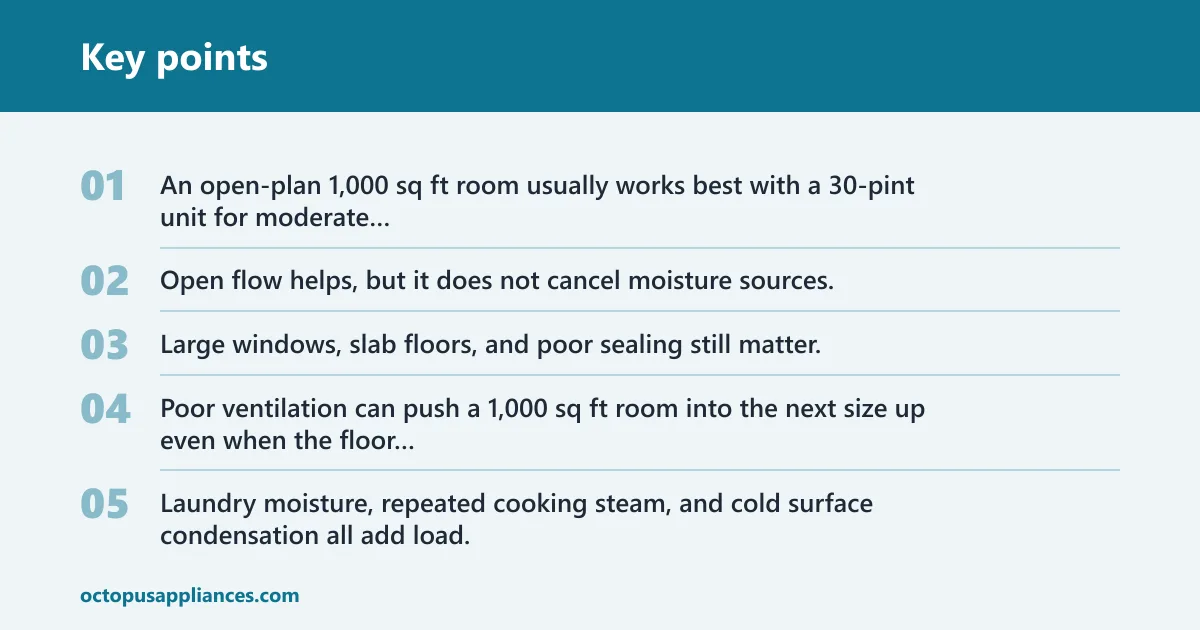
An open-plan 1,000 sq ft room usually works best with a 30-pint unit for moderate dampness and a 50-pint unit for very damp conditions. Open flow helps, but it does not cancel moisture sources. Large windows, slab floors, and poor sealing still matter.
Poor ventilation and laundry moisture
Poor ventilation can push a 1,000 sq ft room into the next size up even when the floor area itself seems manageable. Laundry moisture, repeated cooking steam, and cold surface condensation all add load. That is why the same square footage can land in different pint ranges.
Suppose a 1,000 sq ft upstairs bonus room is mostly dry, but one corner shares space with a washer and dryer. The laundry corner may force you from 30 pints to 50 pints because moisture does not spread evenly through a room.
When to move to whole-home drainage
Move to whole-home drainage when a portable unit runs almost continuously, when a tank would need constant attention, or when several connected rooms all stay damp. That step makes more sense than adding more portable capacity once the moisture problem is spread through the house.
A 2-car garage typically needs a 35-pint dehumidifier, which shows how load changes with space type. A 1,000 sq ft basement can be harder than that because ground contact and cooler surfaces keep humidity higher for longer.
Frequently asked questions
Is a 50-pint dehumidifier enough for 1000 square feet?
Yes, a 50-pint dehumidifier is enough for many 1,000 sq ft basements and very damp spaces. It is usually more capacity than an upstairs room needs, but basements often justify the larger size because they retain moisture longer and need more run time.
What size dehumidifier do I need for a 1000 sq ft basement?
A 1,000 sq ft basement commonly needs about 50 pints, especially if it is moderately damp or very damp. The basement modifier matters because below-grade walls and floors hold moisture. If the basement is wet or has water intrusion, address the leak or seepage first.
How many pints per day do I need for 1000 sq ft?
For 1,000 sq ft, think in roughly a 30-pint to 50-pint range. Use 30 pints for moderate dampness in an above-ground room and 50 pints for very damp or below-grade spaces. The more moisture the room holds, the closer you get to 50 pints.
Do I need a 30-pint or 50-pint dehumidifier for 1000 sq ft?
Choose 30 pints if the space is moderately damp and above grade. Choose 50 pints if the space is a basement, if moisture is heavy, or if you want faster pull-down and longer runtime margin. When in doubt, basement use usually pushes the answer upward.
Can a dehumidifier be too big for 1000 sq ft?
Yes. An oversized unit can short-cycle, cost more to run, or remove moisture less efficiently in some conditions. That is why the goal is the right pint range, not the biggest number. For 1,000 sq ft, that usually means 30 pints or 50 pints, not a much larger unit.