Robot Vacuum vs Robot Vacuum and Mop: Which Is Better?
A robot vacuum is better for homes with carpet, pet hair, and heavier debris; a robot vacuum and mop combo is better for mostly hard floors with light daily dust and stuck-on spots. Pick the wrong one, and you spend on a machine that misses the mess you care about or adds upkeep you will not want to repeat. This guide compares both by floor type, mess type, and upkeep tolerance so you can match the machine to your home.
| Decision factor | Robot vacuum | robot vacuum and mop | Winner |
|---|---|---|---|
| Carpet and rugs | Strong fit for suction-based debris pickup on carpet and rugs | Can cross carpet, but mop hardware adds complexity on mixed flooring | Robot vacuum |
| Sealed hard floors | Cleans dry debris well, but does not handle residue | Adds wet cleaning for dust, crumbs, and sticky spots on sealed floors | robot vacuum and mop |
| Maintenance burden | Dustbin emptying, brush cleaning, and dock upkeep if self-emptying | All of that, plus water refills and pad or roller washing | Robot vacuum |
| Mess type | Loose dust, crumbs, and pet hair | Loose debris plus damp residue and dried-on spots | Depends |
| Mixed-floor handling | Good if carpet is the priority | Better when auto-lift mop tech protects carpet during wet cleaning | robot vacuum and mop |
| Ownership effort over time | Usually lower, especially without water tanks and washable pads | Higher because consumables and wash cycles add repeat tasks | Robot vacuum |
Robot vacuum vs robot vacuum and mop: the core trade-off
A robot vacuum focuses on suction-based debris pickup. A robot vacuum and mop adds a water reservoir plus mop pads or a roller, so it can vacuum and wet-clean in one pass. That extra function is useful on sealed hard floors, but it also adds refills, washing, and more parts to maintain.
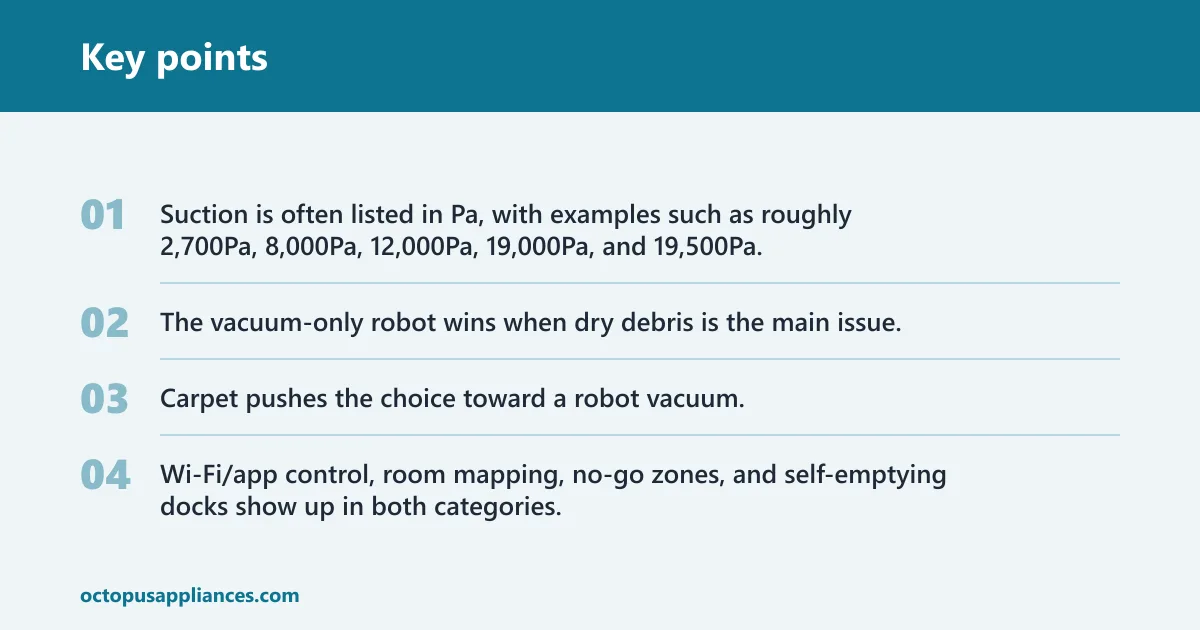
Suction is often listed in Pa, with examples such as roughly 2,700Pa, 8,000Pa, 12,000Pa, 19,000Pa, and 19,500Pa. Higher suction helps with pet hair and carpet, while the mop side matters only when the floor and mess can actually benefit from moisture and scrubbing.
| Factor | Robot vacuum | robot vacuum and mop | Winner |
|---|---|---|---|
| Cleaning method | Suction-based debris pickup | Suction plus wet mopping | robot vacuum and mop |
| Floor range | Best on carpet, rugs, and mixed homes that skew dry | Best on sealed hard floors and mixed homes with auto-lift mop tech | Depends |
| Upkeep | Lower maintenance burden | More maintenance from pads, water, and wash cycles | Robot vacuum |
| Convenience features | Often app-controlled, may include mapping, no-go zones, and self-emptying docks | Often has the same features, plus mop controls and sometimes auto-wash docks | Tie |
Cleaning method
The vacuum-only robot wins when dry debris is the main issue. The combo wins when you want wet cleaning in the same cycle, which matters for sticky residue that dry suction cannot remove.
Floor range
Carpet pushes the choice toward a robot vacuum. Sealed tile, vinyl, and laminate often push the choice toward a robot vacuum and mop, especially if the model can auto-lift mop pads over carpet instead of dragging moisture across it.
Upkeep
The combo adds more steps. You still deal with dustbin emptying and brush cleaning, but you also refill water, wash or replace pads, and maintain a tank or roller system.
Convenience features
Wi-Fi/app control, room mapping, no-go zones, and self-emptying docks show up in both categories. One competitor says robot vacuums often use app control and Wi-Fi, and another says robots can store home maps and clean specific rooms. These features help, but they do not change whether the machine fits your floors.
Which floors favor each option?
Floor type should lead the decision. Carpet and rugs favor a robot vacuum because suction does the work there. Sealed hard floors favor a robot vacuum and mop because wet cleaning can remove fine dust and stuck-on residue that dry pickup leaves behind.
Mostly carpet
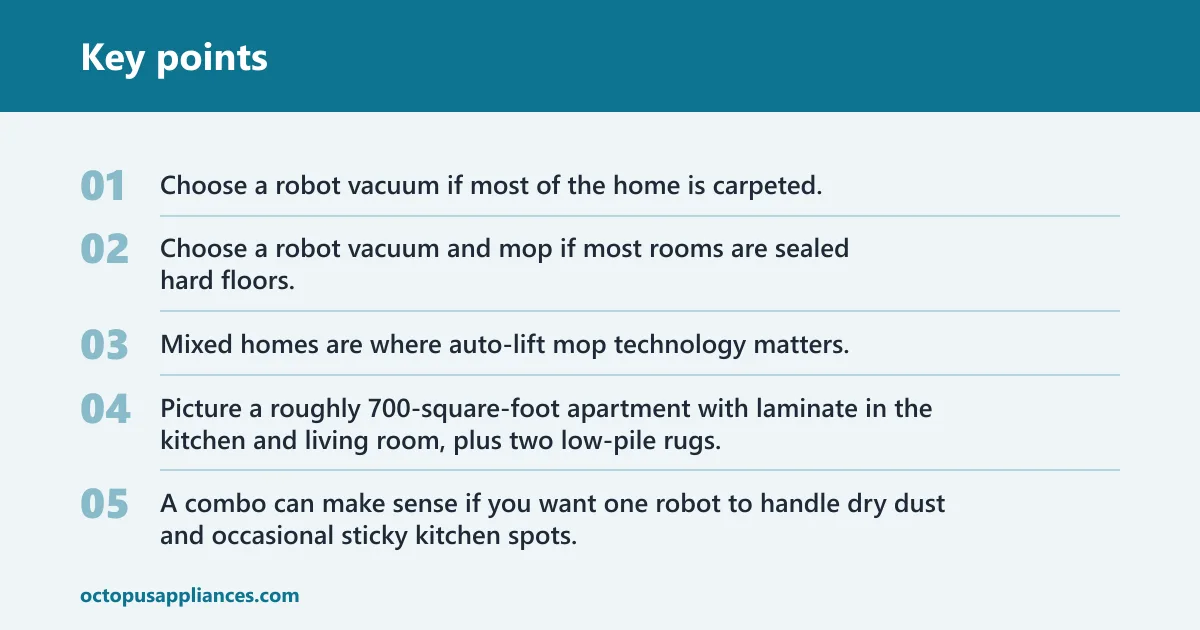
Choose a robot vacuum if most of the home is carpeted. A combo can cross carpet, but the mop hardware adds little value there, and even auto-lift systems are solving a problem the room layout created in the first place.
Mostly hard floors
Choose a robot vacuum and mop if most rooms are sealed hard floors. That is where wet pads or a roller mop add real value, especially in kitchens, entryways, and open-plan spaces that collect both dust and footprints.
Mixed floors and rugs
Mixed homes are where auto-lift mop technology matters. One competitor claims combo robots can raise the mop over carpet, which helps protect rugs and thresholds, but the more carpet you have, the more the vacuum-only robot regains the advantage.
Picture a roughly 700-square-foot apartment with laminate in the kitchen and living room, plus two low-pile rugs. A combo can make sense if you want one robot to handle dry dust and occasional sticky kitchen spots. If those rugs cover most of the floor, the simpler vacuum-only model is usually the better fit.
Which messes does each handle best?
Loose dust, crumbs, and pet hair favor vacuuming. Sticky kitchen messes and dried-on grime favor mopping. A robot vacuum and mop is useful when both show up in the same day, but it should not be treated as a universal answer for every spill or every surface.
Loose dust and pet hair
Robot vacuums are the safer choice for this job. Suction works directly on debris, and higher suction ratings help when hair is packed into carpet or tracked across hallways. One competitor lists 19,000Pa in a top pet-hair robot vacuum, which shows where the category tends to compete.
Sticky kitchen messes
Combo robots win here. Wet pads or a roller can loosen residue that dry suction cannot remove, especially on sealed hard floors near sinks, stoves, and dining areas. That said, they need clean water and clean pads to keep working well.
Dried-on grime and spills
Robot vacuum and mop models have the edge if the mess is on a hard floor and the spill has dried. They are weaker on carpet, thresholds, and rugs, where moisture should stay away from the fibers.
Robot vacuum decision matrix
| Scenario | Recommended device | Why it wins | Trade-off you accept |
|---|---|---|---|
| Mostly carpet | Robot vacuum | Suction matters more than wet cleaning, and carpet rewards debris pickup | You still mop by hand for spills |
| Mostly hard floors | robot vacuum and mop | Dry dust plus sticky residue can be handled in one routine | You maintain water, pads, and wash parts |
| Mixed floors | robot vacuum and mop | Auto-lift mop tech helps it move between hard floors and carpet | More complexity than a vacuum-only robot |
| Pet hair | Robot vacuum | Higher suction and carpet-focused pickup help more than wet mopping | Floor shine and residue removal are limited |
| Sticky kitchen messes | robot vacuum and mop | Wet mopping is the better tool for dried spots and tacky residue | Extra maintenance after each run |
| Small apartment | Depends | If the space is mostly hard floor, a combo earns its keep; if it is mostly carpet, vacuum-only is simpler | You may pay for a feature you do not use often |
| Busy household | robot vacuum and mop | Frequent crumbs and footprints benefit from one automated pass | Higher upkeep than dry vacuuming alone |
| Low-maintenance preference | Robot vacuum | Less refilling, fewer washable parts, and fewer cleaning chores | No wet-cleaning help on hard floors |
Do you need a mop if you already have a robot vacuum?
You need a mop if your hard floors regularly get sticky, greasy, or visibly smeared after dry pickup. You do not need one if your main problem is carpet debris, pet hair, and a light layer of dust that a suction-only robot can already manage.
When a vacuum-only robot is enough
If your floors are mostly carpet, a robot vacuum is usually enough. It is also enough when you already mop manually once in a while and want the robot to handle daily dust, crumbs, and hair between deeper cleanings.
When a combo is worth the extra upkeep
A combo is worth the extra upkeep when hard floors dominate and messes include tracked-in dirt or kitchen residue. One competitor says some robot cleaners can mop simultaneously with vacuuming, and that convenience matters most when the same rooms collect both dry debris and sticky marks.
How do I choose between a vacuum-only robot and a combo?
Start with floor type, then check mess type, then decide how much upkeep you will tolerate. Automation features such as mapping, no-go zones, self-emptying docks, and app control should be tie-breakers, not the main reason to buy.
Identify the main floor. If carpet covers most rooms, lean toward a robot vacuum. If sealed hard floors dominate, put the combo on the shortlist.
Match the mess. Loose dust and pet hair favor suction. Sticky residue, dried splashes, and footprints favor wet mopping.
Count the upkeep. A robot vacuum usually asks for dustbin emptying and brush cleaning. A combo adds water refills and washing mop pads or a roller, which increases the total effort.
Check the automation extras. Wi-Fi/app control, maps, room-specific cleaning, no-go zones, and self-emptying docks are useful, but they should not override floor fit. One competitor says self-emptying docks are a selling point, and that can reduce manual bin emptying, yet it does not remove mop maintenance.
Suppose a home has tile in the kitchen, laminate in the hallway, and carpet in two bedrooms. If the kitchen is where most of the mess happens, a robot vacuum and mop with auto-lift can be the better fit. If the bedrooms and hallway are the cleaning priority, the vacuum-only model is easier to live with.
Choose Robot vacuum if… / Choose robot vacuum and mop if…
Choose Robot vacuum if your home is mostly carpet or rugs, pet hair is the main problem, and you want the lowest-maintenance option. It is also the better pick if you would rather mop by hand only when needed and do not want water tanks, washable pads, or extra wash cycles.
Choose robot vacuum and mop if your home is mostly sealed hard floors, you deal with sticky kitchen spots or tracked-in residue, and you want one machine to handle dry debris plus light wet cleaning. It is the stronger choice for mixed floors only when the model has auto-lift mop technology and you are comfortable with the added upkeep.
Frequently asked questions
Is a robot vacuum better than a robot vacuum and mop?
Yes, if your home has a lot of carpet, pet hair, or loose debris. A robot vacuum is usually the better value when wet cleaning will not matter much. A combo is better when sealed hard floors need both dust pickup and light mopping in the same routine.
What floors are best for a robot vacuum mop combo?
Sealed hard floors are the best match. Tile, sealed vinyl, and laminate are good fits because the mop can clean the surface without risking water damage. Carpeted rooms are different; even with auto-lift mop tech, more carpet usually shifts the decision back toward a vacuum-only robot.
Are robot vacuum mop combos worth it for pet hair?
They can be, but only when pet hair is not the whole story. If hair is mostly on carpet, a vacuum-only robot with strong suction is the better tool. If hair lands on hard floors along with dust and paw prints, a combo can be worth the added upkeep.
Can a robot vacuum and mop replace manual mopping?
Not in every home. It can reduce how often you need to mop by hand, especially on sealed hard floors with light daily soil, but stubborn grime, edges, and certain spills may still need manual cleaning. Treat it as a helper, not a full replacement.
Do robot vacuum mop combos need more maintenance?
Yes. In addition to dustbin emptying and brush cleaning, you also refill water, wash or replace mop pads or rollers, and maintain the wet-cleaning parts. Premium docks can automate some of that, but the upkeep is still higher than a robot vacuum alone.